
📅 WEEK 8
Most leaders say their customer is the number one priority. But their calendars tell the truth. This Rule is in Chapter 2: Know Your Customer for very good reason. Every leader claims to be customer-focused. But when I review a younger business owner’s weekly schedule, I usually see almost no direct customer interaction. No structured time for customer feedback. No strategic sessions dedicated to improving their experience. Yet they insist the customer comes first.
Early in my career, I used to tell people what mattered most to me —satisfied customers, company growth, culture, innovation, etc —it all sounded right. But if someone had quietly studied my calendar, they would have drawn a very different conclusion. Meetings stacked on meetings and firefighting —with very little time spent where value is actually created.
That’s when I learned something uncomfortable: your calendar is a confession. It always tells the truth about your priorities, by looking at how you allocate your time.
Ask yourself…
—Would a stranger know my priorities by looking at my calendar?
If you truly know your customer, your calendar will show it. Customer visits. Review of feedback. Strategy sessions around value creation. Time invested in understanding their reality.
📌 Rule No. 18 —Your calendar reflects your priorities.
If your schedule becomes consumed entirely by internal operations, you’re drifting inward. Companies that drift inward eventually become irrelevant. Knowing your customer isn’t a slogan. It’s a disciplined allocation of time. And if you don’t intentionally block that time, the urgent will always crowd out the important.
Your calendar is either building proximity to the customer —or distance from them.
An executive who says that talent development is a priority but has not scheduled time for it is not telling the truth about their priorities. Their calendar is. An executive who says customer relationships matter but fills every week with internal meetings has revealed their actual values through their time allocation. This is not a criticism. It is an observation about how easy it is for the week to fill up with defensible activity that does not advance the things that matter most.
“Show me your calendar — I’ll show you what you really value.”
At The Executives Institute, we treat this principle as a discipline: Your calendar reflects your priorities. Not what you intend to prioritize —what you actually do.
Schedule accordingly.
 Write this down…
Don’t tell people your priorities. Show them your calendar.

Rule No. 18 —Your calendar reflects your priorities.
NOTES:
This rule confronts the lie we tell ourselves that “we didn’t have time,” when in reality, we simply didn’t make it a priority. If you want to know what truly matters to a person, don’t ask them —look at their calendar.
This rule is not about time management tools. It’s about discipline and alignment. If your calendar doesn’t reflect your stated priorities, one of them is lying.
If, 5 years from now,
you had 5 editions of The Ledger on the shelf behind your desk, you would have a written record of the decisions, priorities, and hard truths that shaped your business year by year.
The Ledger is your working companion to The Executives Institute —whether you follow The Weekly Edge or participate in a 10K Leaders study group. This is where discipline takes shape —where the priorities that drive your business are identified, challenged, and acted on.
📓 Print each week as you go for free, or collect the hardcover Ledger each year, with a $100 contribution to the Institute. Coming Q4 2026.
The Institute teaches. The Ledger records.
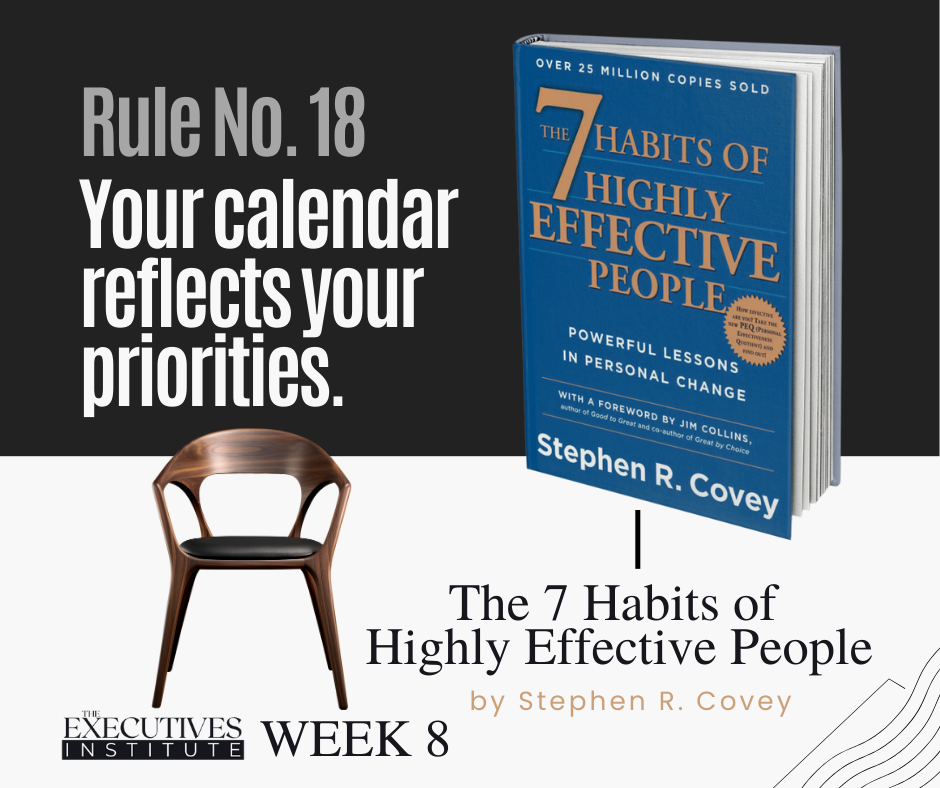
This week’s recommended reading: The 7 Habits of Highly Effective People by Stephen R. Covey
Stephen Covey’s work on effectiveness, in The 7 Habits of Highly Effective People, remains as relevant as it was when it was written, in part because the principles he described are not trends —they are enduring truths about how human attention and time translate into outcomes.
The discipline he articulated is simple but demanding: put the important things in your schedule before the urgent things fill it. Urgency feels pressing. Importance actually moves the needle. The two are not the same, and the default behavior of most organizations is to let urgency crowd out importance.
This week’s key takeaway —your calendar is the document that doesn’t lie. Don’t tell me you priorities, show me your calendar.
Momentum matters. On to the next week.
Up next…the final week in Chapter 2, 📅 WEEK 9 📌 Rule No. 21 —Clarity creates confidence.