
📅 WEEK 2
Now that you’ve identified your customer’s real problem, let me challenge you with a question that requires and little ego check. Ask yourself,
— Are we defending our solution…or are we actually solving our customer’s real need?
This is the trap that so many founders fall into. Often times, the smarter the founder, the more dangerous the trap.
📌 Rule No. 2 —Fall in love with the problem, not the solution.
Intelligent people are excellent at building compelling arguments. They can rationalize a product direction with logic that sounds airtight. They can explain why the market needs what they’ve built. They can find evidence to support almost any conclusion they’ve already reached.
This is exactly the problem.
I’ve been there. You invest capital. You commit payroll. You rally your team. And once you do, it’s human nature to protect what you’ve built. But protecting your idea and solving the right problem aren’t the same thing. If you find yourself explaining to your team why customers should care, instead of proving that they already do, that’s a warning sign.
In his book, The Mom Test, Rob Fitzpatrick wrote clearly about what happens when entrepreneurs ask the wrong questions. They talk to potential customers and hear what they want to hear. The customer is polite. The founder is encouraged. And the product gets built on a foundation of misread signals.
“Your idea is amazing. Your customer just doesn’t care.”
The discipline is to stay attached to the problem, not the solution you’ve already invented. That means asking customers about their lives, their frustrations, their workarounds —not about whether they’d buy what you’re about to pitch them.
One of our core principles at The Executives Institute reflects this directly: Fall in love with the problem, not the solution. It is deceptively simple advice. It is also among the hardest to actually practice.
 Write this down…
Solutions change. The problem worth solving rarely does.

Rule No. 2 —Fall in love with the problem, not the solution.
NOTES:
Solutions come and go, but a deep understanding of the real problem creates lasting value. Focus on the true needs and challenges of your customers—not your preconceived ideas. By anchoring yourself to the problem, you remain flexible, innovative, and better positioned to deliver meaningful solutions.
If, 5 years from now,
you had 5 editions of The Ledger on the shelf behind your desk, you wouldn’t just see where your business grew—you would see how your judgment evolved.
The Ledger is your working companion to The Executives Institute —whether you follow The Weekly Edge or participate in a 10K Leaders study group. This is where discipline takes shape —where the priorities that drive your business are identified, challenged, and acted on.
Print each week as you go for free, or collect the hardcover Ledger each year, with a $100 contribution to the Institute. Coming Q4 2026.
The Institute teaches. The Ledger records.
As business owners, we don’t get paid for being right about our ideas. We get paid for solving problems that matter. Don’t ask customers if they like your idea. Watch what they actually do about the problem. If the pain is real, they’re already trying to solve it—and that’s where the real opportunity is.
It’s Rule No. 2 for a reason. First, you commit to solving something real. Then you guard yourself against ego. This rule keeps you customer-centered instead of ego-driven. It forces you to keep listening, keep validating, and stay willing to pivot—no matter how much you’ve already invested.
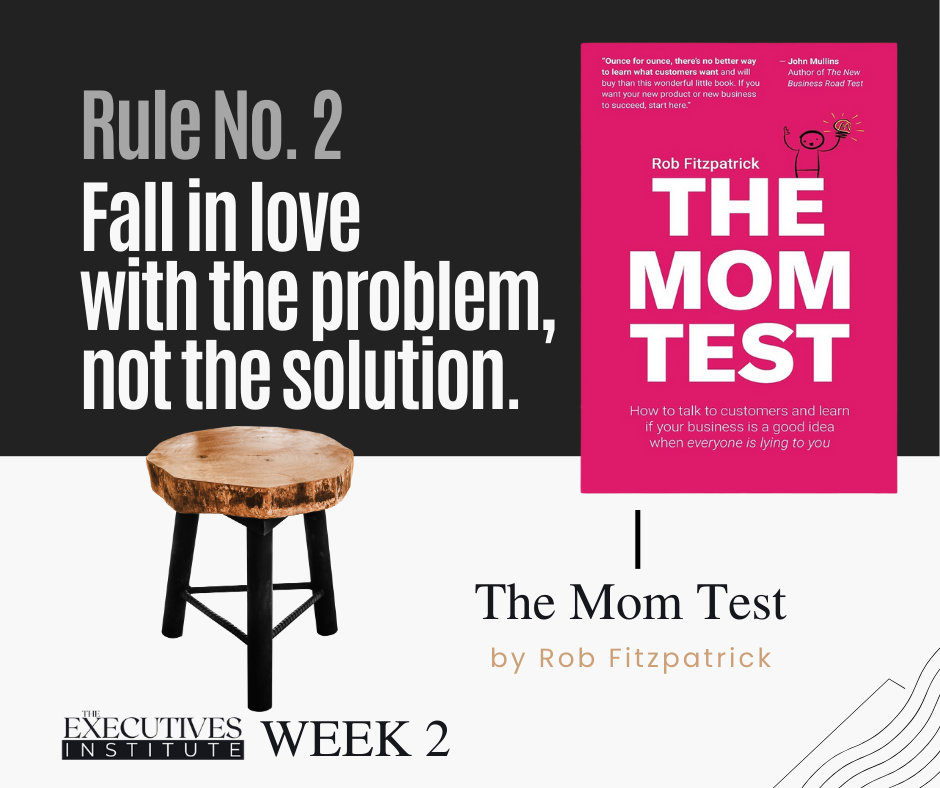
This week’s recommended reading:The Mom Test by Rob Fitzpatrick
The Mom Test by Rob Fitzpatrick is a short, tactical guide to asking better questions and getting honest, useful feedback when talking to customers. The central premise is simple: you can’t trust people—especially your mom—to tell you the truth if your questions are flawed.
Fitzpatrick teaches entrepreneurs how to avoid biased feedback by asking about past behaviors rather than opinions or hypotheticals. Instead of asking, “Would you use this?”, you learn to ask, “How have you solved this in the past?” The goal is to uncover real pain points, not polite compliments.
This book is a must-read for anyone building products, launching a business, or trying to truly understand their audience. It emphasizes listening over pitching and relentlessly testing assumptions.
Remember, the solution will change. The problem, if it’s real, won’t.
Congratulations on sticking around for Week 2.
📅 WEEK 3 📌 Rule No. 6 —Your first idea is rarely your best is next.