📅WEEK 4
“Old sayings” typically get to be that, because they’re true. For example; “What got you here won’t get you there”. Meaning, experience is valuable —but it’s also dangerous. The longer you lead, the easier it is to lean on instinct, history, and pattern recognition. You start solving today’s problems with yesterday’s answers. That works… until it doesn’t.
Ask yourself honestly:
—Where am I operating on autopilot? or, Where am I relying on what I already know instead of pursuing what I need to know?
If you can answer that with humility —and act on it —you won’t just maintain your business. You’ll evolve it. I’ve watched so many good businesses stall because their owners stopped stretching. They weren’t lazy. They were successful. And success can quietly convince you that you’ve already figured it out. Trust me, you haven’t. None of us have. Success is one of the more effective ways to stop learning.
📌 Rule No. 10 —Never stop learning.
The leader who stopped growing. It is counterintuitive but consistent. Early in our careers, we’re forced to learn —we don’t know enough yet to rely on what we already know. Failure is instructive. Uncertainty drives inquiry.
Then the wins accumulate. A pattern of success forms. And gradually, almost imperceptibly, the instinct to question our own assumptions weakens. The leader who once challenged everything begins to defend the decisions that built the success they’re protecting.
“The moment you think you’ve arrived — you’ve expired.”
In her book, Mindset, Carol Dweck’s research on fixed versus growth mindsets illuminated this dynamic clearly. The fixed mindset treats ability as a finite resource to be protected. The growth mindset treats it as a capacity to be expanded continuously, through effort and honest feedback.
The most effective senior leaders I’ve observed share this characteristic: they remain genuinely curious. They read widely. They ask questions in rooms where they could have been expected to have all the answers. They’re not performing humility — they actually want to know.
This is why Never stop learning holds a permanent place in The Executives’ Institute’s core principles. Not as inspiration, but as a standard of conduct for serious leaders.
The day you stop learning is the day your edge starts to erode.
 Write this down…
The day you think you’ve figured it out is the day your competitors catch up.

Rule No. 10 —Never stop learning.
NOTES:
A growth-minded leader embraces learning as a lifelong process —not a phase to graduate from. Whether you’re in the boardroom or the breakroom, staying open to new ideas, skills, and feedback separates those who evolve from those who become irrelevant.
If, 5 years from now,
you had 5 editions of The Ledger on the shelf behind your desk, you would have a written record of the decisions, priorities, and hard truths that shaped your business year by year.
The Ledger is your working companion to The Executives Institute —whether you follow The Weekly Edge or participate in a 10K Leaders study group. This is where discipline takes shape —where the priorities that drive your business are identified, challenged, and acted on.
📓 Print each week as you go for free, or collect the hardcover Ledger each year, with a $100 contribution to the Institute. Coming Q4 2026.
The Institute teaches. The Ledger records.
Why is this so important? Because a growth mindset fuels reinvention. Markets shift. Technology evolves. Customers change. The only leaders who stay relevant are the ones willing to admit they don’t know everything—and then go do something about it.
Learning isn’t academic. It’s survival. It’s strategy. It’s how you avoid becoming a museum of your former success. Schedule time to learn the way you schedule time to lead. Block an hour every day to read, study, or explore something outside your immediate expertise. Most executives fill their calendars with meetings. The ones who keep growing fill part of it with thinking and learning.
Because the truth is simple: The leaders who keep learning compound their advantage the same way money compounds —quietly at first, then all at once.
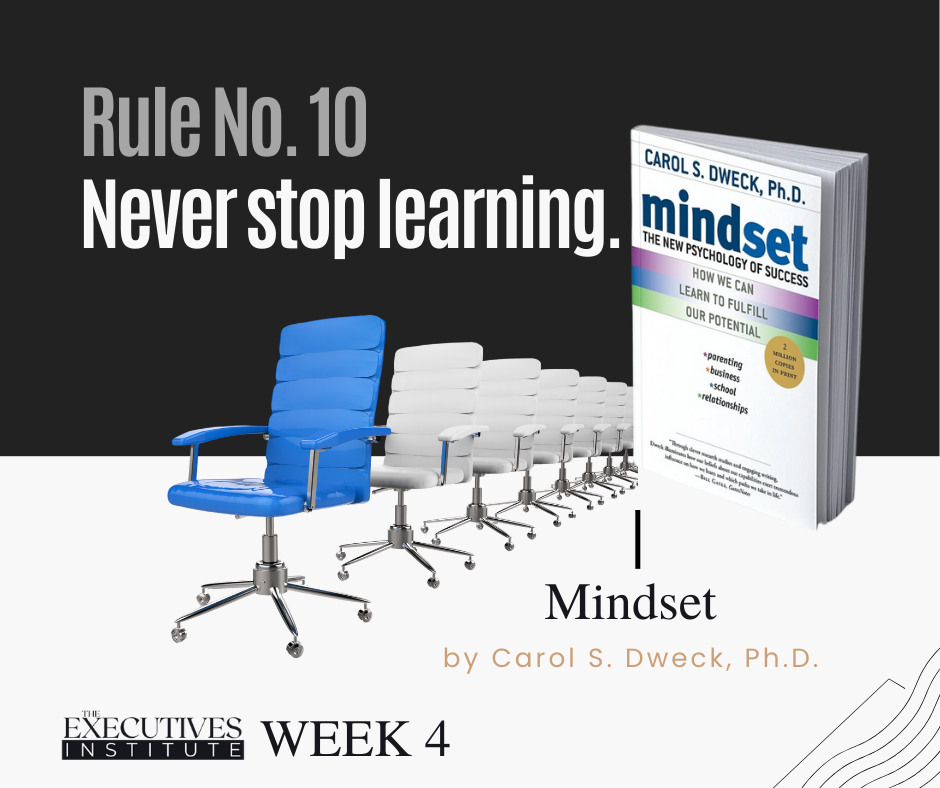
This week’s recommended reading: Mindset by Carol S. Dweck
Mindset explores the profound impact of how we think about our abilities. Dweck identifies two primary mindsets: the fixed mindset, which believes talent and intelligence are static, and the growth mindset, which sees them as skills that can be developed through effort, feedback, and persistence. Leaders, teams, and organizations that embrace a growth mindset adapt faster, overcome challenges more effectively, and unlock greater long-term potential. The book makes it clear: success isn’t just about what you know—it’s about your willingness to keep learning.
Remember, if you’re the smartest person in every meeting, your company has stopped growing.
Consistency beats intensity. Continue.
Up next…📅 WEEK 5 📌Rule No. 15 —Work on your business, not just in it.