
📅 WEEK 31
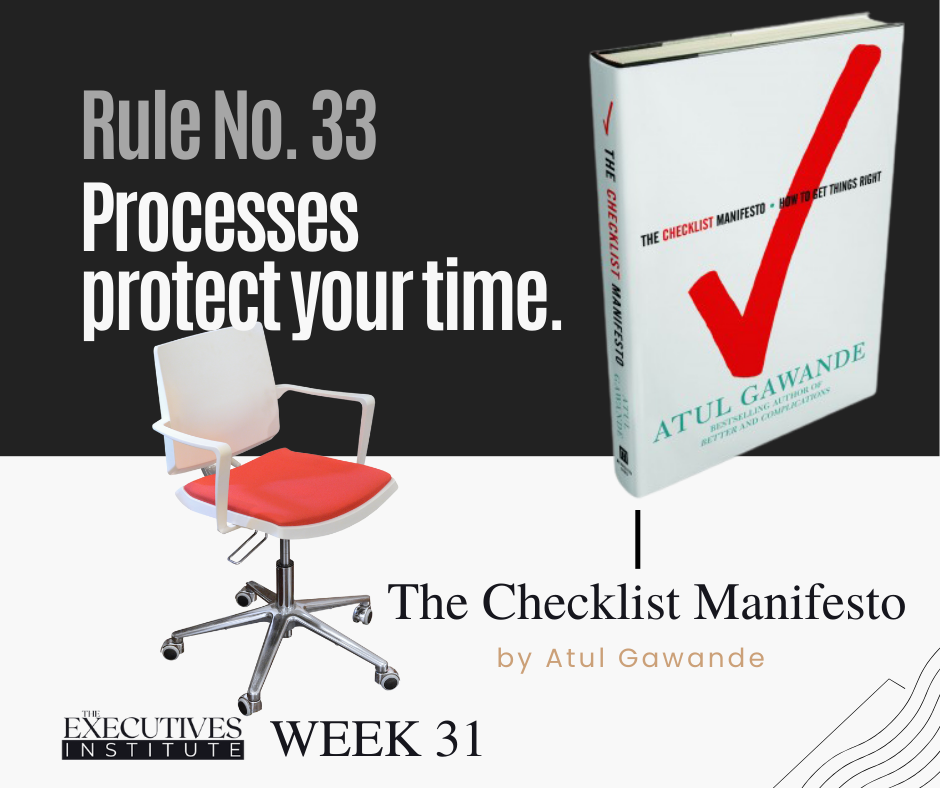
📌 Rule No. 33 —Processes protect your time.
— Why the Most Important Work Needs a System
Rule: Processes protect your time.
Source: The Checklist Manifesto by Atul Gawande
The best professionals in the world use checklists. Not because they don’t know what to do. Because they know that memory is unreliable under pressure.
Atul Gawande made a compelling case from medicine and aviation: complex processes, when left to individual memory and judgment, produce inconsistent results. Systematic processes — even simple ones — reduce errors and improve outcomes, even among experts.
In business, this translates directly. The onboarding process that lives in the founder’s head will be executed differently every time and will deteriorate as the company grows. The sales process that each rep invents for themselves will produce wildly variable results. The financial review that happens when someone thinks of it will miss the moments when it matters most.
Processes are not bureaucracy. They are accumulated wisdom about how to do something well, documented so that the wisdom doesn’t leave when the person does. They protect time by eliminating the recurring decision of how to approach a recurring situation.
The leaders who resist process often believe they’re preserving flexibility. What they’re often doing is preserving inconsistency.
Processes protect your time is a principle at The Executives’ Institute that acknowledges a practical truth: the more consistently your business executes, the more time you have to focus on what actually requires your judgment.
Document what works. Repeat it reliably. Improve it over time.

coming Monday, August 3, 2026
Systems aren’t bureaucracy—they’re armor. In fast-paced environments where decisions pile up and mistakes cost time, solid processes safeguard your focus. A well-designed checklist isn’t about reducing thought—it’s about removing chaos, catching preventable errors, and freeing your mind for higher-level work. The right process protects what matters most: your attention, your energy, and your time.
Chapter 8: Sales, the Lifeblood →
Ask yourself: “Are we selling something people believe in—or just something we hope they’ll buy?“