
📅 WEEK 3
Let me share something most young business owners learn the hard way: the first idea usually wins because it’s convenient, not because it’s correct. It sounds decisive. It feels productive. Everyone nods, and you move. But speed can often mask shallow thinking. Be honest with yourself…
— In your organization are decisions being made too quickly, built on the first idea that hits the table?
The first idea is usually the most obvious one —which is precisely why it’s the most dangerous.
📌 Rule No. 6 —Your first idea is rarely your best.
Like many “serial entrepreneurs” I’ve met, early in my career, I mistook momentum for wisdom. I thought strong leadership meant having the answer quickly. What I eventually realized is that real strength is having the discipline to pause and ask, “What else?” Not because you’re indecisive —but because the stakes are too high to build on the obvious. In your organization, people will rally around the first idea you voice. That’s the weight of leadership. If you don’t intentionally create space for second and third options, no one else will.
This week isn’t about slowing down your business. It’s about sharpening it. Because the cost of locking in too early compounds —and so does the payoff of thinking one layer deeper. If I had to give you one piece of advice, it would be this: treat your first idea like a rough draft, not a decision. The danger in business isn’t a bad idea —it’s falling in love with the first one before you’ve compared it to better options. Write it down, set it aside, and force yourself to come back with two more approaches. The discipline of comparison is where better judgment is built.
In his book, Originals, Adam Grant studied how original thinkers operate and found something counterintuitive: the people who generate the most good ideas are the same people who generate the most bad ones. The difference isn’t raw creativity. It’s volume and iteration.
In business, there’s enormous pressure to decide quickly and execute. Speed is a virtue. But speed applied to the wrong idea compounds the mistake.
“That ‘brilliant’ idea you had in the shower? Keep brainstorming.”
The executives who consistently make good strategic decisions have usually developed the discipline to question their first instinct. Not endlessly —decision paralysis is its own failure. But enough to pressure-test the assumption underneath the idea before committing resources to it.
The best strategic decisions I’ve observed came from leaders who were willing to hold their first idea loosely. They explored alternatives. They let the thinking evolve. And then they committed fully —to a decision that had survived scrutiny.
Your first idea is rarely your best. It’s a reminder that the quality of your thinking often depends on your willingness to keep thinking a little longer.
Patience before commitment. Conviction after it.
 Write this down…
The obvious idea is usually the one everyone else already had.

Rule No. 6 —Your first idea is rarely your best.
NOTES:
Great ideas emerge after rethinking and refining initial concepts, proving that persistence and revision often lead to better solutions. The most original thinkers don’t settle for their first solution —they generate many. Great ideas often emerge later in the creative process, after initial concepts have been tested, challenged, or discarded.
Quantity breeds quality when you’re willing to rethink, revise, and persist beyond what’s obvious.
If, 5 years from now,
you had 5 editions of The Ledger on the shelf behind your desk, you’d be able to look back and see exactly where you gained clarity, where you lost focus, and where your leadership changed for the better.
The Ledger is your working companion to The Executives Institute —whether you follow The Weekly Edge or participate in a 10K Leaders study group. This is where discipline takes shape —where the priorities that drive your business are identified, challenged, and acted on.
Print each week as you go for free, or collect the hardcover Ledger each year, with a $100 contribution to the Institute. Coming Q4 2026.
The Institute teaches. The Ledger records.
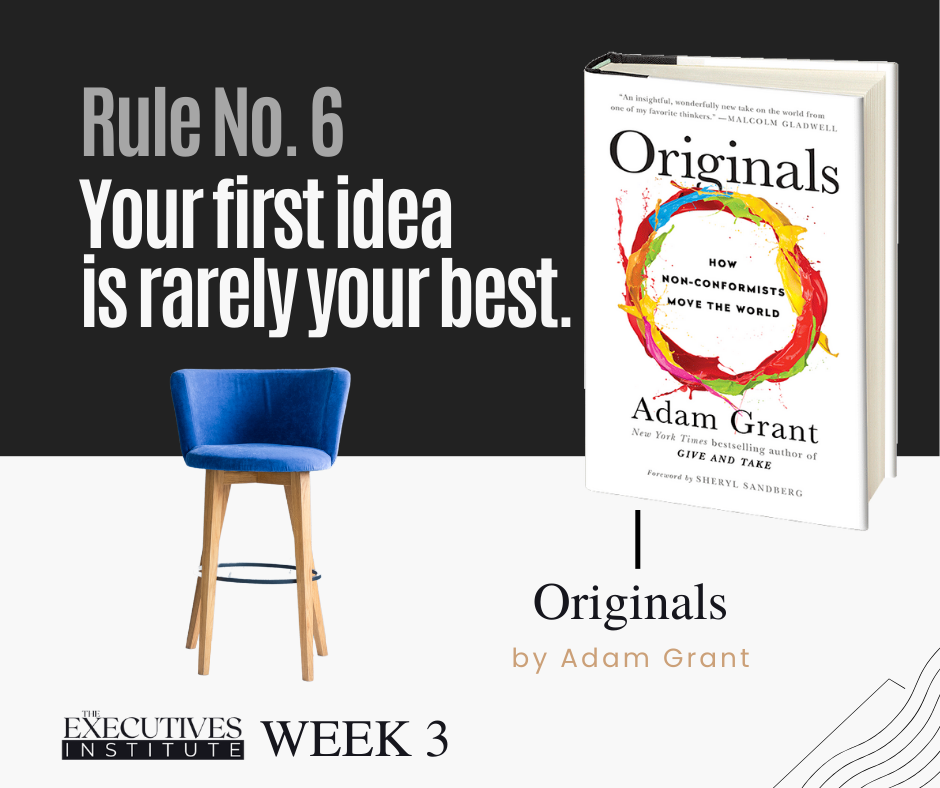
This week’s recommended reading: Originals by Adam Grant
Originals shows that innovation isn’t about having a single lightning-bolt idea—it’s about generating many, challenging your own thinking, and refining until the best solution emerges. The most successful leaders aren’t the ones who act first, but the ones who think differently and persist long enough to get it right.
Originals explores how individuals champion new ideas and drive change without waiting for permission or perfect timing. Adam Grant draws on research and real-world examples to reveal that originality isn’t just about creativity—it’s about courage, persistence, and strategic risk-taking. He explains how to recognize good ideas (and weed out bad ones), speak up effectively, build support, and overcome the fear of failure. The book challenges the myth of the lone genius, showing that innovation thrives through iteration, feedback, and a willingness to challenge the status quo.
Remember, the market punishes arrogance faster than incompetence.
Well done. That’s three weeks. Serious leaders keep studying.
Up next…📅WEEK 4 📌Rule No. 10 —Never stop learning.