

Rule No. 18 summary:
This rule confronts the lie we tell ourselves that “we didn’t have time,” when in reality, we simply didn’t make it a priority.
It is not about time management tools. It’s about discipline and alignment.
If you want to know what truly matters to a person, don’t ask them—look at their calendar. If it doesn’t reflect their stated priorities, they’re lying to themselves.
Most leaders say their customer is the priority. But your calendar tells the truth.
When you look back at a period when your business was drifting or struggling, what did your calendar look like at the time?
Can you recall a moment when you realized your calendar didn’t match what you claimed were your priorities?
What is one block of time you added to your calendar that had an outsized impact on your business?
Where do business leaders most commonly waste time without realizing it?
If a young entrepreneur asked you how to structure their week to avoid the mistakes you made, what would you tell them to protect on their calendar?
If you’ve fought battles that became lessons — this is where we collect them.
The insight you share might be the turning point someone else is waiting for.
 Write this down…
Don’t tell people your priorities. Show them your calendar.
📌 STUDY Rule No. 18 —Your calendar reflects your priorities.
📓 My Edge
My Edge is the recommended companion to your weekly study through The Weekly Edge. Each week includes a printable PDF designed to help you plan with intention, apply the Rule in real time, and record the decisions, priorities, and lessons that shape your leadership. You can print one week at a time and begin anytime throughout the year, or choose the full professionally printed spiral-bound hardcover Edge for a complete year of disciplined growth and reflection.
— The Edge Volume 1 will be available this Summer 2026 through this site
This rule helps business leaders…
- Get clear on what matters most—and translate that clarity into scheduled action
- Reduce overwhelm by aligning time with values and strategic goals
- Escape the trap of urgency by proactively blocking time for important but non-urgent work (Quadrant II)
- Strengthen leadership credibility by modeling disciplined time use
- Say”no” with conviction—because your calendar already reflects your yeses
Time is the most democratic resource—everyone gets 24 hours. High performers don’t find more time; they allocate it better. They schedule their values. They protect their most important goals from being swallowed by the urgent but unimportant. Covey called this “putting first things first”—and it’s the difference between being busy and being effective.
If your week is full of internal meetings, chasing small fires, or tinkering with low-value details—and almost no time spent listening to, learning from, or serving your best customers—then the customer isn’t actually your priority, no matter what you claim.
Why this Rule is important: Because, intentionality beats reactivity.
Time is the most democratic resource—everyone gets 24 hours. High performers don’t find more time; they allocate it better. They schedule their values. They protect their most important goals from being swallowed by the urgent but unimportant. Covey called this “putting first things first”—and it’s the difference between being busy and being effective.
Ask Yourself —
Would a stranger know your priorities by looking at your calendar?
If someone audited your calendar for the last 30 days, what would they say your top priorities are—and how does that compare to what you say they are?
What in my calendar last week reflects my top three priorities?
Example: You say team development matters, but your calendar is packed with back-to-back sales calls. Why isn’t there any time carved out for coaching or one-on-ones?
Where am I letting other people’s urgency override my own strategy?
Example: You keep saying yes to meetings that could be emails or fire drills that aren’t your fires. This question exposes if you’re operating in Quadrant I (urgent) instead of Quadrant II (important).
Red Flags: When Your Calendar Is Working Against You
1. You Constantly Say, “I Just Haven’t Had Time.”
Leaders make time for what matters. Everyone else makes excuses.
2. Your Week Is 90% Reactive.
If most of your schedule is filled with last-minute meetings, operational fires, and other people’s problems, you are living in Quadrant I. That’s survival mode—not leadership mode.
3. There Is No Protected Strategic Block.
No recurring deep work. No thinking time. No review sessions. No proactive customer or culture focus. If it’s not blocked, it won’t happen. And if it doesn’t happen, it wasn’t a priority.
4. Your Team Mirrors Your Chaos.
If your calendar is erratic, constantly shifting, and overloaded, don’t be surprised when your leadership team operates the same way. Calendars set cultural tone. Disorder at the top multiplies downward.
5. You’re Busy—but the Needle Isn’t Moving.
Revenue stalls. Culture drifts. Innovation slows. Yet you feel exhausted. That’s a classic sign your time is being spent on activity instead of advancement. Motion is not progress.

💬 Leadership Team Discussion
Most leaders don’t lack ambition—they lack alignment. We talk about values, vision, and long-term priorities, but when you examine our calendars, they’re dominated by short-term fires and distractions. The calendar doesn’t lie. It reveals what we really prioritize. This conversation is meant to surface that gap and provoke course correction.
As a team, are we time-blocking for what matters most—or just reacting?
What sacred blocks of time need to be re-established or protected again?
What would need to change in your week for your calendar to reflect your true strategic intent?

WEEK 8 | Action Step —
Review next week’s schedule and remove anything not tied to top priorities.
✅ Actionable Strategies
Here are 10 disciplined, actionable strategies tied directly to Rule No. 18: The Calendar Reflects Your Priorities. These are not productivity hacks. They are structural leadership decisions.
1. Schedule Your Top Three Priorities First
Before anything else fills your week, block time for your top three strategic priorities. If growth, culture, and customer retention matter, they should appear on your calendar before operational noise does.
2. Establish a Weekly Strategic Block (Non-Negotiable)
Protect 90–120 minutes each week for uninterrupted strategic thinking. No phone. No email. No team interruptions. If you won’t defend this time, no one else will.
3. Audit the Last 30 Days
Print your calendar and mark each meeting as:
- Strategic
- Operational
- Reactive
- Unnecessary
The pattern will expose your true priorities quickly.
4. Kill or Delegate 10% of Recurring Meetings
Most leadership calendars are bloated with legacy meetings that no longer produce value. Eliminate, shorten, or delegate at least one recurring commitment this quarter.
5. Time-Block Development Conversations
If people development is a stated priority, schedule recurring one-on-ones focused on growth—not just updates. Leadership culture is built intentionally, not accidentally.
6. Pre-Block Quarterly Planning Days
Don’t “fit in” strategy sessions. Schedule quarterly planning days at the start of the year. Treat them like client meetings—immovable.
7. Create a Personal No-Meeting Zone
Designate specific windows each week where no meetings are allowed. Use that time for deep work, customer calls, or proactive leadership tasks.
8. Tie Every Major Meeting to a Stated Priority
Before accepting or scheduling a meeting, ask:
Which strategic priority does this support?
If there’s no clear answer, decline or delegate.
9. Schedule Culture
If recognition, vision reinforcement, and relationship building matter, block time for:
- Walking the floor
- Team appreciation
- Customer engagement
Culture erodes when it isn’t calendared.
10. Review Your Calendar Before You Review Your Metrics
At the end of each month, evaluate your calendar before analyzing performance numbers. Results follow allocation. If outcomes are off, your time allocation likely is too.
This rule is simple but unforgiving:
Your calendar is either reinforcing your leadership—or exposing it.
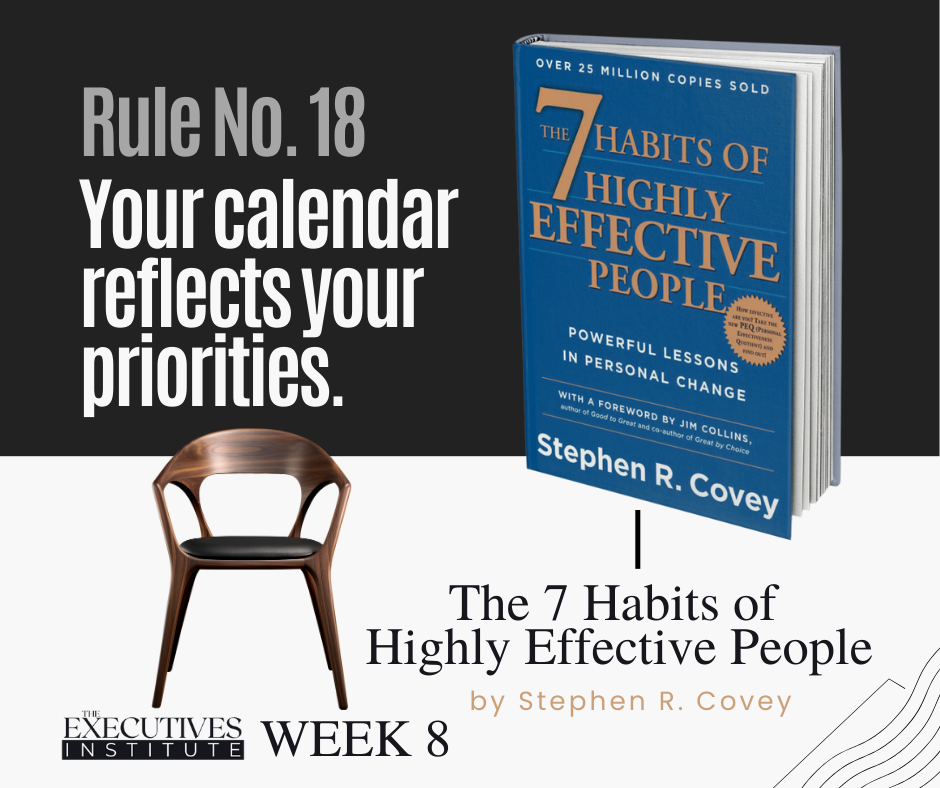
WEEK 8 | Recommended Reading —
The 7 Habits of Highly Effective People by Stephen R. Covey
“The key is not to prioritize what’s on your schedule, but to schedule your priorities.” — Stephen R. Covey
This line cuts to the heart of the rule. Covey wasn’t just talking about better time management—he was calling out a lack of integrity between what we say matters and what we actually do. When leaders adopt this mindset, calendars stop being reactive checklists and start becoming tools of intentional impact.
📘 Book Summary
Covey’s book is a timeless framework for personal and professional effectiveness. It emphasizes principles over quick fixes, showing how character, integrity, and disciplined habits create sustainable success. The core idea: effectiveness comes from aligning your values, vision, and actions—not just managing time or tactics.
Key Executive Takeaway
Leadership, personal growth, and meaningful impact come from consistent habits, not shortcuts or reactive fixes.
Effectiveness is a principle-centered, inside-out approach. Start with character and values, then align behaviors and relationships.
The Time Management Matrix (Quadrants I-IV) is a tool to focus on what matters most, not just what’s urgent.
Stephen Covey’s 7 Habits reminds us that effectiveness comes from aligning time with true priorities. In the context of knowing your customer, this means:
- Blocking time to meet with customers face-to-face (or virtually).
- Reviewing customer feedback, not just sales reports.
- Scheduling work that sharpens your brand promise and message.
- Making space for the deep, strategic thinking that turns customer insight into action.
Your calendar is a mirror of what you value. If your customer is at the center of your business, they should show up on your schedule—not just your mission statement.
✅ Habit 1: Be Proactive
Take full responsibility for your life. Don’t react to circumstances—choose your responses. Proactivity is about recognizing your ability to influence outcomes rather than being controlled by external forces.
✅ Habit 2: Begin with the End in Mind
Define a clear vision of your desired outcomes. Know your personal and professional goals so that daily actions align with long-term purpose. Without a clear destination, even effortful action can be wasted.
✅ Habit 3: Put First Things First
Prioritize what truly matters. Focus on high-impact, important activities instead of just urgent tasks. This is where time management meets values alignment. Covey introduces the Time Management Matrix here:
- Quadrant I: Urgent and Important (crises, deadlines)
- Quadrant II: Not Urgent but Important (planning, strategy, prevention)
- Quadrant III & IV: Urgent but Not Important / Not Urgent & Not Important (distractions, time-wasters)
✅ Habit 4: Think Win-Win
Approach relationships and negotiations seeking mutual benefit. Effective leaders build trust and collaboration rather than competing for dominance or short-term gain.
✅ Habit 5: Seek First to Understand, Then to Be Understood
Communication starts with empathetic listening. Truly understanding others’ perspectives builds trust, opens dialogue, and allows solutions that stick.
✅ Habit 6: Synergize
Leverage differences to create outcomes greater than the sum of the parts. Collaboration with diversity of thought produces innovation and resilience.
✅ Habit 7: Sharpen the Saw
Invest in continuous renewal—physical, mental, emotional, and spiritual. High performers sustain effectiveness by prioritizing personal growth alongside work responsibilities.
This Rule isn’t finished—and it never will be. Business changes, leaders learn, and our Members keep sharpening the edges with real stories and hard-won lessons. What you see here is today’s version. Tomorrow’s will be better, clearer, and backed by more lived experience.
Thank you for being here and bringing your perspective—add your insight, share a story, or challenge what’s written. Together, we keep these Rules alive and relevant.