
Welcome back.
Chapter 2: Know Your Customer | Weeks 6-9
Over the next 4 weeks, we’ll cut through the noise and confront the reality: if your brand is fuzzy inside your walls, it’s invisible outside them. Your brand is not what you say—it’s what your best customers believe. That belief is earned when you understand them deeply, speak their language, and deliver on your promise with focus and discipline.

Knowing your customer isn’t just a marketing effort. It’s an executive-level responsibility. It shows up in your calendar, your conversations, and your culture. Because the businesses that know exactly who they serve are the ones that grow with purpose —and attract loyalty that lasts. Before strategy, before scale, before standing out —you need to lock in who you’re truly serving.
📌Rule No. 11 —Your brand is your promise.
📌 Rule No. 12 —Know your customer deeply.
📌 Rule No. 18 —Your calendar reflects your priorities.
📌 Rule No. 21 —Clarity creates confidence.
Who you serve —and how clearly you serve them —determines your future.
📅 WEEK 6
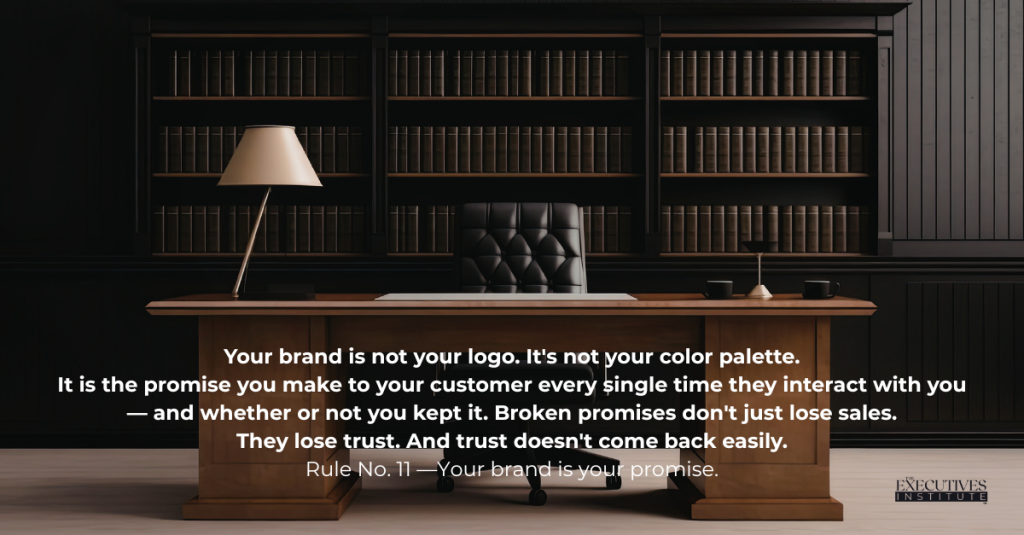
Here’s the hard truth: Every business makes promises —through its words, its actions, and the expectations it sets. But only the best businesses keep them. This week’s Rule: Your brand is your promise.
Your brand isn’t what you say it is. It’s what your customers experience when no one from your marketing team is in the room. It’s how quickly you return a call. It’s whether your invoice matches the estimate. It’s whether your team treats people the way you claim to. Every touchpoint either reinforces your promise—or quietly chips away at it. Ask yourself
—Does every customer interaction in our organization, strenthen or weaken trust in that promise?
This Rule matters perhaps more than all of the others, because, in business, once your word stops meaning something, everything else gets harder. It takes years to build a reputation and five minutes to destroy it. Protect your brand the same way you protect your capital—patiently, carefully, and without shortcuts.
📌Rule No. 11 —Your brand is your promise.
This week’s recommended reading: Building Strong Brands by David A. Aaker. David spent decades studying how brands are built and why they endure. His conclusion is that brand strength is fundamentally about consistency between what a company promises and what a customer actually experiences.
Most businesses understand this in the abstract and violate it in practice. The marketing says one thing. The product delivers another. The customer service resolves a problem in a way that contradicts the tone of the advertising. Over time, the gap between the promise and the experience becomes the real brand —and it’s not the one the company intended.
Durable brands are built through repetition of a consistent experience, not through repetition of a consistent message. The message may communicate the promise, but the experience is what validates it.
“Your logo isn’t your brand. Your behavior is.”
And here’s the part most owners underestimate: trust compounds. The longer you keep your word, the stronger your reputation becomes. Referrals increase. Pricing pressure decreases. Loyalty deepens. But the reverse is just as true. Small inconsistencies, tolerated over time, erode credibility until you’re competing on price instead of principle.
This has significant operational implications. Brand is not a marketing department concern. It is a leadership concern, because the experience a customer has is a function of every decision made inside the organization.
Your brand is your promise is a principle we anchor firmly at The Executives Institute. Every time you keep the promise, the brand compounds. Every time you break it, you pay a cost that no amount of advertising can fully offset.
Guard it accordingly.
 Write this down…
Your brand isn’t what you say. It’s what customers repeat about you.

Rule No. 11 —Your brand is your promise.
NOTES:
A brand is not a logo. A brand is the sum of every expectation your customers carry about you.
Your brand is the trust you build over time by delivering the same values, the same quality, and the same experience —over and over again. The moment that promise is broken, customers don’t complain —they quietly leave.
If, 5 years from now,
you had 5 editions of The Ledger on the shelf behind your desk, you wouldn’t just see where your business grew —you would see how your judgment evolved.
The Ledger is your working companion to The Executives Institute —whether you follow The Weekly Edge or participate in a 10K Leaders study group. This is where discipline takes shape —where the priorities that drive your business are identified, challenged, and acted on.
Print each week as you go for free, or collect the hardcover Ledger each year, with a $100 contribution to the Institute. Coming Q4 2026.
The Institute teaches. The Ledger records.
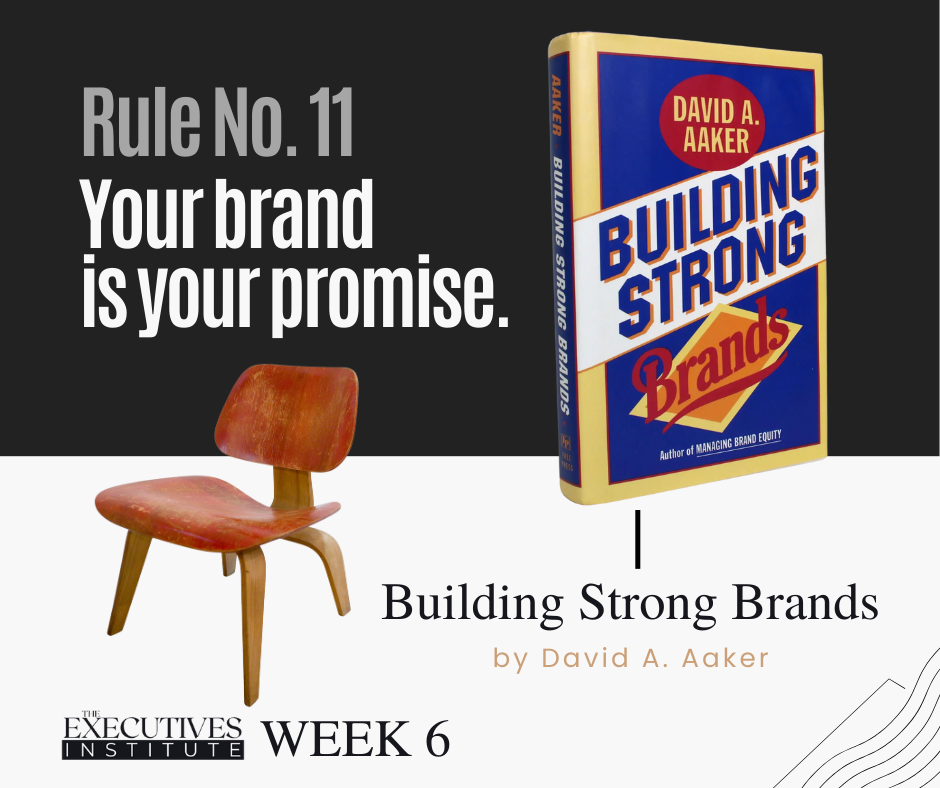
This week’s recommended reading: Building Strong Brands by David A. Aaker
Building Strong Brands explores how companies can create, manage, and leverage brands to drive long-term success. Aaker emphasizes that a brand is more than a logo or slogan—it is a promise to customers that shapes perceptions, builds trust, and drives loyalty. The book outlines strategies for developing a clear brand identity, maintaining consistency across touchpoints, and differentiating from competitors. Through practical frameworks and real-world examples, Aaker shows how strong brands deliver lasting value, both for customers and the business itself.
Your name is your brand. If people associate it with winning, quality, and results, they’ll keep coming back. If they don’t, they won’t. It’s that simple.
Remember, the next rule always sharpens the last one.
Up next…📅 WEEK 7 📌 Rule No. 12 —Know your customer deeply.