📅 WEEK 17
 Write this down..
The quality of your answers will never exceed the quality of your questions.
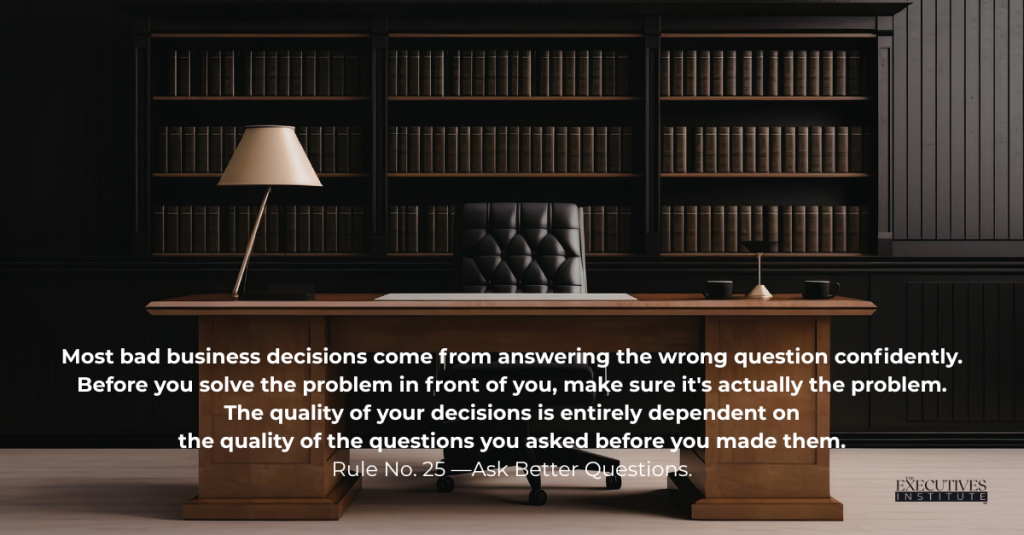
📌 Rule No. 25 —Ask better questions.
—The Skill Most Leaders Undervalue
The quality of your decisions depends heavily on the quality of the questions that preceded them.
Ask better questions is one of The Executives Institute’s core principles because most leaders are trained to answer —not to think.
That sounds a little harsh, but it’s very true. From early in their careers, high performers are rewarded for decisiveness, speed, and having the solution. Over time, that habit becomes a liability. They stop questioning assumptions, stop challenging direction, and start operating inside problems that were never clearly defined in the first place.
This rule earns its place in the first 50 because it sits upstream of everything else. Strategy, innovation, culture, execution—they all depend on whether you’re asking the right questions at the right time.
Organizations that separate themselves move faster —but they also pause long enough to ask, Are we still solving the right problem? They challenge what everyone else accepts and create space for uncomfortable questions that expose blind spots before they become costly mistakes.
“Great answers start with uncomfortable questions.”
In a room full of smart people, the one who asks the right question often holds more power than the one who rushes to offer the right answer. Yet in business, we tend to glorify speed over depth. The problem with this is that shallow questions produce shallow thinking —and predictable results.
Great leaders know that progress begins with curiosity, not with certainty. By learning to ask better questions, we unlock clarity, challenge assumptions, and open the door to smarter strategies and stronger teams.
The discipline is to ask questions with genuine curiosity rather than as a rhetorical device —not to lead the room to the conclusion you’ve already reached, but to actually explore what you don’t yet know. It is a simple instruction with significant implications for leadership style, team culture, and decision quality. The leader who asks the right question at the right moment is often more valuable than the one who has all the answers.
Ignore this rule, and you’ll stay busy solving the wrong things.
Apply it, and you change the trajectory of decisions before they’re made.

Rule No. 25 summary:
The quality of your outcomes is directly tied to the quality of your questions.
Leaders who ask better questions don’t just get better answers—they uncover blind spots, surface assumptions, and spark clearer thinking in themselves and others.
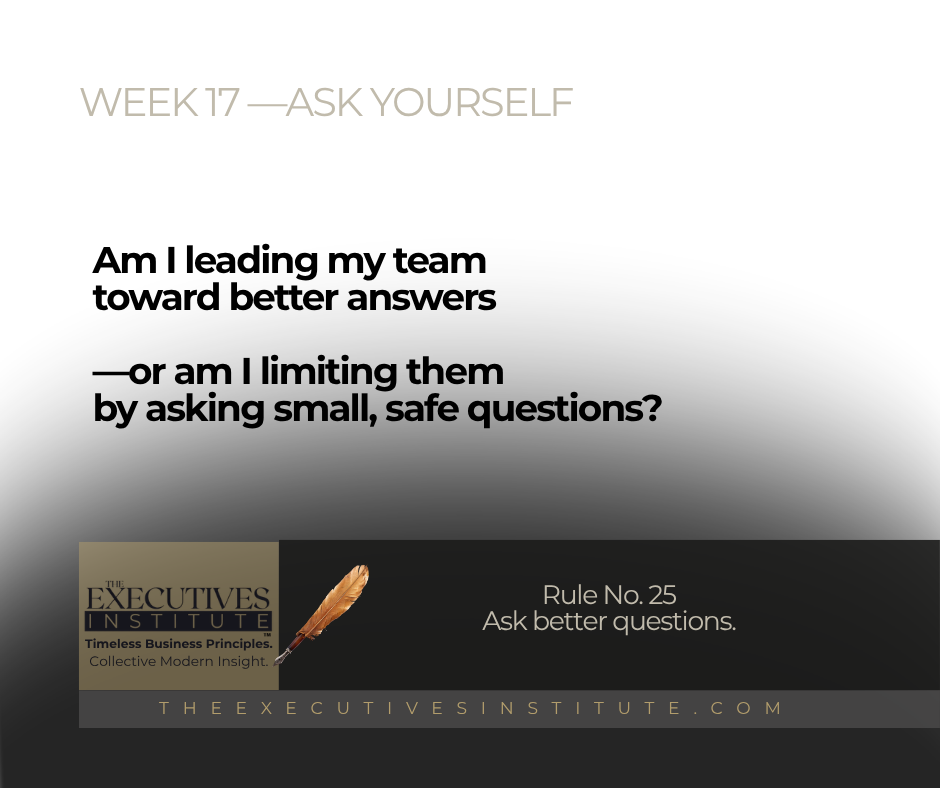
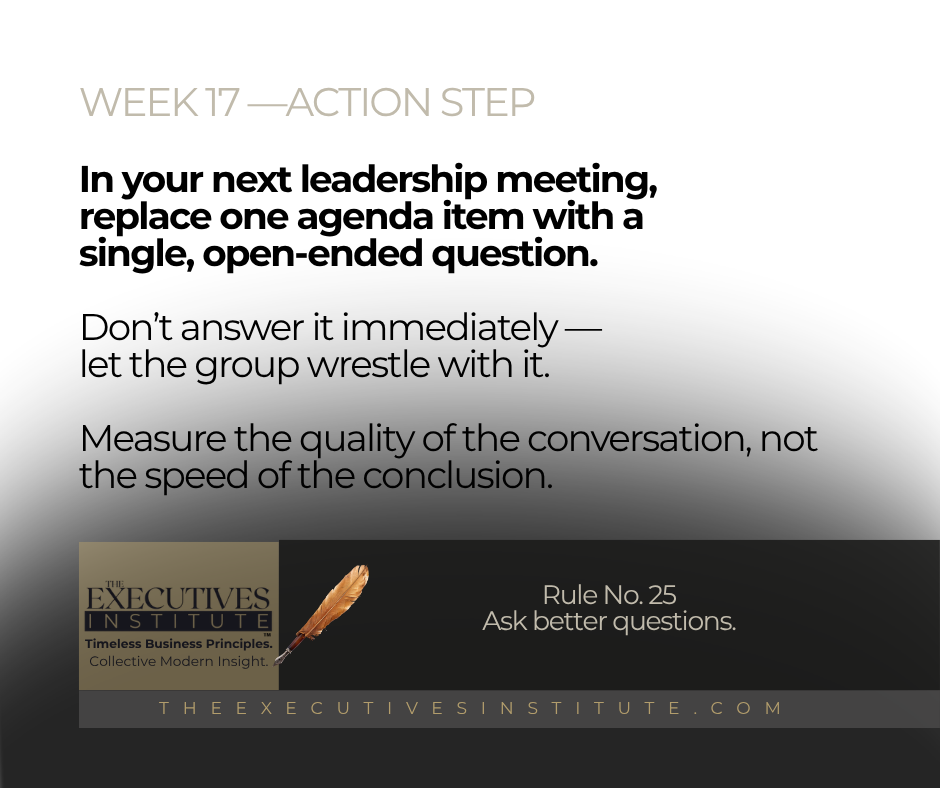
Warren Berger spent years studying the relationship between inquiry and innovation. What he found is that the most important advances in business and science don’t begin with answers. They begin with someone willing to ask an uncomfortable question that others have decided to stop asking.
In organizational life, the pressure runs in the opposite direction. Leaders are expected to have answers. Admitting uncertainty or asking basic questions can feel like a vulnerability in a room full of people who expect confidence.
But the leaders who ask better questions make better decisions. They uncover assumptions that have calcified into facts. They surface options that weren’t on the original list. They create the kind of thinking environment where people bring their best ideas rather than their most defensible ones.
Berger makes a simple but disruptive case: the leaders who win aren’t the ones with the fastest answers, but the ones who ask the kinds of questions that reframe problems, challenge assumptions, and spark innovation.
Through examples from business, education, and entrepreneurship, the book shows how powerful questions move organizations from stagnation to possibility.
Berger breaks questioning into a disciplined cycle—Why? What if? How?—and shows how leaders can use this process to break through rigidity, reveal opportunity, and push their teams to think more boldly.
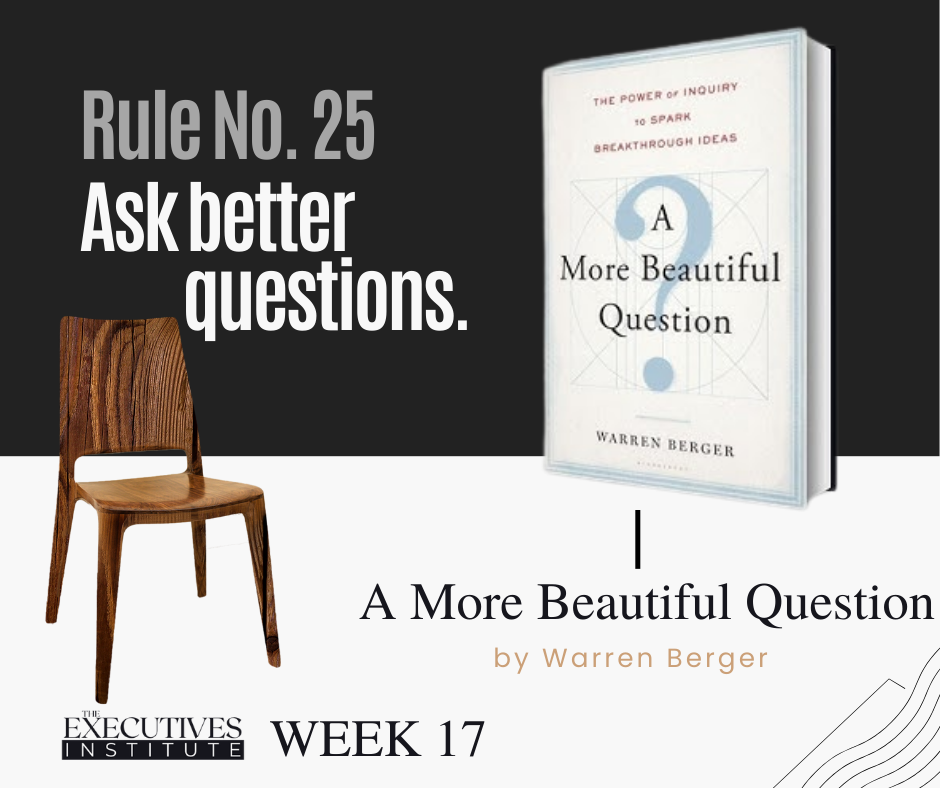
The Executives Institute Rule No. 25 —Ask better questions.
This week’s recommended reading: A More Beautiful Question by Warren Berger
“The ability to ask beautiful questions — profound, ambitious questions that can shift the way we perceive or think about something — is one of the most powerful forces for change.” – Warren Berger
Key Executive Takeaway
If you want better results, stop demanding better answers and start demanding better questions. A leader’s job isn’t to have all the solutions —it’s to create an environment where the right questions surface and shape the path forward.
The next page holds the next edge.