
📅 WEEK 11
 Write this down…
Leaders who own mistakes build trust. Leaders who hide them lose it.
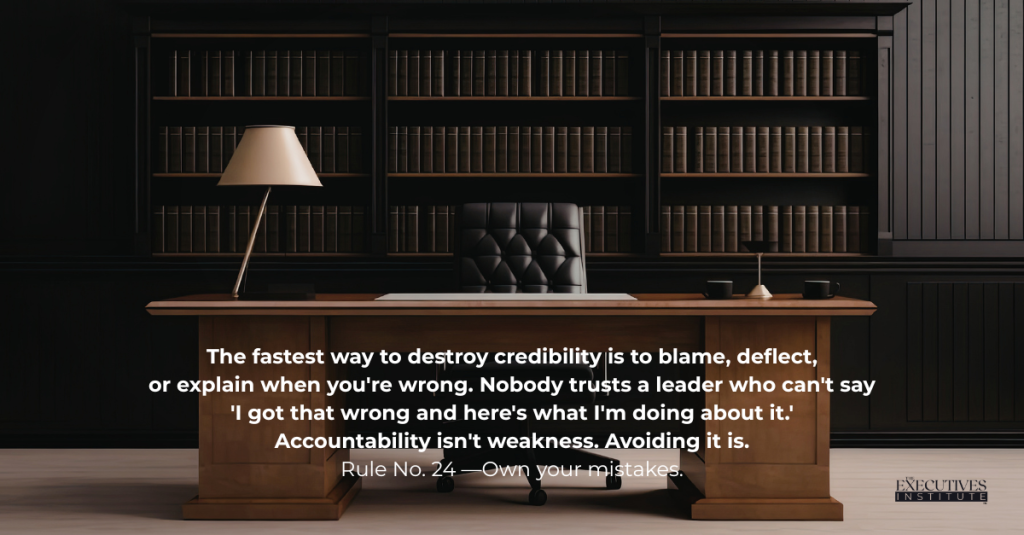
📌 Rule No. 24 —Own your mistakes.
— The Leadership Quality That Cannot Be Faked
The quality of a leader is often most visible in how they respond to failure.
In leadership circles, we often talk about accountability — but rarely do we confront what it really looks like when the stakes are high, the optics are bad, and the blame could easily fall elsewhere. Owning your mistakes in these moments separates true leaders from those just holding the title. It’s not about being the fall guy — it’s about being the kind of leader who earns the right to lead again tomorrow.
Ask yourself: If my team copied the way I handle mistakes, would we be stronger — or weaker — as an organization?
Every leader eventually faces the mirror — and it doesn’t always reflect back a win. Projects go sideways, communication breaks down, results fall short. In those moments, the instinct is to explain, justify, or quietly shift the blame. But real leadership demands the opposite. When you own the mistake — fully, visibly, and without excuses — you don’t lose credibility. You gain it.
Experienced observers can read an organizational culture in minutes. The way people talk about what went wrong tells you everything about whether the leadership values ownership or deflection.
“Blame is the fastest way to stall progress.”
Own your mistakes is part of The Executives’ Institute’s foundational principles. Not as a standard of performance, but as a standard of character.
Think back to a recent mistake or failure — one that impacted others. How did you respond publicly and privately? What would “extreme ownership” have looked like in that moment? And how might your team’s perception of you shift if you had owned more — or less — of it?
The leader who owns everything earns the trust that makes everything else possible.

Rule No. 24 summary:
Great leaders don’t deflect blame — they absorb it, learn from it, and lead forward. Owning your mistakes isn’t weakness; it’s the foundation of credibility, respect, and real accountability. In any failure, you either make excuses or you make progress — never both.
The strongest leaders don’t hide from failure; they stand in front of it, learn from it, and lead forward. That’s not just responsibility — that’s extreme ownership.
The Ledger is your working companion to The Executives Institute —whether you follow The Weekly Edge or participate in a 10K Leaders study group. This is where discipline takes shape —where the priorities that drive your business are identified, challenged, and acted on. Print each week as you go, or collect the hardcover Ledger each year, with a $100 contribution to the Institute. Over time, each annual Ledger becomes a record of your decisions, your lessons, and the growth of your organization.
The Institute teaches. The Ledger records.
In their book, Extreme Ownership, Jocko Willink and Leif Babin brought a military concept into business language that translates directly: on a high-performing team, the leader owns the outcome — all of it. Not the parts that went well, not the decisions that were directly theirs. All of it.
This is not about self-flagellation. It is about a practical commitment to accountability that makes the organization better. When a leader takes ownership of a failure, they signal that the environment is safe for honest assessment. The team can focus on what went wrong and how to correct it rather than on protecting themselves from blame.
The opposite — assigning blame, finding external causes, insisting that the failure belonged to others — may feel defensible in the moment. But it teaches the organization to do the same. Accountability diffuses until nobody is responsible for anything.
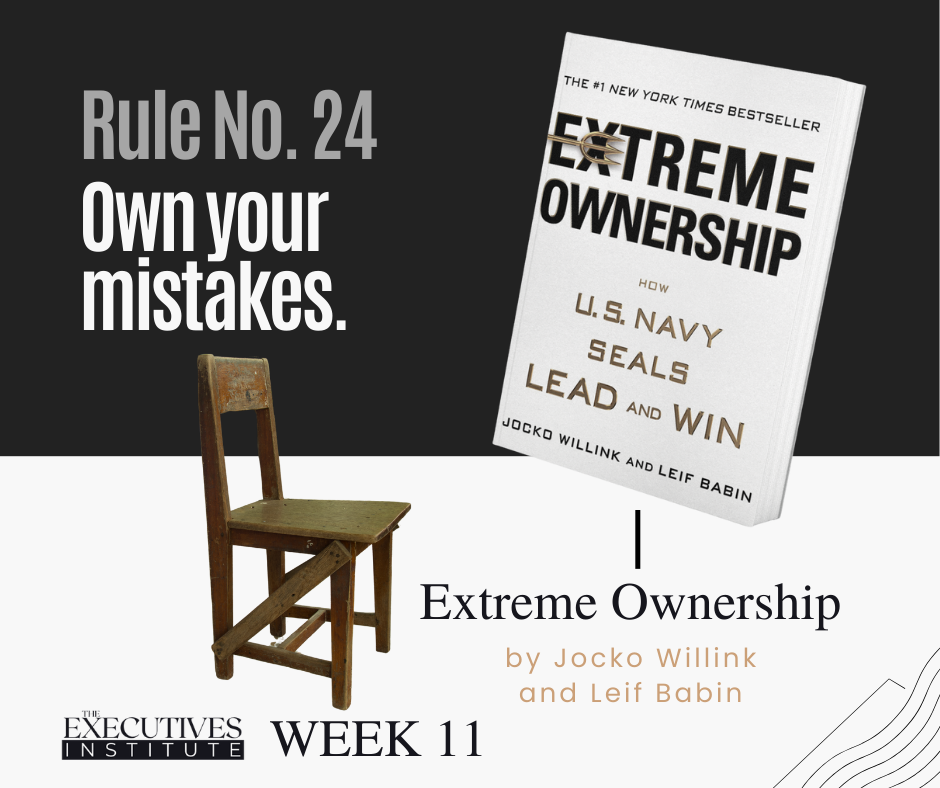
The Executives Institute Rule No. 24 —Own your mistakes.
This week’s recommended reading: Extreme Ownership by Jocko Willink & Leif Babin
Business rewards the prepared. Continue.