
📅 WEEK 7
By this point in the journey, the question isn’t can you run a business —it’s whether you’re still grounded in who you’re actually running it for. Many of the bad decisions I’ve ever made traced back to an assumption about the customer that went untested. We thought we knew. We didn’t. Rule No. 12, Know your customer deeply, exists because clarity here sharpens everything else —strategy, messaging, product, service, growth.
Because, and let’s be very clear —most business problems aren’t execution problems. They’re understanding problems. I’ve watched good companies struggle not because they lacked effort or intelligence, but because leadership drifted too far from the customer’s real world. That’s why this rule sits where it does.
Ask most executives who their best customer is. They can answer. Ask what that customer values most. The answer gets harder.
Ask yourself…
—How much of our customer’s daily reality do we truly understand?
A question many leaders struggle to answer.
📌 Rule No. 12 —Know your customer deeply.
There is a meaningful difference between knowing who buys from you and understanding why they buy from you, what they’re trying to accomplish when they do, and what frustration they’re willing to tolerate because your alternative is better than the other options.
In his book, Know Your Customer, Robert Woodruff’s research on customer value has held up for decades because the underlying truth it describes hasn’t changed: customers make decisions based on their perception of value, and that perception is shaped by factors that are often invisible to the company serving them.
The executives who build loyal customer bases spend serious time in proximity to their customers. Not just through data dashboards or satisfaction surveys —though those matter —but through real conversations that reveal motivation, frustration, and aspiration. When a company loses touch with this, the products drift. The messaging disconnects. The company starts optimizing for the wrong things —often for itself rather than for the people it serves.
“Guessing what customers want is an expensive hobby.”
When was the last time you sat down face-to-face with a customer and just listened? Not pitch or promote, just listen.
Know your customer deeply is not a suggestion to spend more time on market research. It is a reminder that customer insight is a leadership responsibility, not a department function. The company that understands its customers better than any competitor will almost always find a way to win.
 Write this down…
The businesses that win know their customer better than the customer knows themselves.

Rule No. 12 —Know your customer deeply.
NOTES:
When you know your customer deeply, everything changes. You market with clarity. You build with purpose. You sell with relevance. Most important, you stop wasting time solving the wrong problems.
This rule demands humility, proximity, and the discipline to listen more than you speak. It’s not flashy — but it is the foundation of every lasting business.
If, 5 years from now,
you had 5 editions of The Ledger on the shelf behind your desk, you would have a written record of the decisions, priorities, and hard truths that shaped your business year by year.
The Ledger is your working companion to The Executives Institute —whether you follow The Weekly Edge or participate in a 10K Leaders study group. This is where discipline takes shape —where the priorities that drive your business are identified, challenged, and acted on.
📓 Print each week as you go for free, or collect the hardcover Ledger each year, with a $100 contribution to the Institute. Coming Q4 2026.
The Institute teaches. The Ledger records.
Know Your Customer is a no-nonsense guide to building stronger, smarter businesses by deeply understanding the people you serve. Robert Woodruff strips away the fluff and emphasizes that real competitive advantage doesn’t come from products or pricing —it comes from insight.
The book walks readers through practical ways to uncover customer motivations, identify unspoken needs, and build systems that prioritize listening over assumptions. It’s a call to stop generalizing and start observing, interviewing, and engaging.
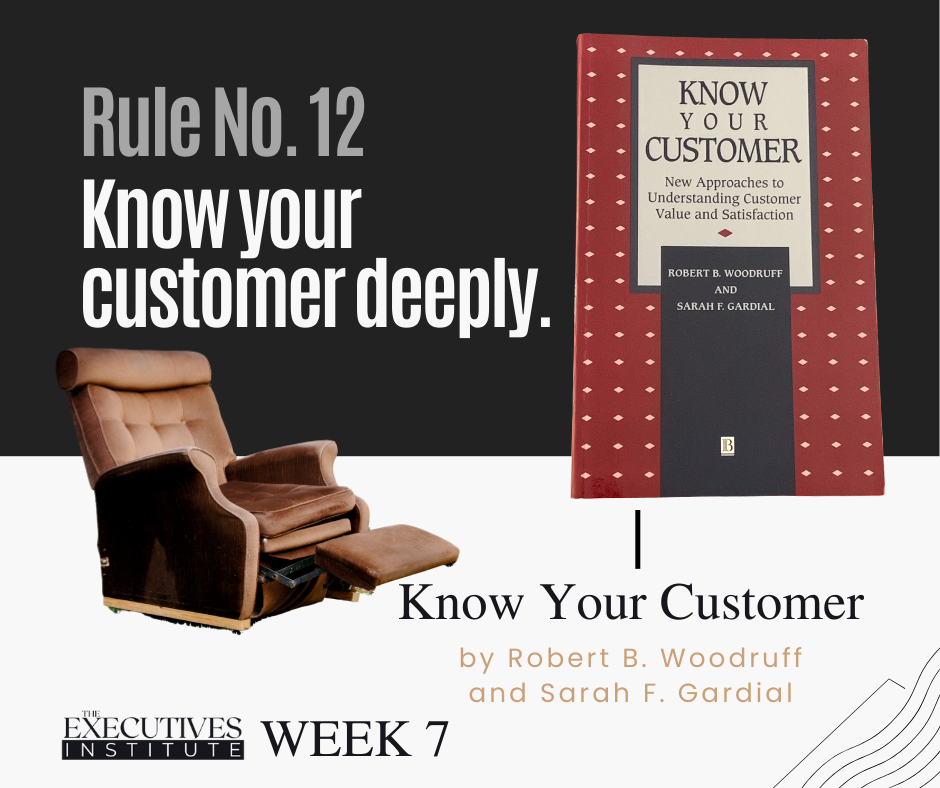
This week’s recommended reading: Know Your Customer by Robert Woodruff
The takeaway is clear: if you know your customer better than anyone else, you can serve them better than anyone else —and win because of it.
As reinforced in Know Your Customer, real advantage doesn’t come from more data or better dashboards. It comes from staying close enough to the customer to see what others miss —even after success gives you permission to stop paying attention. Ignore this rule, and you’ll work harder than necessary. Live it, and you’ll stop solving the wrong problems.
Learning is sequential. Keep turning the pages.
Up next…📅 WEEK 8 📌 Rule No. 18 —Your calendar reflects your priorities.