
📅 WEEK 9
When creating the chapters of The Weekly Edge, shuffling and grouping the Rules together, we moved this Rule from one of the more “internally-focused” chapters to Chapter 2: Know Your Customer, because clarity is not just an internal leadership function —it is one of the most important customer experience functions in business.
Most companies think they have a marketing problem, sales problem, or retention problem when they actually have a clarity problem. Customers buy with confidence when they clearly understand:
- what you do,
- who it’s for,
- why it matters,
- how it helps them,
- what it costs,
- and, what happens next.
When businesses fail to communicate those things clearly, hesitation enters the relationship. Confused customers delay decisions, compare endlessly, mistrust pricing, overwhelm support teams, or walk away entirely. Internally, clarity aligns teams. Externally, clarity earns trust. A company that lacks internal clarity creates inconsistent customer experiences:
- Sales promises one thing.
- Operations delivers another.
- Marketing says something different entirely.
- Customer service is left cleaning up confusion.
Customers feel that disconnect immediately. The strongest brands in the world are rarely the most complicated. They are the clearest. Their messaging, standards, expectations, and customer experience are unmistakable.
This move also reinforces an important leadership truth: You cannot create customer confidence externally if your organization lacks clarity internally. Teams that clearly understand the mission, customer, standards, and expectations communicate with consistency. And consistency is what customers ultimately trust. In many ways, clarity becomes the bridge between:
- leadership and execution,
- marketing and operations,
- employee confidence and customer confidence.
That makes this rule a natural fit inside Know Your Customer because understanding the customer is only half the battle. Communicating clearly enough for them to confidently act is the other half. Ask Yourself:
— If I were seeing my company for the first time as a customer, would I immediately understand what we do, why it matters, what makes us different, and what I should do next —or would I leave confused and uncertain?
📌 Rule No. 21 —Clarity creates confidence.
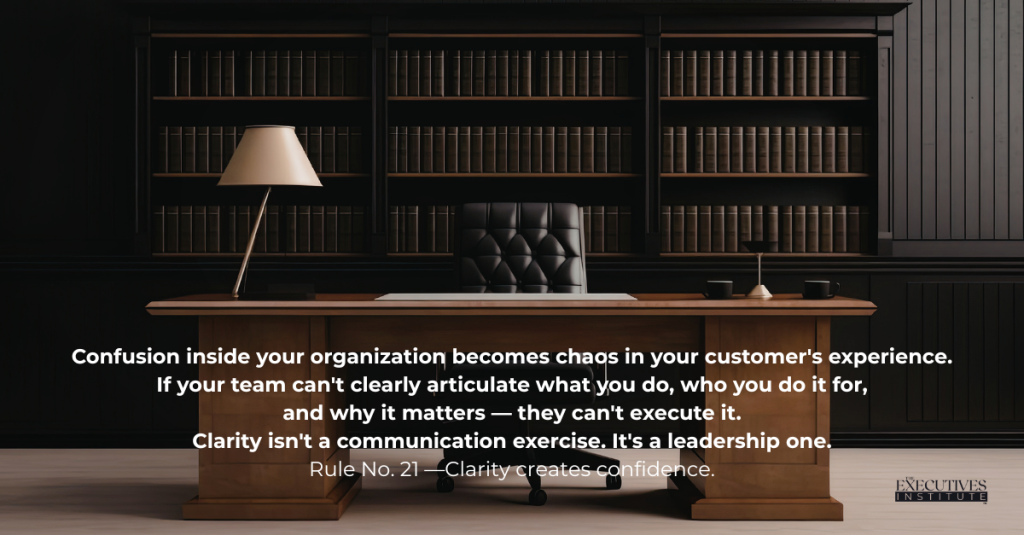
Let’s also talk about the internal aspect of clarity and how your team carries the message to your customer. Clarity isn’t about sounding sharp in the conference room. It’s about building an organization that can act without you. If your people hesitate, re-interpret, or wait for approval, that’s not a talent issue. It’s a clarity issue. Here’s another question to ask yourself:
—If you stepped away from your business for 30 days, would your team move forward with confidence —or freeze waiting for clarification?
Most communication problems in business aren’t really communication problems —they’re clarity problems. As leaders, we often assume we’ve been clear because we understand what we said. But clarity isn’t measured by how well you spoke —it’s measured by how well others understood.
Clear communication is not about simplifying complex ideas into slogans. It is about doing the hard work of making the strategy specific enough that the people responsible for executing it can make decisions without constantly escalating for guidance.
“If you can’t explain it simply — neither can your team.”
When leaders complain that their teams aren’t aligned, the diagnosis usually begins not with the team but with the clarity of direction they were given. When people understand where they’re going and why, they act with more conviction and require less management. Vague strategy produces confused execution. Precise strategy produces decisive teams. When you communicate with precision, people move faster, decisions get easier, and confidence grows across the board. Clear messaging always wins.
Ambiguity is expensive. Most organizations don’t know how much they’re paying for it.
 Write this down…
Confused teams move slowly. Clear teams move fast.

Rule No. 21 —Clarity creates confidence.
NOTES:
In business, confusion is expensive. Teams stall, customers hesitate, and leaders lose credibility—all because the message wasn’t clear. Clarity isn’t just a communication skill—it’s a leadership responsibility.
When people know exactly what to do, why it matters, and how to move forward, confidence rises and results follow. If you’re not being understood, you’re not being effective.
This Rule should be expanded to: Clarity creates confidence —always.
If, 5 years from now,
you had 5 editions of The Ledger on the shelf behind your desk, you’d be able to look back and see exactly where you gained clarity, where you lost focus, and where your leadership changed for the better.
The Ledger is your working companion to The Executives Institute —whether you follow The Weekly Edge or participate in a 10K Leaders study group. This is where discipline takes shape —where the priorities that drive your business are identified, challenged, and acted on.
Print each week as you go for free, or collect the hardcover Ledger each year, with a $100 contribution to the Institute. Coming Q4 2026.
The Institute teaches. The Ledger records.

This week’s recommended reading: Made to Stick by Chip Heath & Dan Heath
Chip and Dan Heath studied why some ideas spread and others don’t. Their conclusion had less to do with the quality of the ideas and more to do with how clearly they were communicated — whether they could be understood, remembered, and repeated.
In organizations, strategic ambiguity compounds. The leader has a direction in their head that feels clear to them. It is communicated in general terms. Each level of the organization interprets it slightly differently. By the time decisions are being made at the execution level, the original intent has been diluted, translated, and sometimes inverted.
One last thing on this lesson…
Consider where you’re currently losing time, money or momentum, and ask yourself…Is it actually due to a lack of clarity?
Congratulations on completing Chapter 2: Know Your Customer. You’ve done the work so many leaders I’ve met over the years skip. You’ve clarified who your business is for, what promise you’re making, and how to align your time and team around that clarity. That’s the foundation of every healthy brand and every loyal customer base.
You’re no longer guessing—you’re grounded. And that puts you ahead of most. But clarity isn’t just about your customer. It’s about the people inside your company, too. In this upcoming set of Rules, we take a look at your team.
Up next…Chapter 3: Hiring Without Regret
with 📅 WEEK 10 📌 Rule No. 22 —Hire slow, fire fast.
Ask yourself: “Are the people on our team making our business better—or just busier?“ →