
📅 WEEK 16
 Write this down…
Most companies lose by making too many safe decisions.
📌 Rule No. 5 —Make fewer, bolder moves.
— Why Most Strategic Plans Accomplish Nothing
A strategy that tries to do everything is not a strategy. It is a wish list.
The executives who build great businesses understand that concentrated effort outperforms distributed effort almost every time. One bold move executed with full resource commitment beats five modest moves executed with divided attention.
This requires courage. Selecting fewer priorities exposes you to being wrong about the ones you chose. It is far more comfortable to spread the risk across many bets and explain later that the market simply moved against you.
“Busy isn’t strategic. It’s just loud.”
Our principle at The Executives Institute says it plainly: Make fewer, bolder moves. It is advice that contradicts the instinct of most organizations, and it is precisely why so few follow it.
Discipline in strategy is choosing what you will not do.
Ask yourself…
“What are we doing that looks productive —but isn’t moving the needle?”
“If we could only bet on one initiative this year, what would it be —and why?”
“Where are we spreading ourselves too thin to avoid hard decisions?”

Rule No. 5 summary:
Focus beats frenzy. Spread too thin, you risk mediocrity everywhere. Bold, deliberate moves—rooted in strategy, not reaction—create real advantage. Commit to fewer initiatives, but back them fully. Win where it matters.
Why: Because, focused strategy beats scattershot tactics
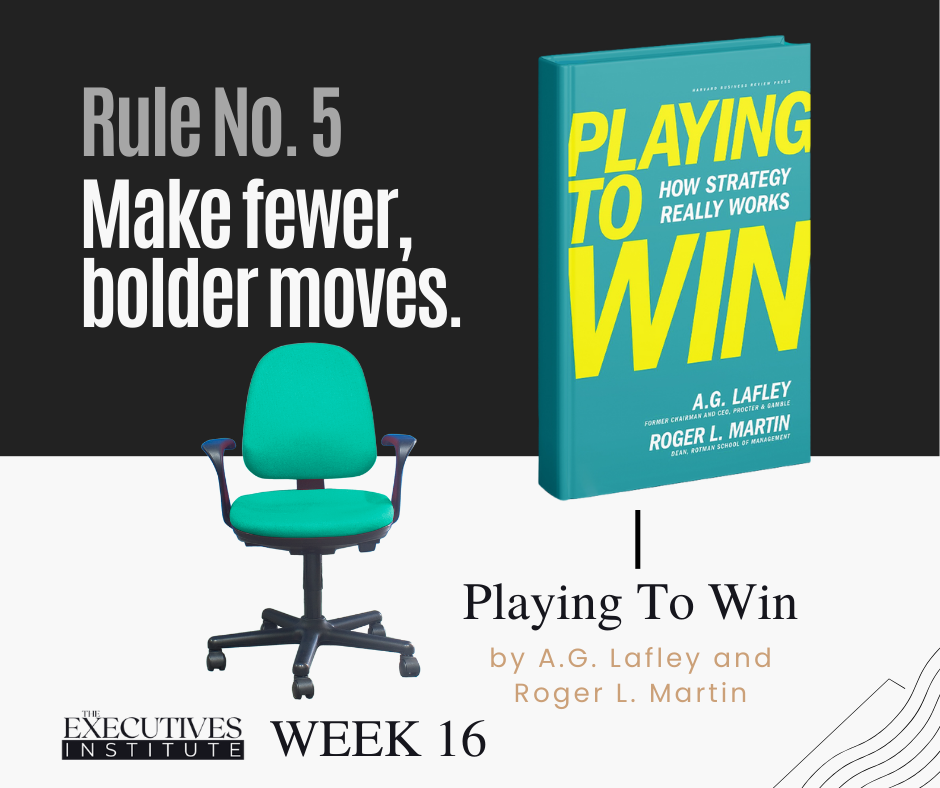
A.G. Lafley and Roger L. Martin wrote one of the more honest books about what strategy actually requires, Playing to Win. Real strategy demands choices. And choices, by definition, mean saying no to things that seem reasonable, even appealing.
Most strategic plans fail not because the ideas in them are bad, but because there are too many of them. Thirty initiatives look like strategic thinking. They are actually a hedge — a way of committing to nothing while appearing to commit to everything.
“The heart of strategy is the answer to two fundamental questions: where will you play, and how will you win there?”
The Executives Institute Rule No. 5 —Make fewer, bolder moves.
This week’s recommended reading: Playing to Win by A.G. Lafley & Roger L. Martin
“Strategy…It requires making explicit choices—to do some things and not others—and building a business around those choices.” — Playing to Win
Key Executive Takeaway:
A strategy that tries to do everything isn’t a strategy. Your advantage comes from saying no—from choosing the markets you’ll dominate, the customers you’ll serve, and the moves you’ll make at the expense of all others. Bold focus beats timid breadth every time.
16 weeks. Well done. Don’t stop here. The next lesson builds on this one.