
Chapter 3: Hiring Without Regret | Weeks 10—13
Every hire is a bet on your future. Get it right, and your business gains momentum. Get it wrong, and you pay for it—financially, culturally, and emotionally. This chapter isn’t about filling seats. It’s about building a team that makes your business stronger simply by being part of it. The best leaders hire with intention, delegate with clarity, and take full ownership of the people decisions they make.

✅ That means hiring slow, firing fast, and being brutally honest when something (or someone) isn’t working.
✅ Culture isn’t built in boardrooms. It’s shaped by who gets promoted, who gets protected, and who gets passed over.
✅ Processes matter—but people drive the mission. When you choose the right people and give them the right outcomes to own, you don’t just get things done. You build something that lasts.
✅ No more excuses. No more passing the buck. Build a team you won’t regret. Your company becomes who you hire—and what you tolerate.
Over the next 4 weeks, ask yourself…“Are the people on my team making our business better—or just busier?”
Let’s begin…
📅 WEEK 10
 Write this down…
One wrong hire tolerated too long can undo ten right ones.
📌 Rule No. 22 —Hire slow, fire fast.
— The Most Costly Decision in Business
The wrong person in the right seat will cost you more than almost any other business mistake.
Most hiring mistakes don’t happen because we lack talent in the market. They happen because we get impatient. The workload piles up, the team is stretched thin, and we convince ourselves the next decent candidate will “probably work out.” Sometimes they do. Often they don’t. And when we know someone isn’t the right fit, we hesitate. We give it more time. We hope things turn around. Meanwhile the rest of the team sees it, feels it, and quietly wonders why the standard isn’t being enforced.
Strong companies aren’t built by filling seats quickly. They’re built by raising the bar on who gets one —and having the courage to act when the wrong person is sitting in it.
Ask Yourself…
Are we keeping someone on the team right now who I already know doesn’t belong here—if so, what’s stopping me from making the call?
Hiring slowly means doing the work before extending the offer — being rigorous about scorecard criteria, running structured interviews, checking references as a serious intelligence-gathering exercise rather than a formality.
Most organizations do the opposite. They hire on gut and manage the consequences. The gut is often responding to charisma, polish, or cultural familiarity — not to the actual predictors of performance in the specific role being filled.
The second half of the principle is equally important and even less comfortable. Once it is clear that a hire was wrong — that the person cannot or will not perform at the level the role requires — the cost of waiting compounds daily. The team adjusts around the gap. Standards drift. The wrong hire pulls the culture in their direction.
“Bad hires don’t improve with motivational posters.”
Hire slow, fire fast is a principle at The Executives Institute that most leaders nod at and then struggle to practice. The hiring process takes time and discipline. The parting conversation takes courage.
Both are worth it.
If you’re sure someone needs to go, act immediately. The cost of waiting isn’t kindness—it’s the slow erosion of your standards. Great leaders protect the bar. The moment the team believes the bar is negotiable, performance follows it down.

Rule No. 22 summary:
The strength of your team determines the strength of your business. Hiring slow means committing to a disciplined process—one that prioritizes fit, capability, and character over speed or convenience. It means refusing to lower the bar just to fill a seat. Firing fast means addressing misalignment or underperformance decisively before it corrodes culture, morale, or momentum.
Tolerating the wrong hire too long is more costly than taking the time to hire the right one. Right people, right roles, right now—or nothing.
The Ledger is your working companion to The Executives Institute —whether you follow The Weekly Edge or participate in a 10K Leaders study group. This is where discipline takes shape —where the priorities that drive your business are identified, challenged, and acted on. Print each week as you go, or collect the hardcover Ledger each year, with a $100 contribution to the Institute. Over time, each annual Ledger becomes a record of your decisions, your lessons, and the growth of your organization.
The Institute teaches. The Ledger records.
Smart and Street built their research on a simple finding: the number one driver of business failure at the executive level is a poor hiring decision. Not strategy. Not market conditions. Not capital allocation. People.
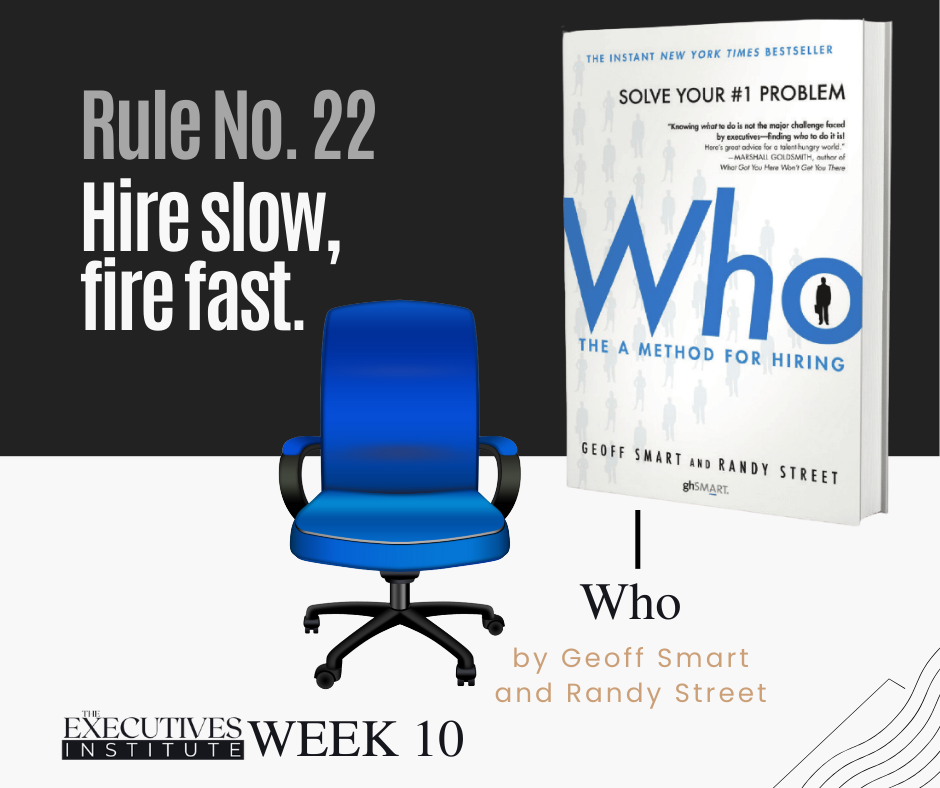
The Executives Institute Rule No. 22 —Hire slow, fire fast.
This week’s recommended reading: Who: The A Method for Hiring by Geoff Smart & Randy Street
You’ve finished this rule. Now earn the next one.