
📅 WEEK 15
 Write this down…
Short-term wins impress. Long-term discipline builds empires.
📌 Rule No. 4 —Play the long game.
— The Decision That Changes Everything
Most of the short-term decisions that hurt businesses look reasonable at the time.
That’s what makes them dangerous. Nobody wakes up and says they’re going to sacrifice the future for a quarterly number. It happens through a series of individually defensible choices that compound in the wrong direction.
In his book, The Infinite Game, Simon Sinek framed this clearly: there are finite games, where you play to win a defined end, and infinite games, where the objective is simply to keep playing and improve over time. Business, done well, is an infinite game.
“Short-term wins feel great… until they kill the company.”
The leaders I’ve observed who build durable businesses think in decades, not quarters. They make pricing decisions, hiring decisions, and culture decisions based on where they want the company to be in ten years — not on what solves this month’s pressure.
Playing the long game doesn’t mean ignoring urgency. It means understanding which urgencies are real and which are just noise.
This is embedded in one of The Executives Institute’s foundational principles: Play the long game. It’s a simple instruction with profound implications for how you allocate time, capital, and attention.
The business that’s still here in twenty years will be the one that kept that perspective.

Rule No. 4 summary:
Success in business isn’t about winning — it’s about enduring. Prioritize long-term vision, trust, and adaptability over short-term gains. Great companies focus on building something that lasts, not just something that performs today.
Why: Because, sustainable advantage requires patience.
Simon Sinek argues that most leaders make a critical mistake: they treat business as a finite game with winners, losers, and an endpoint. In reality, business is an infinite game — the rules change, the players come and go, and there is no finish line. Companies that focus on outlasting rather than “winning” build stronger cultures, more loyal customers, and more resilient strategies. Sinek outlines the pillars of infinite-minded leadership: advance a just cause, build trusting teams, study worthy rivals, prepare for existential flexibility, and have the courage to lead with long-term principles rather than short-term pressure. The book is a call for leaders to stop chasing immediate validation and instead build organizations that remain durable, relevant, and principled for decades.
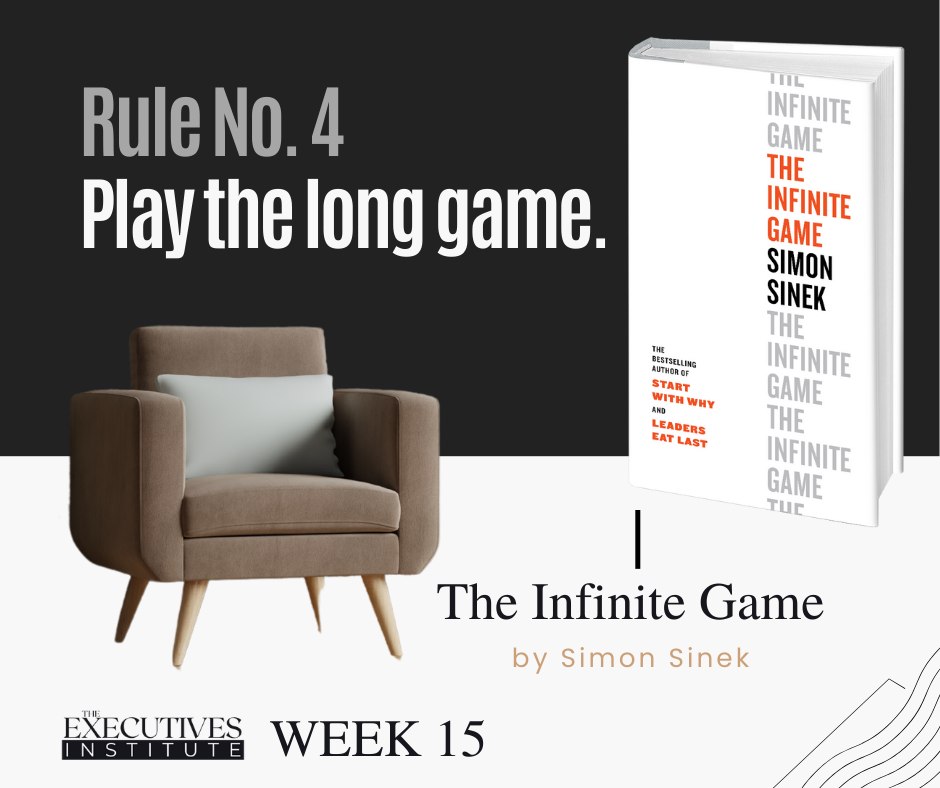
The Executives Institute Rule No. 4 —Play the long game.
This week’s recommended reading: The Infinite Game by Simon Sinek
Key Executive Takeaway
If you run your company like a finite game, you’ll eventually lose. Markets shift, competitors change, and the finish line keeps moving. The leaders who endure are the ones who anchor their decisions in purpose, not quarterly applause. The Infinite Game is a reminder that long-term advantage belongs to the patient, the principled, and the disciplined — not the ones chasing the scoreboard.