
📅 WEEK 13
 Write this down…
Processes guide people, but people ultimately build the business.
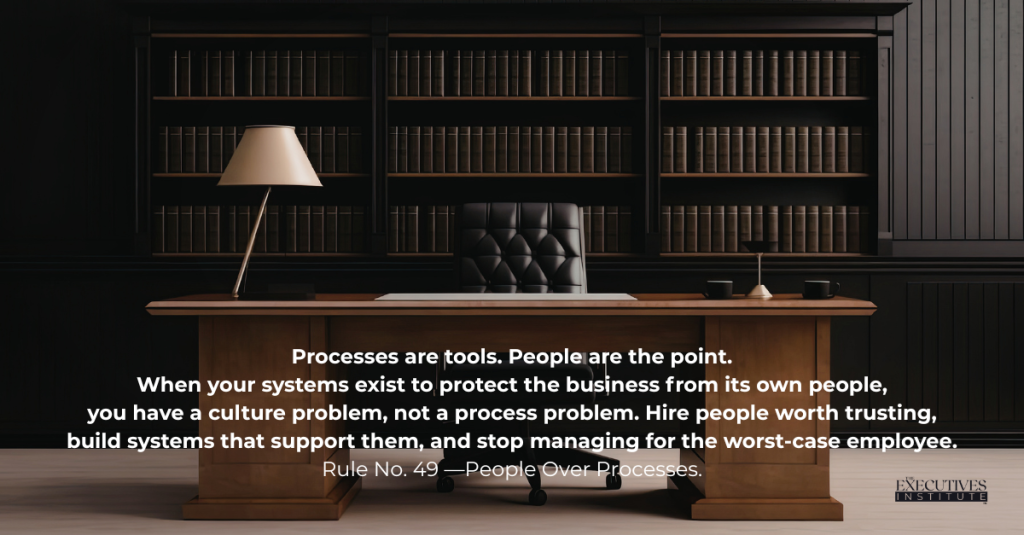
📌 Rule No. 49 —People over processes.
— The Assumption That Shapes Everything
The way a leader thinks about people determines almost everything about how they lead.
Too many companies hide behind processes. When something breaks, they add another form, another system, another rule. But no amount of process can make up for poor leadership—or compensate for a lack of trust in people. The truth is, great organizations are built by humans, not handbooks. When you invest in capable people and give them the freedom to think, decide, and act—you outperform the rigid, over-engineered machines every time. Bureaucracy is easy. Leadership is hard. But leadership wins. Every time.
Ask yourself: If I truly trusted my people, what process would I no longer need?
This is not an argument against structure. It is an argument that structure should exist to enable people, not to substitute for them.
People over processes is a principle at The Executives Institute that acknowledges the uncomfortable truth that no system, however well-designed, can replace the judgment, creativity, and commitment of people who actually care about what they’re doing.
“Systems don’t build culture. People do.”
Invest in the people. The processes will follow.

Rule No. 49 summary:
Processes are important. But people drive results. Over-relying on systems, procedures, and checklists at the expense of human judgment, initiative, and ownership is a slow march to mediocrity.
Organizations thrive when they trust and invest in people—not just when they refine processes. Processes should serve people, not control them.
The Ledger is your working companion to The Executives Institute —whether you follow The Weekly Edge or participate in a 10K Leaders study group. This is where discipline takes shape —where the priorities that drive your business are identified, challenged, and acted on. Print each week as you go, or collect the hardcover Ledger each year, with a $100 contribution to the Institute. Over time, each annual Ledger becomes a record of your decisions, your lessons, and the growth of your organization.
The Institute teaches. The Ledger records.
Douglas McGregor articulated a distinction that remains among the most practically important in leadership: Theory X leaders believe people are fundamentally unmotivated and need to be controlled; Theory Y leaders believe people are fundamentally motivated and need conditions that allow that motivation to express itself.
The organizational implications are profound. Theory X produces bureaucracy, surveillance, and micromanagement. Theory Y produces autonomy, accountability, and discretionary effort — the kind that no job description can mandate and no process can generate.
The leaders I’ve observed who build the highest-performing cultures tend to have made a genuine commitment to the Theory Y assumption. They hire people they trust and then trust the people they’ve hired. They build processes that enable rather than constrain. They hold standards without holding hands.
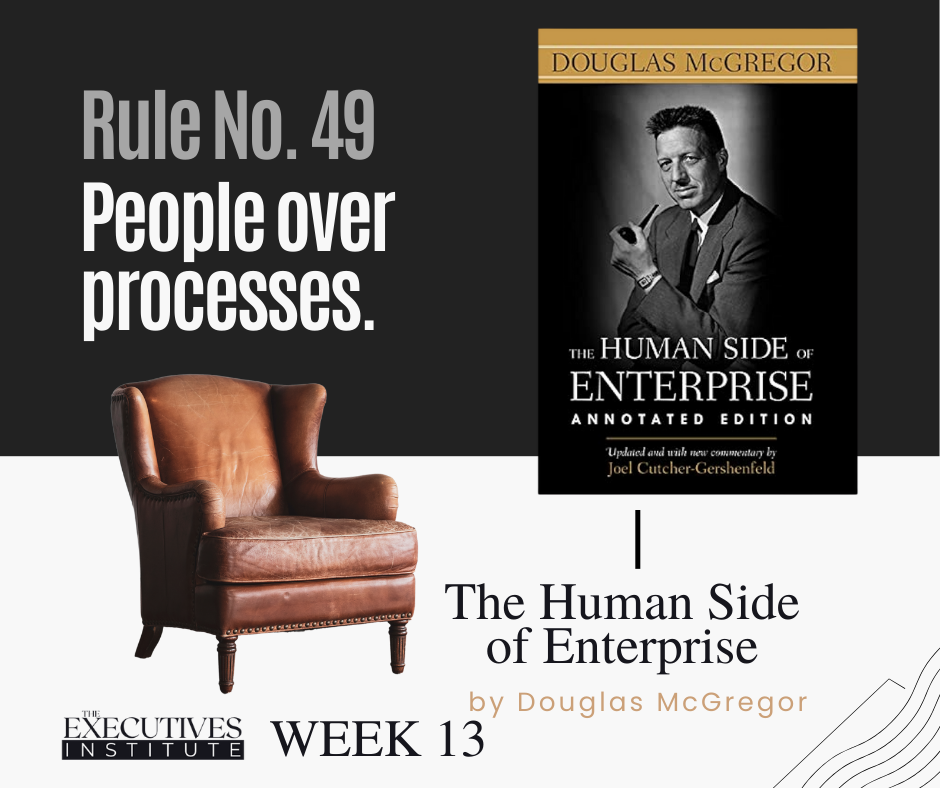
The Executives Institute Rule No. 49 —People over processes.
This week’s recommended reading: The Human Side of Enterprise by Douglas McGregor
Here at The Executives Institute, for example, we don’t want to over-engineer our platform. We are relying on real people to shape the experience —business leaders from across the U.S. —from hand-picking the Rules, to recommending the books, to spreading the word. We’re not here to automate insight. We’re here to spark it. And we trust our users and contributors to help lead the way.
If you’ve made it through this chapter, you’re not just managing people—you’re owning the weight of leadership. Congratulations.
You’ve faced the hard truths: that every hire sends a message, that delegation is a trust test, and that culture is built by what you tolerate. The cost of avoiding people decisions is far greater than the discomfort of making them. You know that now.
You don’t need a perfect team. You need a committed one—with clarity, accountability, and a shared standard for what good looks like. That begins with you.
You’ve hired without regret. Now it’s time to lead without hesitation.
Up Next: Chapter 4: Strategy in the Real World
Ask yourself: “Am I bold enough to make fewer, sharper moves that matter?“
A strategy isn’t what’s written—it’s what gets repeated. In the next chapter, we’ll move past buzzwords and boardroom slides to uncover what strategy really looks like when the pressure’s on. You’ll get ruthless about focus, deliberate in your decisions, and clear on what truly drives results.
Ready to stop reacting and start leading with intent? Let’s go →