
Chapter 4: Strategy in the Real World | Weeks 14-18
A strategy isn’t a slide deck—it’s the choices you make when it counts.
Chapter Theme: Direction, Focus & Discipline
Strategy only matters if it’s bold, clear, and lived out daily. This isn’t about over-polished mission statements or five-year plans that ignore reality. It’s about making hard calls, saying no more than yes, and focusing your efforts where they’ll actually move the needle.

This chapter pushes you to differentiate or die—because playing the long game means refusing to blend in. It means asking sharper questions, making fewer but bolder moves, and aligning every action to the outcomes that actually matter. If you can’t define it, you can’t measure it. And if you can’t measure it, you won’t achieve it.
Most companies don’t fail because they lack ideas. They fail because they confuse motion with meaning—and spread themselves too thin. Real strategy cuts through the noise and turns clarity into a competitive advantage.
Ask yourself…
✅ What do we do—or offer—that no one else does in quite the same way?
✅ What trade-offs are we willing to make in the short term to win long term?
✅ What bold move have we been avoiding because it feels risky—but might be exactly what’s needed?
✅ What’s the question we should be asking—but aren’t?
✅ Where are we relying on vague goals instead of concrete targets?
Let’s begin—
📅 WEEK 14
 Write this down…
If you sound like everyone else, customers will treat you like everyone else.
📌 Rule No. 3 —Differentiate or die.
— The Market You’re Ignoring
Competition is expensive. Most businesses choose it anyway.
Walk into almost any industry and you’ll find the same pattern: companies watching each other, matching each other’s pricing, copying each other’s features, and grinding against each other for incremental share in a market where nobody is winning cleanly.
If customers can’t explain why you’re different, you aren’t.
In their book, Blue Ocean Strategy, W. Chan Kim and Renée Mauborgne called this the red ocean — a space so crowded and competitive that margins bleed out and growth becomes a war of attrition.
The alternative isn’t easy, but it is simple: find the space where you are not competing with anyone at all. Create value in a way that makes comparison difficult. Build something specific enough that a particular customer says, ‘That was built for me.’
“Competing on price is the business version of a clearance rack.”
Differentiation is not a marketing exercise. It is a strategic choice that has to be made at the level of product, service, culture, and business model.
This is what Differentiate or die means inside The Executives Institute. Not ‘be different for the sake of it.’ Be meaningfully different in ways that matter to the people you intend to serve. Why: Because, if you look like everyone else, you’ll be commoditized.
The graveyard of businesses is full of companies that were good enough. Good enough does not survive.

Rule No. 3 summary:
If your business blends in, it’s already falling behind.
In crowded markets, blending in is a slow death. The only way to lead—not just survive—is to break away from the pack by creating clear, compelling differentiation. This isn’t about being slightly better. It’s about being meaningfully different in a way that customers recognize, value, and talk about.
The Ledger is your working companion to The Executives Institute —whether you follow The Weekly Edge or participate in a 10K Leaders study group. This is where discipline takes shape —where the priorities that drive your business are identified, challenged, and acted on. Print each week as you go, or collect the hardcover Ledger each year, with a $100 contribution to the Institute. Over time, each annual Ledger becomes a record of your decisions, your lessons, and the growth of your organization.
The Institute teaches. The Ledger records.
Most businesses don’t fail because they’re bad. They fail because they’re forgettable. Competing on features, price, or marginal improvements in saturated markets is a slow bleed—one that leaves companies reactive, worn down, and undifferentiated. “Differentiate or Die” is not a slogan; it’s a survival principle.
The most successful companies don’t just compete better—they compete differently. They define new categories, solve overlooked problems, and make themselves impossible to ignore. This rule calls leaders to stop benchmarking the competition and start creating uncontested space—what Blue Ocean Strategy calls “value innovation.” It’s not about being louder. It’s about being unmistakably valuable.
“Value innovation is about making the competition irrelevant by creating a leap in value for buyers and your company.”
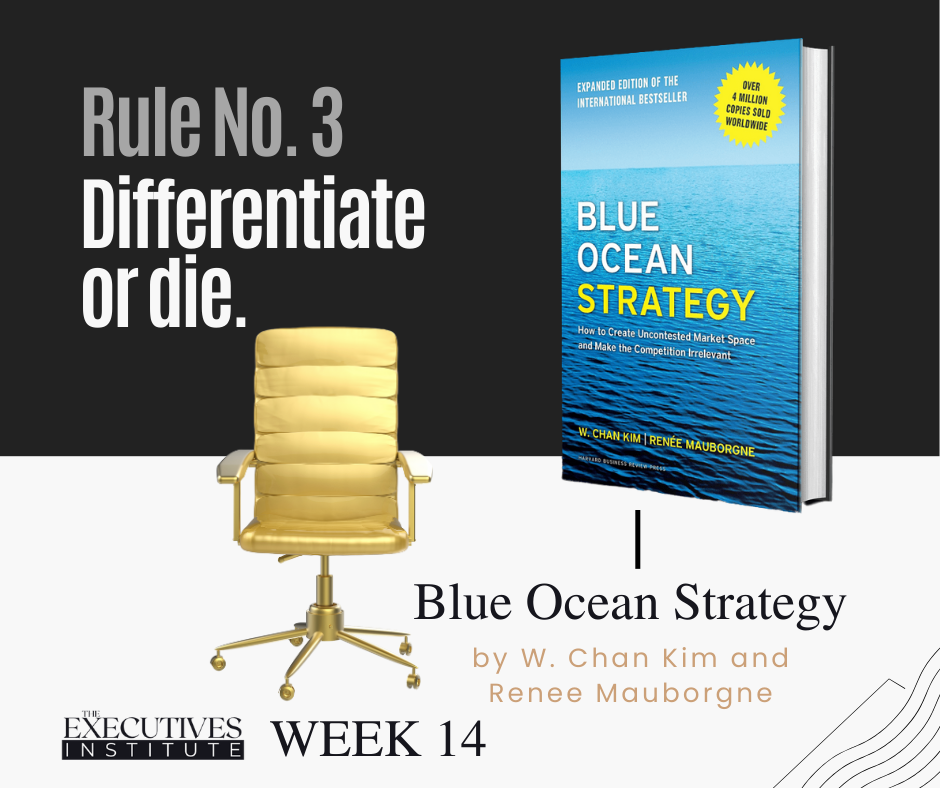
The Executives Institute Rule No. 3 —Differentiate or die.
This week’s recommended reading: Blue Ocean Strategy by W. Chan Kim & Renée Mauborgne
“The only way to beat the competition is to stop trying to beat the competition.”
Progress belongs to those who continue.