
📅 WEEK 5
Here, in the final week of Chapter One, Foundations First, we are going to exam the brutal trap that catches most founders: the leader who is indispensable to daily operations of the company. If the only way your company works is because you’re there pushing every decision, every task, every fire—then you haven’t build a business, you built a job, a dependency. If you can’t point to something you’re fixing, documenting, or delegating, then you’re just clocking hours in a company you happen to own. If every month feels just as hard as the last one, you’re not building a business—you’re just surviving inside it. Ask yourself this question and answer (especially the second part) with complete honesty:
— What parts of my business still rely solely on me? and, What’s the cost? $$
I’ve been there. Long hours. Constant decisions. Everything routing back to me. It feels productive. It isn’t. The real move is designing systems so good that the company keeps improving even when you’re not in the room. Great operators work hard in the business. Great owners redesign the business so hard work isn’t required everywhere.
📌 Rule No. 15 —Work on your business, not just in it.
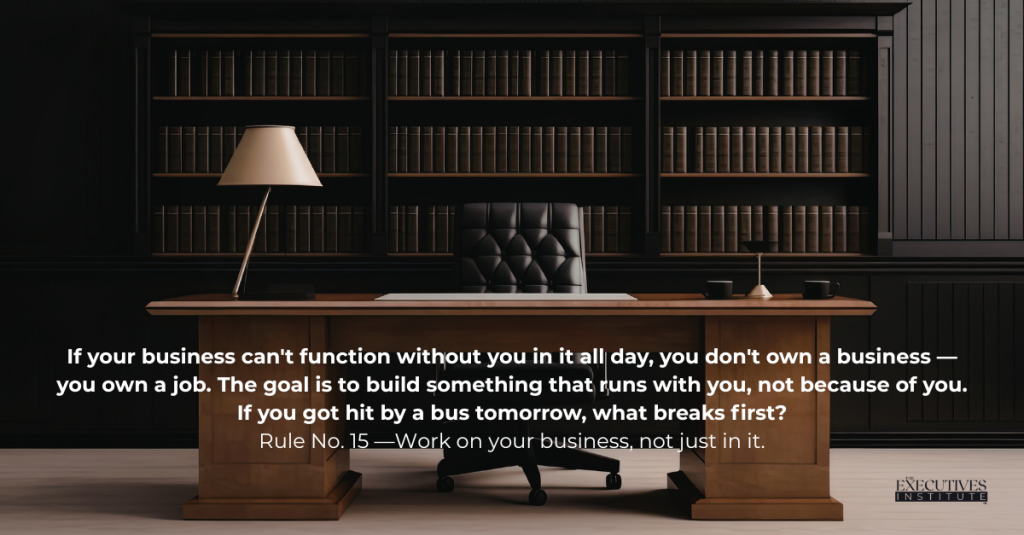
Work on the business, not just in it is one of the clearest principles at The Executives Institute, and among the most universally violated. Most leaders know it’s true. Very few have actually built the habit. Working on the business —designing it, improving its systems, developing its people, building its future —requires time. That time has to be protected deliberately, because the demands of daily operation will consume it otherwise.
The most effective operators I’ve observed hold non-negotiable time for strategic work. They treat their role as business architect as seriously as they treat their role as practitioner. The business you want to run in five years has to be designed today.
“If you’re the whole company, you don’t own a business — you own a job.”
Michael Gerber’s observation from his 1980s book, The E-Myth Revisited, remains one of the most accurate descriptions of small business failure ever written. The person who starts a company is often the most skilled at the core work — the baking, the coding, the consulting, the craft. And so they do the work. All of it. The business grows to the edge of what one person can handle, and then it stops. Because the founder never built the systems, the processes, or the team that would allow the business to function without them.
Here’s why that matters: if you don’t deliberately improve the way the work gets done, the work will always own you. The goal isn’t to grind harder next month. The goal is to make next month structurally easier because you built a better system this month. Build systems. Or you’ll wake up one day and realize you built yourself a very demanding job instead.
 Write this down…
If the business can’t run without you, you don’t own a business —you own a job.

Rule No. 15 —Work on your business, not just in it.
NOTES:
Most entrepreneurs don’t build businesses—they build traps. They start with a skill, launch into doing the work, and before long, they’re drowning in tasks, chained to the very thing they thought would give them freedom.
If, 5 years from now,
you had 5 editions of The Ledger on the shelf behind your desk, you wouldn’t just see where your business grew—you would see how your judgment evolved.
The Ledger is your working companion to The Executives Institute —whether you follow The Weekly Edge or participate in a 10K Leaders study group. This is where discipline takes shape —where the priorities that drive your business are identified, challenged, and acted on.
Print each week as you go for free, or collect the hardcover Ledger each year, with a $100 contribution to the Institute. Coming Q4 2026.
The Institute teaches. The Ledger records.
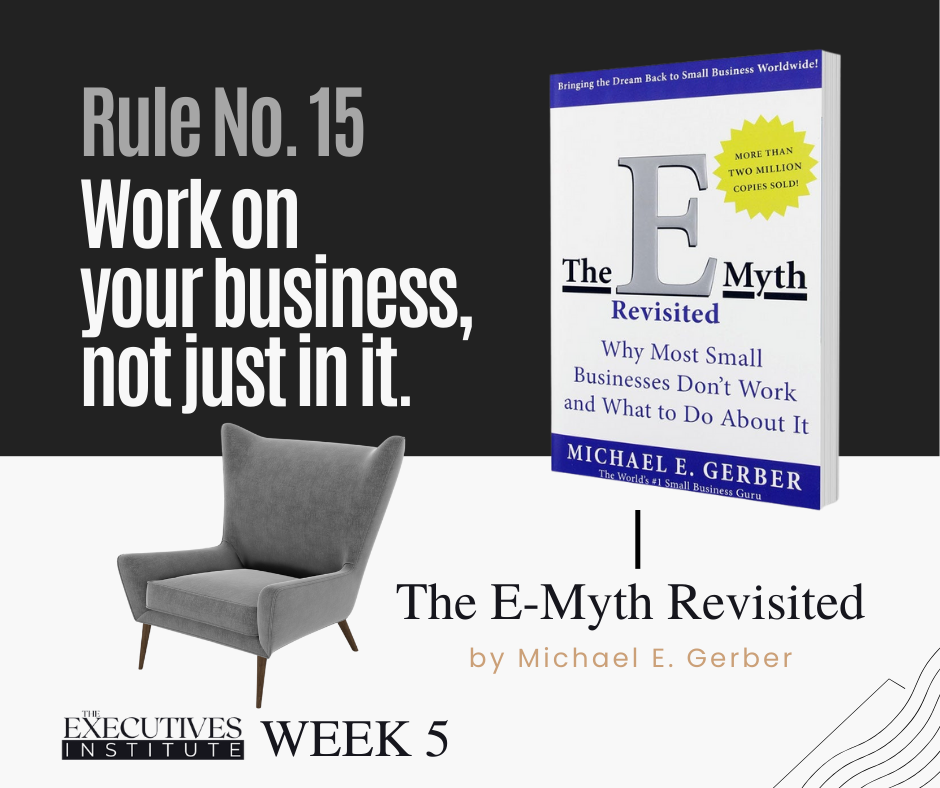
This week’s recommended reading: The E-Myth Revisited by Michael E. Gerber
The book argues that lasting success comes from building systems, processes, and structures that allow a business to run without relying on the owner’s constant presence. In short, a business should be designed like a franchise—even if you never intend to franchise it—so it’s scalable, consistent, and sustainable.
Don’t just work harder in your business. Work smarter on your business, so it can thrive without you.
Congratulations —you’ve laid the groundwork. By studying these first five Rules, you’ve done more than just begin —you’ve made a commitment to build something that lasts. Foundations aren’t flashy, but they are everything. The strongest companies, teams, and leaders return to these principles often, especially when they drift off course (and we all drift off course).
In this next set of Rules,
we are going to shift from building to connecting —diving deep into who you serve, why it matters, and how to build trust that lasts. These 4 Rules focus on understanding real needs, creating value that resonates, and shaping your business around the people who ultimately decide whether it succeeds or fails.
Are you ready to Ask: “Do we truly understand who our best customer is —and does our team know how to serve them with clarity and consistency?”
Up next…Chapter 2, Know Your Customer, begins on page 6 with Week 6 📌Rule No. 11 —Your brand is your promise.