

Rule No. 12 summary:
When you know your customer deeply, everything changes. You market with clarity. You build with purpose. You sell with relevance. Most important, you stop wasting time solving the wrong problems.
This rule demands humility, proximity, and the discipline to listen more than you speak. It’s not flashy — but it is the foundation of every lasting business.
Success doesn’t come from serving the average — it comes from understanding the specific.
Too many businesses operate on assumptions — chasing trends and mimicking competitors. But the ones who endure, the ones who lead, take the time to know their customer at a level most never reach. This isn’t about surveys or generic feedback. It’s about getting inside the mind and daily reality of the people you serve. This rule demands more than surface-level data; it requires insight into your customer’s motivations, frustrations, values, and unmet needs — the things they might not even articulate themselves.
Businesses that take the time to know their customers at this level earn loyalty, trust, and relevance in a way competitors can’t replicate.
Ignore this rule, and you’ll work harder than necessary.
Live it, and you’ll stop solving the wrong problems.
Tell us about a time you thought you understood your customer — and then discovered you were completely wrong. What happened, and what changed afterward?
What conversation with a customer has stuck with you over the years because it changed the way you ran your business?
Have you ever lost an important customer and later realized you missed the real reason why they left? What did that experience teach you?
What is something about your customers today that most competitors probably still don’t understand? How did you discover it?
Looking back, what was the moment when you truly began to understand your customer — not just their purchase, but their world? What triggered that shift?
If you’ve fought battles that became lessons — this is where we collect them.
The insight you share might be the turning point someone else is waiting for.
 Write this down…
The businesses that win know their customer better than the customer knows themselves.
STUDY 📌 Rule No. 12 —Know your customer deeply.
📓 the LEDGER
the LEDGER is the recommended companion to your weekly study through The Weekly Edge. Each week includes a printable PDF designed to help you plan with intention, apply the Rule in real time, and record the decisions, priorities, and lessons that shape your leadership. You can print one week at a time and begin anytime throughout the year, or choose the full professionally printed spiral-bound hardcover LEDGER for a complete year of disciplined growth and reflection.
— the LEDGER Volume 1 will be available this Summer 2026 through this site
This Rule will help you to..
- Design products, services, and experiences that truly solve the customer’s real problems
- Create marketing and messaging that resonates at an emotional level
- Build lasting customer relationships based on trust and value
- Avoid costly assumptions and misaligned offerings
- Make strategic decisions grounded in reality, not guesses or generalizations
Here are five red flags that signal your team may be neglecting Rule No. 12…
Decisions driven by internal opinions, not customer insight. If strategy meetings sound more like “I think” than “Our customers told us,” you’re guessing, not knowing.
Customer feedback is filtered or secondhand. Relying solely on survey summaries, NPS scores, or what frontline staff say — without hearing the customer directly — means blind spots are guaranteed.
Low repeat business or referrals. If customers aren’t coming back or sending others, it’s a sign you’ve missed what really matters to them.
Marketing messages feel generic or interchangeable with competitors. When your campaigns could easily have another company’s logo slapped on, you haven’t tapped into your customer’s unique voice.
Product or service improvements are reactive, not proactive. If you only change when complaints pile up, you’re not anticipating needs — you’re chasing them.
Why is this Rule so important?
Because nothing else works without it.
You can have a great strategy, a sharp brand, strong operations, and disciplined execution — but if you don’t truly understand the people you serve, you’re building on guesses. And guesses eventually get exposed. Every failed product, flat marketing campaign, lost customer, and stalled growth curve usually traces back to one root issue: leaders made decisions based on assumptions instead of real customer insight.
This rule earns its place because it’s foundational. It’s the difference between pushing what you want to sell and delivering what customers actually value. As emphasized throughout Know Your Customer, real advantage doesn’t come from working harder — it comes from seeing clearer. The businesses that endure are led by executives who stay close to the customer long after success gives them an excuse not to.
Ask Yourself —
How much of our customer’s daily reality do we truly understand?
What are our customers actually trying to accomplish — and what’s getting in their way?
Example: A company selling ergonomic office chairs believed customers wanted comfort. After deeper interviews, they learned buyers were actually trying to reduce long-term medical claims and improve employee retention. Comfort was just a means to that end.
When was the last time we sat down face-to-face with a customer and just listened — without pitching?
Example: A software firm assumed clients loved their reporting features. But in a candid on-site conversation, they learned users were bypassing reports entirely — they just needed faster mobile access. That insight led to a major pivot and measurable growth.
Are we solving the problem our customer talks about, or the one they silently struggle with?
Example: A fitness studio thought clients were seeking weight loss. Deeper conversations revealed that most were busy professionals craving stress relief and routine. The studio shifted its messaging, retention improved, and referrals soared.
Quick Quiz: Rule No. 12 —Know your customer deeply.
1. When was the last time you had a direct, unfiltered conversation with a customer — not through surveys, staff, or reports, but face-to-face?
- A) Within the last month
- B) Within the last six months
- C) I honestly can’t remember
2. Do you know the real reason your top three customers chose your company — beyond price, product, or convenience?
- A) Yes, and I can state it clearly
- B) I have a guess, but not proof
- C) No, I’ve never asked directly
3. If your best customer left tomorrow, would you know exactly why?
- A) Yes, we’re close enough to spot the signs
- B) Maybe — but it would still surprise me
- C) No, it would catch us off guard
Mostly A’s:
You’re actively living the rule. You engage directly with your customers, understand their true motivations, and anticipate their needs. Your business decisions are informed by reality, not assumptions. Keep up the disciplined curiosity.
Mostly B’s:
You’re partially in the know, but gaps remain. You have some insight into your customers, yet assumptions or secondhand information may be guiding critical decisions. Make it a priority to dig deeper and validate your understanding directly.
Mostly C’s:
Red flag: you’re flying blind. Without direct knowledge of why your customers choose you or what frustrates them, your strategy, marketing, and product development are at risk. Schedule time immediately to meet, listen, and observe your customers firsthand.

WEEK 7 | Action Step —
Call a loyal customer and ask what nearly stopped them from buying from you.
Here are 5 actionable strategies to live out Rule No. 12: Know Your Customer Deeply — grounded in the principles behind Know Your Customer:
1. Schedule customer conversations like board meetings
Block time every month to speak directly with real customers — no agenda, no pitching, just listening. Treat it as non-negotiable leadership work, not a “nice to have.”
2. Track real customer motivations — not just demographics
Go beyond age, industry, and revenue size. Document what customers are trying to achieve, what stresses them out, what success looks like in their world, and why they chose you.
3. Follow customers through their full experience
Walk the journey yourself — from first interaction to post-purchase support. Where they hesitate, get confused, or frustrated is where opportunity lives.
4. Build feedback into everyday operations
Create simple systems for frontline teams to capture what customers say in real time — complaints, compliments, objections, and patterns. Review these weekly, not quarterly.
5. Test assumptions before scaling decisions
Before launching a product, campaign, or major change, validate it with actual customers. If you haven’t heard it from them directly, it’s a guess — not insight.
Bottom line: businesses don’t lose because they work hard.
They lose because they build for customers they think they understand.
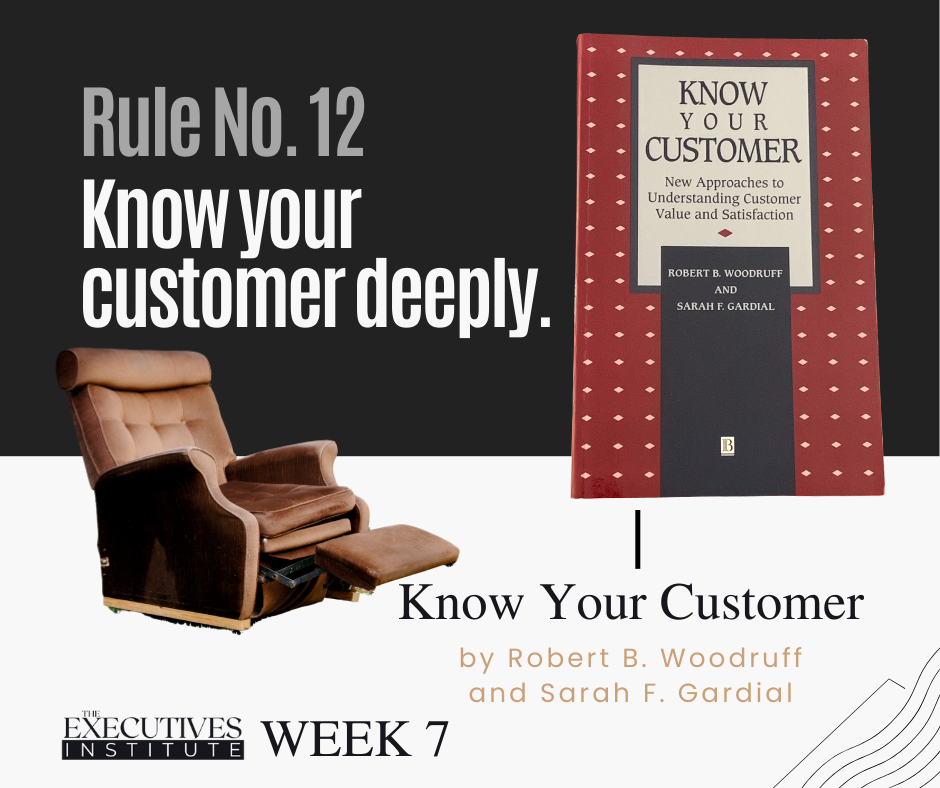
WEEK 7 | Recommended Reading —
Know Your Customer by Robert Woodruff
“The greatest mistake in business is assuming you already understand the customer. Real understanding comes not from data, but from dialogue.” — Robert Woodruff
📘Book Summary
Know Your Customer is a no-nonsense guide to building stronger, smarter businesses by deeply understanding the people you serve. Robert Woodruff strips away the fluff and emphasizes that real competitive advantage doesn’t come from products or pricing — it comes from insight.
The book walks readers through practical ways to uncover customer motivations, identify unspoken needs, and build systems that prioritize listening over assumptions. It’s a call to stop generalizing and start observing, interviewing, and engaging. The takeaway is clear: if you know your customer better than anyone else, you can serve them better than anyone else — and win because of it.
Key Executive Takeaway
If you’re not talking directly to your customers, you’re not leading — you’re guessing. Woodruff’s core message is blunt: insight doesn’t live in spreadsheets. It lives in the conversations most executives avoid. The companies that win are the ones whose leaders get out of the boardroom, get close to the customer, and stay relentlessly curious about what those customers value, fear, and struggle with. Know them better than anyone else, and you’ll serve them better than anyone else.
Subscribe to The Executives Institute YouTube Channel