
Rule No. 25 summary:
The quality of your outcomes is directly tied to the quality of your questions.
Leaders who ask better questions don’t just get better answers —they uncover blind spots, surface assumptions, and spark clearer thinking in themselves and others.
What’s the real question you’re not asking?
Most leaders can point to a moment where a better question would’ve changed everything—before the bad hire, the stalled strategy, the missed opportunity. This is where you tell the truth about those moments.
Where did you move too fast and fail to ask? What question finally forced clarity—or exposed what no one wanted to see? Share the turning point, not the polished version. That’s where the real value is.
If you’ve fought battles that became lessons — this is where we collect them.
The insight you share might be the turning point someone else is waiting for.
 Write this down…
The quality of your answers will never exceed the quality of your questions.
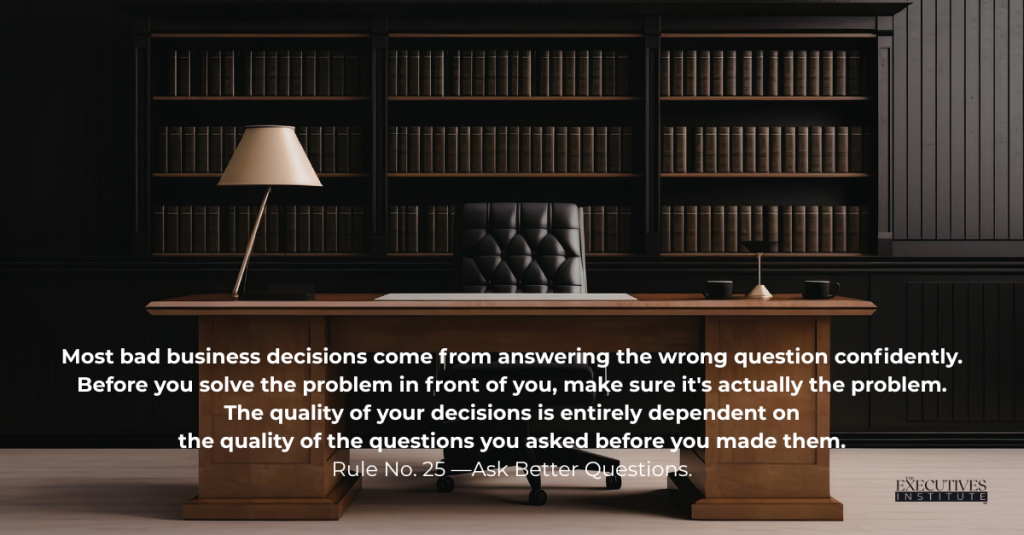
STUDY 📌 Rule No. 25 —Ask Better Questions.
—The Skill Most Leaders Undervalue
The quality of your decisions depends heavily on the quality of the questions that preceded them.
Ask better questions is one of The Executives Institute’s core principles because most leaders are trained to answer —not to think.
That sounds a little harsh, but it’s very true. From early in their careers, high performers are rewarded for decisiveness, speed, and having the solution. Over time, that habit becomes a liability. They stop questioning assumptions, stop challenging direction, and start operating inside problems that were never clearly defined in the first place.
This rule earns its place in the first 50 because it sits upstream of everything else. Strategy, innovation, culture, execution—they all depend on whether you’re asking the right questions at the right time.
Organizations that separate themselves move faster —but they also pause long enough to ask, Are we still solving the right problem? They challenge what everyone else accepts and create space for uncomfortable questions that expose blind spots before they become costly mistakes.
“Great answers start with uncomfortable questions.”
In a room full of smart people, the one who asks the right question often holds more power than the one who rushes to offer the right answer. Yet in business, we tend to glorify speed over depth. The problem with this is that shallow questions produce shallow thinking —and predictable results.
Great leaders know that progress begins with curiosity, not with certainty. By learning to ask better questions, we unlock clarity, challenge assumptions, and open the door to smarter strategies and stronger teams.
The discipline is to ask questions with genuine curiosity rather than as a rhetorical device —not to lead the room to the conclusion you’ve already reached, but to actually explore what you don’t yet know. It is a simple instruction with significant implications for leadership style, team culture, and decision quality. The leader who asks the right question at the right moment is often more valuable than the one who has all the answers.
Ignore this rule, and you’ll stay busy solving the wrong things.
Apply it, and you change the trajectory of decisions before they’re made.

Here are three clear warning signs that an organization is ignoring this Rule:
⚠️ Meetings are filled with updates, not inquiry
If your leadership meetings sound like a series of reports with little challenge or pushback, you’ve got a problem. Information is being shared, but not examined. No one is pressing deeper, and weak assumptions are slipping through untouched.
⚠️ The same problems keep resurfacing
When issues keep coming back in different forms, it’s a sign you’re treating symptoms instead of causes. That usually traces back to poor questioning—no one stopped to ask what’s really driving the problem in the first place.
⚠️Decisions are made quickly—and quietly
Speed can look like strength, but if decisions aren’t being tested with hard questions, it’s just unchecked momentum. When people hesitate to question direction—or feel it’s unwelcome—you lose the friction that sharpens thinking.
If any of these feel familiar, the issue isn’t capability—it’s discipline. Better questions aren’t a personality trait; they’re a standard.

👥 Leadership Team Discussion
In your leadership meetings, are you creating space for real questions—or just confirming decisions that have already been made?
Explore whether your culture encourages curiosity and challenge, or quietly rewards agreement.
What would change if better questions—not faster answers—became the standard?
Follow-Up Question:
When was the last time a tough, uncomfortable question in your organization actually changed the direction of a project or decision—and what made that moment possible?
Examples of “better questions”
💬 What’s the real question we’re not asking?
Too often, we rush to answer the first problem that shows up. This question forces a pause and invites deeper diagnosis before acting.
💬 If we started from scratch today, what would we do differently?
A powerful reset question. Helps expose legacy systems, outdated assumptions, or bloated processes that persist simply because they always have.
💬What would have to be true for this idea to work?
Rather than instantly judging an idea, this shifts the conversation to possibility and planning, not default skepticism.
💬 What problem are we trying to solve—and for whom?
Re-grounds the team in purpose. If you can’t answer this clearly, you’re probably solving the wrong thing for the wrong person.
💬 Where are we mistaking answers for understanding?
Many leaders nod along to metrics, dashboards, or surface-level updates—but rarely interrogate what’s underneath. This question invites deeper insight.

Contrarian View for Debate
At some point, better questions become a crutch. Execution—not inquiry—is what actually drives results.
You can question everything to death. Endless curiosity can stall decisions, dilute accountability, and give the illusion of progress without any real movement. Strong organizations don’t just ask better questions—they know when to stop asking and start committing.
So here’s the tension worth debating:
Are we under-questioning… or are we hiding behind questions to avoid making hard decisions?

Ask Yourself
Am I leading my team toward better answers—or am I limiting them by asking small, safe questions?
Action Step
In your next leadership meeting, replace one agenda item with a single, open-ended question. Don’t answer it immediately—let the group wrestle with it. Measure the quality of the conversation, not the speed of the conclusion.
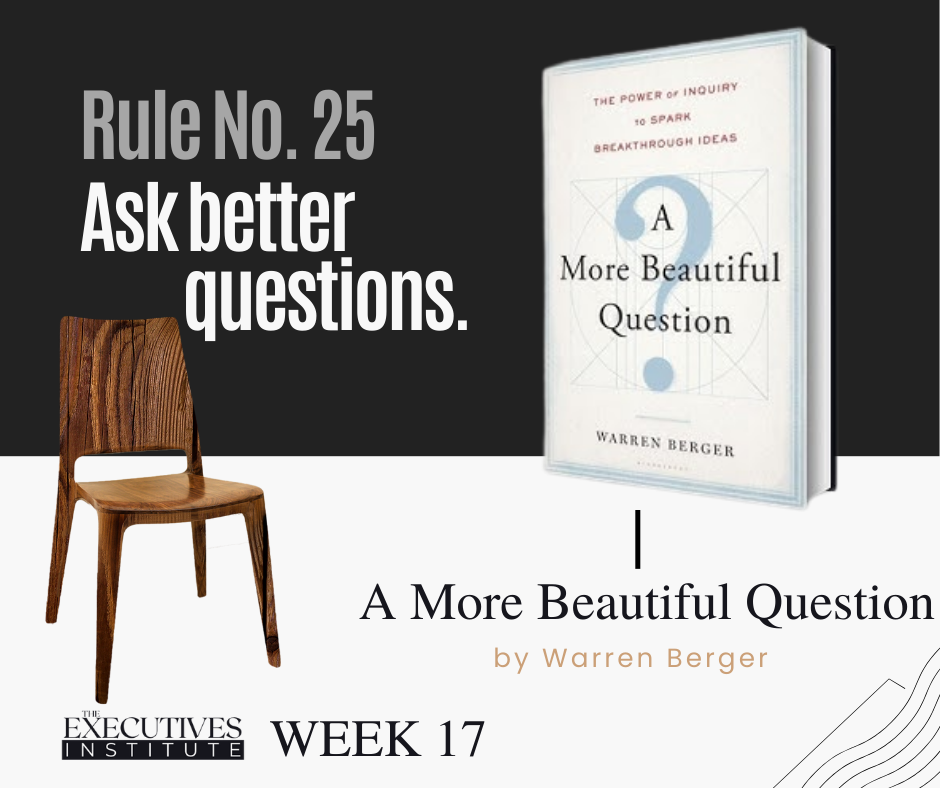
📚 Recommended Reading
A More Beautiful Question
by Warren Berger
“The ability to ask beautiful questions — profound, ambitious questions that can shift the way we perceive or think about something — is one of the most powerful forces for change.”
📘 Book Summary
Warren Berger makes a simple but disruptive case: the leaders who win aren’t the ones with the fastest answers, but the ones who ask the kinds of questions that reframe problems, challenge assumptions, and spark innovation. Through examples from business, education, and entrepreneurship, the book shows how powerful questions move organizations from stagnation to possibility. Berger breaks questioning into a disciplined cycle—Why? What if? How?—and shows how leaders can use this process to break through rigidity, reveal opportunity, and push their teams to think more boldly.
🔑 Key Executive Takeaway
If you want better results, stop demanding better answers and start demanding better questions. A leader’s job isn’t to have all the solutions—it’s to create an environment where the right questions surface and shape the path forward.
 This Rule isn’t finished—and it never will be. Business changes, leaders learn, and our Members keep sharpening the edges with real stories and hard-won lessons. What you see here is today’s version. Tomorrow’s will be better, clearer, and backed by more lived experience.
Thank you for being here and bringing your perspective—add your insight, share a story, or challenge what’s written. Together, we keep these Rules alive and relevant