

Rule No. 5 summary
Focus beats frenzy. Spread too thin, you risk mediocrity everywhere. Bold, deliberate moves—rooted in strategy, not reaction—create real advantage. Commit to fewer initiatives, but back them fully. Win where it matters.
Playing to win means saying no more often than yes. If you’re serious about real results, it’s time to make fewer, bolder moves—and stand behind them.
If your strategy doesn’t scare anyone on your team, it’s not a strategy.
Most organizations don’t fail from a lack of ideas—they fail from a lack of focus. In the name of flexibility, they spread themselves across too many priorities, chasing incremental wins and avoiding hard calls. This rule demands the opposite. It calls leaders to stop hedging and start committing—to fewer initiatives, bigger bets, and clearer strategic choices.
 Write this down…
Most companies lose by making too many safe decisions.
STUDY 📌 Rule No. 5 —Make Fewer, Bolder Moves.
— Why Most Strategic Plans Accomplish Nothing
A strategy that tries to do everything is not a strategy. It is a wish list.
The executives who build great businesses understand that concentrated effort outperforms distributed effort almost every time. One bold move executed with full resource commitment beats five modest moves executed with divided attention.
This requires courage. Selecting fewer priorities exposes you to being wrong about the ones you chose. It is far more comfortable to spread the risk across many bets and explain later that the market simply moved against you.
“Busy isn’t strategic. It’s just loud.”
Our principle at The Executives Institute says it plainly: Make fewer, bolder moves. It is advice that contradicts the instinct of most organizations, and it is precisely why so few follow it.
Discipline in strategy is choosing what you will not do.
Ask yourself…
“What are we doing that looks productive —but isn’t moving the needle?”
“If we could only bet on one initiative this year, what would it be —and why?”
“Where are we spreading ourselves too thin to avoid hard decisions?”

Here are five eye-opening warning signs that signal your organization is ignoring Rule No. 5 —Make Fewer, Bolder Moves. These are the kinds of issues leaders pretend aren’t problems…until they’ve already cost them years.
⚠️ 1. Everything is labeled a “priority.” When every project is “critical,” none of them are. This is the classic sign of a leadership team that lacks the courage to choose. Busyness replaces strategy.
⚠️ 2. The roadmap keeps expanding, but nothing meaningful gets finished. If initiatives pile up while outcomes stall, you’re not being bold—you’re drifting. A bold move has a finish line. A bloated list is just avoidance dressed up as ambition.
⚠️ 3. Leaders defend pet projects instead of killing them. Old initiatives stick around because no one wants to pull the plug. That’s how companies end up with dozens of half-alive efforts draining energy and morale.
⚠️ 4. Resources are spread so thin that teams are constantly “starting over.” People jump between five projects and make progress on none of them. This is the operational death spiral that comes from refusing to commit.
⚠️ 5. The company talks about “innovation” but only pursues low-risk tweaks. If your boldest move each year is a new feature, a new tagline, or a new flavor, you’re not innovating—you’re decorating. Real strategy requires stakes.

👥 Leadership Team Discussion
“Where are we pretending to have a strategy by spreading ourselves thin—and what are we unwilling to stop?”
Push this hard. Go initiative by initiative. If everything is still justified, you’re not being honest. The goal is to expose the projects that survive out of comfort, politics, or habit—not impact.
Team Action Step
List every active initiative on one page. Force-rank them by expected impact on the business over the next 12 months. Draw a hard line—top 1–2 stay fully funded and resourced. Everything else is paused, cut, or clearly deprioritized by end of week.
No hedging. If it’s still “kind of active,” you didn’t follow the rule.
Additional Takeaway Questions
- “What are we currently doing that we know wouldn’t make the cut if we were starting from scratch today?”
If it wouldn’t earn its way onto a clean slate, it doesn’t deserve to stay. - “Where are we choosing comfort over conviction?”
Identify the initiatives you’re keeping alive to avoid conflict, not because they win.
🛠️ Follow-Up for the Next Meeting
Come back in two weeks with a clear, uncomfortable report:
- What did we actually stop—not discuss, not delay, but shut down?
- Where did we reallocate time, budget, and people to our top 1–2 priorities?
- What resistance showed up—and who pushed back?
If nothing meaningful was cut or reallocated, call it what it is: the rule wasn’t applied.

Contrarian View for Debate
“In a volatile market, making fewer, bolder moves can be reckless—diversifying across many smaller bets is the smarter path.”
Push the team to wrestle with it:
Are we calling something “bold” when it’s actually just concentrated risk?
Or are we hiding behind diversification to avoid making a real strategic commitment?

A mid-sized regional healthcare provider had no shortage of ideas—new service lines, expanded locations, community programs, digital tools, partnerships. On paper, it looked ambitious. In reality, it was scattered.
Leadership was juggling 12+ active initiatives. None were failing outright, but none were winning either. Growth plateaued. Margins tightened. Teams were stretched thin and constantly shifting priorities. Every department could justify their projects, so nothing got cut.
The breaking point came during a budget review. Despite increased spending, there was no meaningful change in patient growth or market position. That’s when leadership finally asked the harder question: What are we actually trying to win at?
They stepped back and made a call most teams avoid.
They shut down or paused over half of their active initiatives—including a planned expansion and two underperforming service lines. It wasn’t popular. But it was necessary.
They chose one clear strategic move: dominate outpatient orthopedic care in their region. That meant doubling down on specialized staff, marketing, referral partnerships, and patient experience in that one area.
Everything else became secondary.
Within 12 months, the shift was clear.
Green Flags —Signs They’re Now on the Right Track
✅ Clear Strategic Narrative: Every leader, manager, and frontline employee could articulate the same focus—no confusion, no competing priorities.
✅ Resource Concentration: Budget, talent, and time were visibly aligned behind the orthopedic initiative—not diluted across side efforts.
✅ Measurable Market Impact: Referral volume and patient demand in their chosen area increased significantly, outpacing competitors.
✅ Faster Execution: Decisions sped up because fewer initiatives meant less friction and fewer trade-offs.
✅ Confident Decision-Making: Leadership became more decisive—killing ideas earlier and backing winning ones more aggressively.
📈Actionable Strategies
Here are five practical ways to actually live Rule No. 5 — not just talk about it once a year and forget it:
1. Enforce a Hard Initiative Cap
Set a non-negotiable limit (e.g., no more than 3 enterprise priorities at a time).
If something new comes in, something else comes out. No exceptions.
2. Run a Quarterly “Kill List” Review
Every quarter, require leaders to identify what should be stopped—not added.
Make killing initiatives a leadership expectation, not a failure.
3. Tie Resources to Priorities—Publicly
Publish where time, budget, and top talent are going.
If resources don’t clearly reflect priorities, your strategy isn’t real.
4. Force Single-Threaded Ownership
Each major initiative has one accountable leader—not a committee.
If everyone owns it, no one owns it. Bold moves need clear accountability.
5. Measure Fewer Things, More Rigorously
Stop tracking dozens of metrics. Identify the 2–3 that define success for each priority—and review them relentlessly.
What gets measured narrowly gets executed deeply.
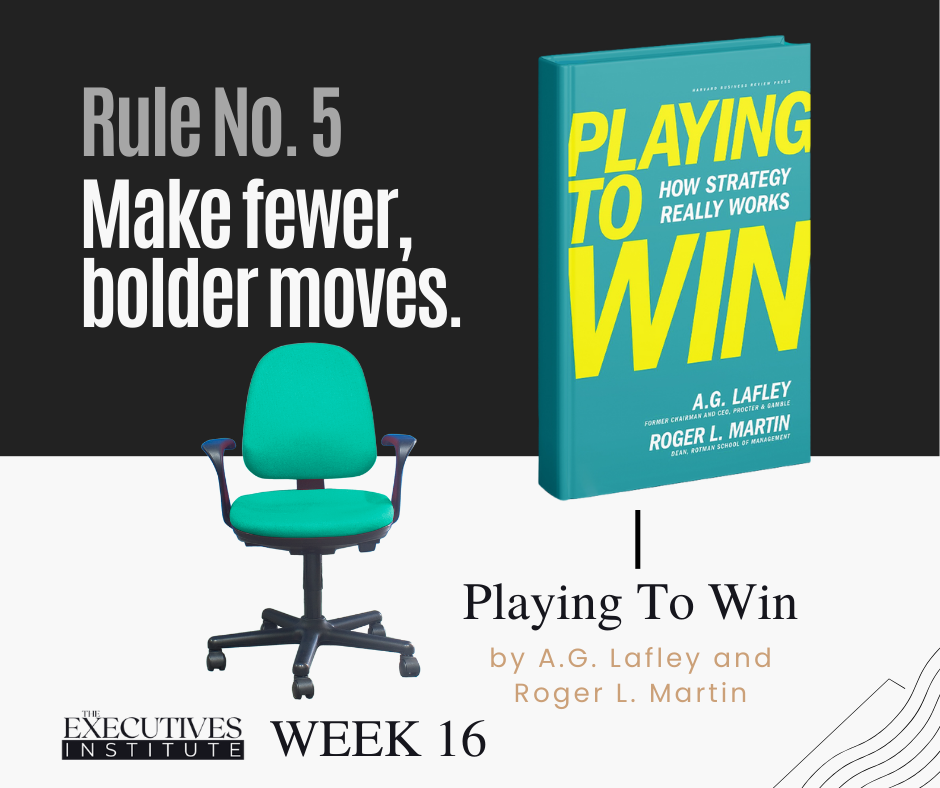
📚 Recommended Reading
Playing To Win
by A.G. Lafley and Roger L. Martin
“Strategy is about making specific choices to win in the marketplace. It requires making explicit choices—to do some things and not others—and building a business around those choices.”
A strategy that tries to do everything isn’t a strategy. Your advantage comes from saying no —from choosing the markets you’ll dominate, the customers you’ll serve, and the moves you’ll make at the expense of all others. Bold focus beats timid breadth every time.
📘 Executive Book Summary
Playing to Win
A.G. Lafley & Roger L. Martin
This book strips strategy back to its essentials: winning requires choice. Lafley and Martin lay out a practical, repeatable framework built on five questions—
- What is our winning aspiration?
- Where will we play?
- How will we win?
- What capabilities do we need?
- What management systems support them?
Drawing from Lafley’s turnaround of Procter & Gamble, the book shows how disciplined, courageous choices—not broad ambition or scattered activity—create real competitive advantage. It’s a blueprint for leaders who want strategy that actually drives action, not slideshows.
Most executives think they have a strategy. They don’t. They have a list of goals dressed up in a deck. Strategy is not about aspiration — it’s about choice. Specifically, five brutally honest choices that most leaders are too scared to make. Lafley ran P&G and doubled its profits. Martin is one of the sharpest strategic minds alive. Together they’ve written the clearest playbook on what strategy actually is — and isn’t.
The Winning Choice Cascade:
1 Winning aspiration | What does winning look like — not just “doing well”?
2 Where to play | Which markets, customers, and channels are you in — and not in?
3 How to win | What’s your real competitive advantage in that space?
4 Core capabilities | What must you be world-class at to win where you’ve chosen?
5 Management systems | What processes and measures reinforce those capabilities daily?
Key takeaways:
Playing not to lose is a losing strategy. | The instinct to hedge, diversify, and keep all options open feels prudent. It isn’t. It’s cowardice dressed as caution. Lafley and Martin are blunt: strategy demands commitment to a specific choice to win in a specific arena. If you’re trying to be everything to everyone, you’re nothing to anyone.
“Where to play” is your single most important decision. | Before you talk about how to win, you need to be ruthlessly honest about where you’re competing. Geography. Customer segment. Price point. Channel. Most failing businesses aren’t losing because of bad execution — they’re on the wrong field entirely. Choosing where NOT to play is just as strategic as where you do.
Competitive advantage means something specific. | Either you win on cost — you genuinely deliver the same thing cheaper than anyone else — or you win on differentiation — customers value what you do enough to pay more for it. That’s it. If your “how to win” answer is vague (“great service,” “quality products”), you don’t have a strategy. You have a wish.
The five choices must reinforce each other. | A winning strategy isn’t five independent answers — it’s a cascade where each choice supports the next. If your capabilities don’t match where you’re playing, you’ll get outmaneuvered. If your systems don’t reinforce your capabilities, they’ll decay. Incoherence between layers is the silent killer of most business strategies.
Strategy is for every level of the business. | This is one most CEOs miss. The cascade isn’t just a boardroom exercise. Every business unit, every function, every product team needs its own set of these five choices — aligned to the ones above it. If your marketing director can’t answer where they play and how they win, you don’t have a strategy. You have a headquarters document no one uses.
Strategy is a hypothesis — test it constantly. | Lafley doesn’t pretend P&G had a crystal ball. Strategy is a bet. Make it explicit, then build in the mechanisms to know when your assumptions are wrong. Leaders who treat their strategy as settled gospel don’t adapt. Leaders who treat it as a living hypothesis do. Bet boldly, but watch the evidence.
Mentor’s verdict:
Read this book once and you’ll never sit through another strategy offsite the same way. You’ll hear the weasel words — the vague aspirations, the refusal to choose, the comfort in “exploring opportunities.” This book gives you the language and the backbone to cut through all of it. If you only internalize one thing: real strategy makes choices that rule things out. If your strategy doesn’t scare anyone on your team, it’s not a strategy.
There it is. The core argument of the book in plain terms: most executives confuse activity with strategy and goals with choices. Lafley and Martin’s great contribution is making that distinction impossible to ignore.
A few things worth sitting with after you read it:
The “where not to play” question is harder than it looks. In practice, saying no to a market, a customer segment, or a channel means leaving money on the table in the short term. Most leadership teams won’t do it unless someone at the top holds the line. That’s your job.
The cascade test. Try walking your leadership team through all five questions cold, without prep. If the answers are inconsistent across the room — or between layers of the business — that’s not a communication problem. That’s a strategy problem.
Pair it with Rule #3 (Differentiate or die — Blue Ocean Strategy). Lafley tells you how to build the strategic logic; Kim and Mauborgne push you to find an arena where the competition is irrelevant. Together they’re a formidable one-two.
 This Rule isn’t finished—and it never will be. Business changes, leaders learn, and our Members keep sharpening the edges with real stories and hard-won lessons. What you see here is today’s version. Tomorrow’s will be better, clearer, and backed by more lived experience.
Thank you for being here and bringing your perspective—add your insight, share a story, or challenge what’s written. Together, we keep these Rules alive and relevant.