

Rule No. 3 summary:
If your business blends in, it’s already falling behind.
In crowded markets, blending in is a slow death. The only way to lead—not just survive—is to break away from the pack by creating clear, compelling differentiation. This isn’t about being slightly better. It’s about being meaningfully different in a way that customers recognize, value, and talk about.
Most businesses don’t fail because they’re bad. They fail because they’re forgettable. It’s not about being louder. It’s about being unmistakably valuable.
Every leader reaches a moment when the old playbook stops working—when blending in becomes more dangerous than standing apart. Differentiation rarely happens by accident; it usually follows a hard lesson, a bold decision, or a turning point in the business. Use the questions below to share a moment when your company chose to stand out instead of blend in. Your experience may be the insight another leader needs to hear.
- When did you first realize your company was blending in with the competition? What forced you to change?
- What decision or shift most clearly separated your company from the pack? Was it a product change, a service model, a niche focus, or something else entirely?
- What did you intentionally stop doing in order to stand out? Real differentiation often requires saying no. What did you walk away from that others in your industry still chase?
- When did a customer first recognize your difference—and how did that moment confirm you were on the right path? Tell the story of the first time someone clearly articulated what made your company unique.
- Looking back, what advice would you give another leader whose business is stuck competing in a crowded, undifferentiated market? What hard truth do they need to hear before it’s too late?
 Write this down…
If you sound like everyone else, customers will treat you like everyone else.
STUDY 📌 Rule No. 3 —Differentiate or Die.
— The Market You’re Ignoring
Competition is expensive. Most businesses choose it anyway.
Walk into almost any industry and you’ll find the same pattern: companies watching each other, matching each other’s pricing, copying each other’s features, and grinding against each other for incremental share in a market where nobody is winning cleanly.
If customers can’t explain why you’re different, you aren’t.
In their book, Blue Ocean Strategy, W. Chan Kim and Renée Mauborgne called this the red ocean — a space so crowded and competitive that margins bleed out and growth becomes a war of attrition.
The alternative isn’t easy, but it is simple: find the space where you are not competing with anyone at all. Create value in a way that makes comparison difficult. Build something specific enough that a particular customer says, ‘That was built for me.’
“Competing on price is the business version of a clearance rack.”
Differentiation is not a marketing exercise. It is a strategic choice that has to be made at the level of product, service, culture, and business model.
This is what Differentiate or die means inside The Executives Institute. Not ‘be different for the sake of it.’ Be meaningfully different in ways that matter to the people you intend to serve. Why: Because, if you look like everyone else, you’ll be commoditized.
The graveyard of businesses is full of companies that were good enough. Good enough does not survive.

Here are a few warning signs, “red flags” that suggest your company is not differentiating —enough.
🚩 You’re constantly competing on price. You’re stuck in a pricing race to the bottom. When price becomes your main lever to win or retain business, it’s a clear signal that customers don’t see a meaningful difference in your value.
🚩 Your innovation efforts are focused on matching, not leading. When internal conversations revolve around keeping up with competitors instead of creating new value, you’re following, not leading.
🚩 Your customers struggle to explain what makes you unique. Your customers confuse you with competitors. If your loyal clients can’t clearly articulate why they choose you—or worse, they hesitate when asked—your differentiation isn’t clear or compelling.
🚩 Your growth stalls in mature, existing markets. Plateaus often come from overreliance on the same playbook. If growth is flat but leadership keeps tweaking instead of reimagining, you’re stuck in a red ocean and need a new strategy.
🚩 Your marketing sounds like everyone else’s. You feel like your messaging isn’t landing. If your website, tagline, or sales pitch could be swapped with a competitor’s and no one would notice—you’re not differentiated, you’re generic.
🚩 Your sales team is hearing “we’ll think about it” too often

💬 Leadership Team Discussion
This question forces a brutally honest assessment of your company’s unique value—or lack of it. It cuts through internal bias and invites a clearer view of how the market sees you.
Discuss with your leadership team:
If we disappeared tomorrow, what would our best customers truly miss—and what would they replace us with?
Mini-Workshop:
Have each member of your team write down the top 3 reasons customers choose you over the competition.
Compare notes. If the answers are vague, inconsistent, or uninspiring, it’s time to redefine and strengthen your differentiators—before your customers redefine them for you.
Three additional questions for discussion with your leadership team:
Where are we competing by default—rather than by design?
Example: A regional bank mimics the offerings of national chains but wonders why it can’t gain traction. The real issue? It hasn’t intentionally chosen who it wants to be different for—or why.
What do our best customers say makes us different—and are we amplifying it or burying it?
Example: A SaaS company hears again and again that their onboarding support is unmatched, but their marketing still focuses on features instead of what customers actually value.
If our top three competitors disappeared tomorrow, would we still need to exist?
Example: A leadership coaching firm realizes its services are interchangeable with others in the region. It begins redesigning its programs to solve deeper, underserved executive problems no one else is tackling.
Contrarian View
(for healthy debate with your leadership team)…
What if differentiation is overrated—and discipline wins instead?
Not every business needs to stand out to succeed. In many industries, the winners aren’t the most unique—they’re the most reliable, efficient, and consistent. Chasing differentiation can become a distraction, pulling leaders away from operational excellence and into unnecessary complexity. Customers don’t always want something different; often, they just want something that works—every time, at a fair price. In these cases, trying to be “remarkable” can dilute focus, confuse the market, and erode trust.

Debate Question:
Are we overestimating the value of being different—and underestimating the power of being consistently better?

Here’s a scenario…
A local gym was locked in a pricing war with big-box fitness centers.
Rather than race to the bottom, they doubled down on a niche: programs exclusively for busy executives with personalized training and executive-level coaching.
Within a year, their pricing tripled — and so did retention.
They didn’t win by competing.
They won by being incomparable.
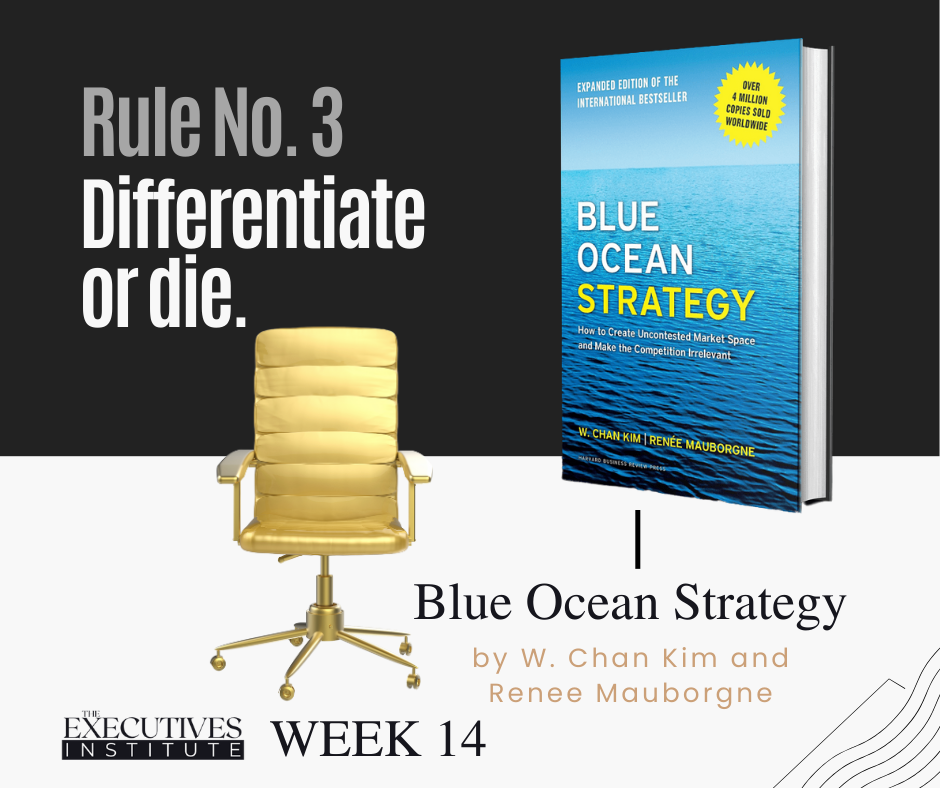
📚 Recommended Reading
Blue Ocean Strategy by W. Chan Kim and Renee Mauborgne
“The only way to beat the competition is to stop trying to beat the competition.”
🔑 Key Executive Takeaway
Winning isn’t about outpacing rivals—it’s about making them irrelevant by creating space only you can own.
📘 Book Summary
This is a powerful read for business owners ready to break free from the status quo and pursue growth through strategic boldness.
The core argument
Most businesses spend their energy fighting over existing customers in shrinking markets — what the authors call “red oceans,” bloodied by competition. Blue Ocean Strategy makes a compelling case for a different path: instead of out-competing rivals, make them irrelevant by creating entirely new market space where you are the only player. The book is built around a deceptively simple idea — that value innovation, not incremental improvement, is the engine of sustained profitable growth.
Red ocean thinking
Compete in existing markets. Beat the competition. Exploit existing demand. Make the value/cost trade-off. Align activities with differentiation OR low cost.
Blue ocean thinking
Create uncontested market space. Make competition irrelevant. Create and capture new demand. Break the value/cost trade-off. Align activities with both differentiation AND low cost.
The ERRC framework
The Four Actions Framework forces executives to rethink every assumption about what the business offers.
Eliminate: Which factors the industry takes for granted should be dropped entirely?
Reduce: Which factors should be brought well below the industry standard?
Raise: Which factors should be raised well above the industry standard?
Create: Which factors should be created that the industry has never offered?
Proven examples
Cirque du Soleil: Eliminated animals and star performers. Created theatrical artistry. New audience who had never been to a circus.
Southwest Airlines: Eliminated meals and seat classes. Raised speed and frequency. Competed against cars, not airlines.
Netflix (back in the day): Eliminated late fees and storefronts. Created convenience at scale. Redefined what a video rental business was.
“The only way to beat the competition is to stop trying to beat the competition.”— Kim & Mauborgne
Key executive takeaways
- Competition is a trap. If your strategy meeting is primarily about what competitors are doing, you are playing defense in someone else’s game. Blue ocean thinking reorients the question: what do non-customers want that no one is offering them yet?
- Value innovation — simultaneously reducing costs while increasing buyer value — is the strategic logic that creates blue oceans. This is not a marketing exercise; it requires ruthless elimination of what customers don’t actually value.
- The ERRC grid is a practical executive tool. Run every product line, service tier, and operational assumption through it annually. What you eliminate often funds what you can create.
- Non-customers are your largest opportunity. The book identifies three tiers of non-customers — soon-to-leave, refusing, and unexplored — and argues that understanding them reveals markets far larger than your current base.
- Strategy canvas visualization exposes whether your business is genuinely differentiated or quietly converging on the competition. If your strategy curve looks like everyone else’s, you are in a red ocean regardless of what your mission statement says.
- Execution is addressed, not ignored. The “tipping point leadership” framework gives executives a roadmap for overcoming the four organizational hurdles — cognitive, resource, motivational, and political — that kill bold strategies before they launch.
- Blue oceans don’t last forever. The book is honest that rivals will eventually follow. The goal is to create enough distance, customer lock-in, and brand equity during the uncontested window to sustain the advantage when competition arrives.
- This is a strategy for business owners, not just large corporations. The framework scales down — a regional service business, a professional practice, or a specialty manufacturer can apply the same logic to redefine its local market.
Competing on features, price, or marginal improvements in saturated markets is a slow bleed—one that leaves companies reactive, worn down, and undifferentiated. “Differentiate or Die” is not a slogan; it’s a survival principle.
The most successful companies don’t just compete better—they compete differently. They define new categories, solve overlooked problems, and make themselves impossible to ignore. This rule calls leaders to stop benchmarking the competition and start creating uncontested space—what Blue Ocean Strategy calls “value innovation.”

Workshop for Rule No. 3: Differentiate or Die
Duration: 45 minutes
Ideal For: Leadership teams, department heads, strategy groups
Incorporates the Executive Discussion Prompt and Ask the Right Questions into a single group exercise.
Workshop Goal 
To help executives identify areas where their company lacks differentiation—and take immediate steps to strengthen their unique value in the market.
Agenda
5 min | Welcome & Framing the Rule
- Briefly introduce Rule No. 3: Differentiate or Die
- Share the key quote: “The only way to beat the competition is to stop trying to beat the competition.” – W. Chan Kim
- Emphasize: This is not about being better. It’s about being different in a way that matters.
10 min. | Group Reflection: Are We Standing Out or Blending In?
Prompt:
- “If we disappeared tomorrow, what would our best customers truly miss—and what would they replace us with?”
Activity:
- Ask each person to write down their answers privately.
- Then, discuss as a group.
- Look for vague, redundant, or mismatched answers.
10 min. | Red Flags Check-in
Review these 5 Red Flags aloud and ask the team to raise hands or vote silently:
- Does our marketing sound like everyone else’s?
- Do we frequently compete on price?
- Do customers struggle to explain what makes us different?
- Are we reacting to competitors instead of leading?
- Has growth stalled with no bold strategy to reignite it?
Discussion: Which of these apply to us? Why?
10 min. | Identify Your Real Edge
Prompt:
- “What do our best customers already value most—but we haven’t leaned into it enough?”
- “Where are we trying to win in a crowded market instead of creating space of our own?”
Activity:
- In pairs or small groups, brainstorm answers.
- Share one powerful insight per group with the room.
5 min. | From Rule to Result: Action Commitments
Prompt:
- “What’s one bold move we can make in the next 30 days to clarify or amplify our differentiation?”
- Encourage ideas that focus on clarity, not complexity.
Examples:
- Rewriting our homepage to speak directly to what makes us different
- Retiring offerings that keep us stuck in commoditized markets
- Launching a customer survey with only differentiation-focused questions
5 min. | Wrap-Up & Closing Challenge
Challenge: Revisit this rule monthly and ask: Have we become more distinct or more diluted?
Reminder: Being different is a choice—and a discipline.
 This Rule isn’t finished—and it never will be. Business changes, leaders learn, and our Members keep sharpening the edges with real stories and hard-won lessons. What you see here is today’s version. Tomorrow’s will be better, clearer, and backed by more lived experience.
Thank you for being here and bringing your perspective—add your insight, share a story, or challenge what’s written. Together, we keep these Rules alive and relevant.