

Rule No. 22 summary:
The strength of your team determines the strength of your business.
Hiring slow means committing to a disciplined process—one that prioritizes fit, capability, and character over speed or convenience. It means refusing to lower the bar just to fill a seat.
Firing fast means addressing misalignment or underperformance decisively before it corrodes culture, morale, or momentum. Tolerating the wrong hire too long is more costly than taking the time to hire the right one.
Right people, right roles, right now—or nothing.
Every executive knows people are the difference—but too many forget that how you hire and when you fire is just as critical as who you hire. Rushed hires to “just fill the seat” lead to long-term dysfunction. And once someone proves they’re the wrong fit, hesitation only makes things worse. This rule demands discipline on the front end and courage on the back end. Great teams don’t happen by accident—they’re built through high standards, tough calls, and a willingness to protect the culture at all costs.
1. Think back to a hire that didn’t work out.
Looking back now, what signals did you see during the hiring process that you ignored—and why did you talk yourself into making the hire anyway?
2. Tell us about a time when you waited too long to let someone go.
What finally forced the decision, and what did that experience teach you about protecting the standard for the rest of the team?
3. On the other side of the coin, tell us about a hire you took your time with that turned out to be exceptional.
What did you do differently in that hiring process—and how did that one person change the trajectory of the team or company?
Ask Yourself —Are we keeping someone on the team right now who I already know doesn’t belong here—if so, what’s stopping me from making the call?
If you’ve fought battles that became lessons — this is where we collect them.
The insight you share might be the turning point someone else is waiting for.
 Write this down..
One wrong hire tolerated too long can undo ten right ones.
📌 STUDY Rule No. 22 —Hire slow, fire fast.
This Rule will help you:
Avoid Costly Misfires: A bad hire isn’t just expensive—it’s contagious. This rule helps you spot red flags earlier and avoid long-term headaches.
Build a Culture of Accountability: When people see you act decisively, they know standards matter—and mediocrity won’t be tolerated.
Improve Talent Acquisition: By slowing down the front end, you improve your ability to find, assess, and secure A-players who actually fit.
Accelerate Recovery: When someone clearly isn’t working out, this rule encourages quick, respectful, and firm action—preventing rot from setting in.
Protect Leadership Bandwidth: A wrong hire drains leaders emotionally and operationally. This rule gives you permission to stop wasting time and move on.
1. Where in my company did we hire someone simply because the pressure to fill the role became unbearable?
When urgency replaces discipline, the wrong hire often follows.
2. Think about the last hire that didn’t work out.
Looking back honestly, what warning signs did we ignore during the hiring process?
3. Do we actually define success before hiring—or are we hoping to “figure it out later”?
If the role isn’t clearly defined, the wrong person can still appear right.
4. Is our hiring process designed to impress candidates—or to reveal the truth about them?
The goal of an interview isn’t comfort. It’s clarity.
5. Where are we currently tolerating mediocre performance because replacing the person feels inconvenient?
Tolerance quietly lowers the standard for everyone.
6. If I asked my best employees privately, “Who on this team shouldn’t be here?”—what names would they give me?
High performers notice misalignment long before leaders act on it.
7. When someone clearly isn’t working out, how long do we typically wait before making the call—and why?
Delay is rarely about strategy. It’s usually about discomfort.
8. Do we treat hiring as a critical leadership discipline—or as an HR task to manage?
Great companies treat talent decisions like capital allocation.
9. What does our team learn about our standards when a poor performer stays too long?
Every delayed decision sends a signal about what the organization truly tolerates.
10. If we rebuilt our company from scratch today, which current team members would we hire again without hesitation—and which ones wouldn’t make the cut?
That answer reveals more about leadership courage than any performance review.

Leadership Team Discussion
Hiring is one of the most important decisions a leader makes—and one of the easiest to get wrong. When done well, it propels performance, culture, and trust. When done poorly, it erodes confidence and burns time. Firing fast can feel harsh, but what’s harsher is allowing the wrong person to stay, damaging the very standards your best people rely on.
Discuss with your leadership team:
Think back to our last two hires.
1. What did we get right, and what did we miss?
2. And if someone didn’t work out—did we act fast enough?
Let’s talk about what happens when we don’t.
Are we hiring out of urgency or intentionality?
Example: We’ve had a key role open for 60 days—are we feeling pressure to just “get someone in” rather than “get the right person”?
What patterns do we keep repeating in bad hires?
Example: Do we consistently overlook red flags during interviews? Are we failing to check for culture fit or overemphasizing resumes?
How long does it take us to admit a hiring mistake—and why?
Example: Are we giving too many chances because we feel guilty or hate conflict, even when performance hasn’t improved?
What would improve our hiring batting average immediately?
Example: Would requiring a structured scorecard, adding a behavioral interview phase, or doing reference checks earlier raise the bar?
5 Red Flags you might be ignoring Rule No. 22
You’re hiring to relieve pain, not to pursue excellence.
—Filling a seat because the workload is heavy or the pressure is high usually leads to regret. Desperation clouds judgment.
You talk yourself into candidates instead of out of them.
—If you find yourself making excuses for gaps, behavior, or fit — you already know the answer. Trust your instincts, not your justifications.
Your team has “workarounds” for a poor performer.
—When others quietly adjust to someone’s incompetence or attitude, the damage is already being done.
You’re keeping someone because you “owe them” or “don’t want to hurt them.”
—That’s empathy turned into avoidance. You’re protecting your comfort, not your culture.
There’s no clear, consistent hiring process.
—Every hire is a roll of the dice when you don’t define what a great hire looks like or how you’ll know it when you see it.

WEEK 10 | Action Step —
Before your next hire, create a one-page Hiring Scorecard that defines exactly what success looks like in the role—skills, cultural fit, and measurable outcomes. Share it with your leadership team and commit to not making an offer until a candidate meets the majority of those standards.
This forces clarity and slows down impulse hiring.
10 Actionable Strategies
Hiring Slow (5 Strategies)
1. Write the Role Scorecard Before the Job Description
Before posting a job, define the 3–5 measurable outcomes the role must deliver in the first 12 months. If success isn’t clear, hiring the right person is impossible.
2. Require Multiple Perspectives in Interviews
Never let one leader make the hiring decision alone. Involve at least two additional team members to evaluate culture fit, competence, and communication style.
3. Conduct a Chronological Career Interview
Walk candidates through their entire career—from their first job forward. Patterns appear quickly when you ask what they were hired to do, what they achieved, and why they left.
4. Check References Like an Investigator, Not a Formality
Ask former managers direct questions:
- Would you enthusiastically hire them again?
- What environment do they succeed in—and fail in?
5. Slow Down the Final Decision
Institute a 24-hour rule before extending an offer. Excitement fades quickly when a candidate isn’t the right fit. Discipline prevents emotional hiring.
Firing Fast (5 Strategies)
6. Define a 90-Day Reality Check
Every new hire should have clear expectations for the first 90 days. If the role is already drifting off course, address it immediately rather than “waiting to see.”
7. Address Performance Issues Within 48 Hours
When a problem appears, discuss it right away. Delayed conversations allow poor habits to harden.
8. Watch How the Team Reacts
If top performers avoid working with someone, trust the signal. Culture deterioration often shows up in subtle ways first.
9. Use the “Would I Rehire Them?” Test
Ask yourself a simple question: Knowing what I know now, would I hire this person again today? If the answer is no, the decision is already made.
10. Protect the Team, Not the Individual
When someone clearly doesn’t fit the role or culture, delaying action punishes the entire team. Leaders are responsible for the standard, not the comfort.
WEEK 10 | Recommended Reading —
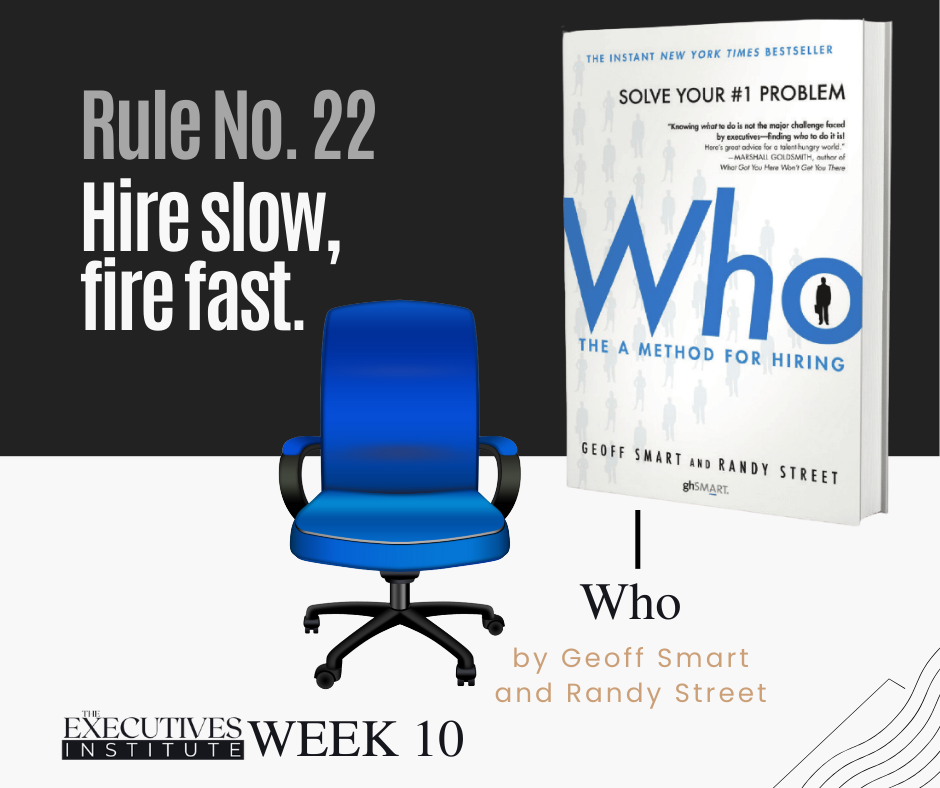
Who by Geoff Smart & Randy Street
“Nothing will accelerate your success more than getting the right team in place. And nothing will derail it faster than keeping the wrong people too long.” — Geoff Smart
📘 Book Summary
Most companies don’t fail because of bad strategy—they fail because of bad hires. Who provides a simple, repeatable system to identify, attract, and select “A Players”—people who consistently deliver results. The authors break hiring into four disciplined steps:
- Scorecard – Define success in the role before interviewing.
- Source – Build a steady pipeline of talent through networks, not job boards.
- Select – Use structured, chronological interviews to uncover patterns of success and failure.
- Sell – Close the right candidates by aligning the role with their motivators.
The book emphasizes clarity over gut instinct, process over personality, and consistency over charisma. It reframes hiring as a skill that can be mastered, not a gamble you hope pays off.
Executive Takeaway
Your biggest competitive advantage isn’t your product, your market, or your strategy—it’s your people. Stop gambling on hiring and start treating it like your most important process. The wrong “who” costs years. The right “who” multiplies results.


This Rule isn’t finished—and it never will be. Business changes, leaders learn, and our Members keep sharpening the edges with real stories and hard-won lessons. What you see here is today’s version. Tomorrow’s will be better, clearer, and backed by more lived experience.
Thank you for being here and bringing your perspective—add your insight, share a story, or challenge what’s written. Together, we keep these Rules alive and relevant.