
The truth is, no one cares if you’ve studied the rules. Not your customers. Not your team. Applying the rules consistently, week after week, is what builds trust in your brand, confidence in your leadership, and momentum in your organization.
This is yourWeeklyEdge: a 50-week entrepreneurial challenge and leadership study of the Rules.
This course can be used in 3 ways:
- independently, at your own pace, in the privacy of your office.
- internally, with your leadership team or a group of trusted advisors.
- over lunch, with a committed and candid group of local executives.
No matter how you choose to study, 50 weeks in a row is tough. Not because the course is complex, but because it demands discipline. We also understand that leaders get busy. Projects become priorities and our attention gets divided. That’s why we intentionally left off the dates. Start anytime. Come back anytime. Just do the work.
This isn’t a calendar, it’s a cirriculum.
yourWeeklyEdge is intentionally not dated. Begin Week 1 whenever you’re ready, and whether you complete one Rule per week or take a break for a month, your next lesson will be waiting for you, right where you left off.
theLEDGER is its printed companion, because writing it down is old school. It forces clarity. Print the pdf for free each week or receive a full printed version with a $100 show of support to The Institute. Each is designed to help you plan, prioritize, and apply the Rules.
Because the best leaders never outgrow the fundamentals, they return to them, year after year, whenever things feel misaligned. We encourage you to revisit the Rules, as your business evolves. Every pass will reveal something new and bring a better understanding of your organization. Over time, a row of completed LEDGERs become a written history of your company and the evolution of your leadership.
✍️ Start with WEEK 1 —Solve a real problem. Each week includes:
- ONE Rule, a fundamental, proven principle of business, along with a recommended read.
- ONE Ask Yourself question, for inner-dialogue or group discussion.
- ONE Actionable Strategy, to help move this Rule into consistent practice (This Week’s Edge)
Each week’s lesson requires just a few, focused minutes per day. However, if you want a deeper dive, click Master this Rule at the end of each lesson for additional questions, workshops and the opportunity to Add your Insights to The Executives Institute Archive.
- Prioritize 2 specific actions each day to move the needle.
- Take notes, ask questions and document what you learn.
- Do this for 50 weeks and you will have a significant advantage over your competion. This is your edge.
Table of Contents
PART I • FOUNDATION
Develop the habits every successful business is built upon.
- Week 1 — Solve a Real Problem
- Week 2 — Fall in Love with the Problem, Not the Solution
- Week 3 — Your First Idea Is Rarely Your Best
- Week 4 — Never Stop Learning
- Week 5 — Work on your business, not just in it
- Week 6 — Your brand is your promise
- Week 7 — Know your customer deeply
- Week 8 — Your calendar reflects your priorities
- Week 9 — Clarity creates confidence
- Week 10 — Hire slow, fire fast
PART II • DISCOVER
Build a company with direction and discipline.
- Week 11 — Own your mistakes
- Week 12 — Delegate outcomes, not tasks
- Week 13 — People over processes
- Week 14 — Differentiate or die
- Week 15 — Play the long game
- Week 16 — Make fewer, bolder moves
- Week 17 — Ask better questions
- Week 18 — Define it. Measure it. Achieve it.
- Week 19 — Momentum beats motivation
- Week 20 — Don’t mistake movement for progress
PART III • PRACTICE
Build systems and teams that thrive without constant intervention.
- Week 21 — Focus beats multitasking
- Week 22 — Do the hard things first
- Week 23 — Learn by doing
- Week 24 — Know when to let go
- Week 25 — Feedback is a gift
- Week 26 — Stop doing what doesn’t work
- Week 27 — If you’re going to eat shit, don’t nibble
- Week 28 — Simplicity scales
- Week 29 — Don’t scale chaos
- Week 30 — Build a business that runs without you
PART IV • CONTRIBUTE
Execute with clarity and accountability.
- Week 31 — Processes protect your time
- Week 32 — Know your numbers
- Week 33 — Cash flow is king
- Week 34 — Build once, sell forever
- Week 35 — Sell the vision, not just the product
- Week 36 — Great businesses outlive great products
- Week 37 — Raise the bar, then raise it again
- Week 38 — Don’t outgrow your values
- Week 39 — Time is your most precious asset
- Week 40 — Speed matters
PART V • PRESERVE
Lead with character. Build with integrity. Leave something worth preserving.
- Week 41 — Protect your downside
- Week 42 — Your network is your net worth
- Week 43 — Profit is not a dirty word
- Week 44 — The bottleneck is at the top
- Week 45 — Reputation compounds
- Week 46 — Own your edge
- Week 47 — Build trust before selling
- Week 48 — Run your race
- Week 49 — Protect your mental bandwidth
- Week 50 — Give more than you take

Hi, Kurt McSparron, founder of The Executives Institute, and after having repeatedly broken and ignored every single one of these rules throughout my 40 year career, I finally decided to get some help compiling them into a somewhat organized fashion. To be clear, I did not write these rules. I’ve had them shouted at me, whispered to me, and suggested to me as “let me give you a piece of advice young man” from 100s of bosses and business leaders across America. With your help, we’ll keep building the list, because yourWeeklyEdge isn’t a system we perfected, it’s a system we’re still practicing.
It doesn’t have to be lonely at the top.
SAVE THE DATE: Monday, January 4, 2027 💬 JOIN THE CONVERSATION.
If you’re studying yourWeeklyEdge privately and could benefit from some accountability and candid discussion, join me on LinkedIn and/or follow The Institute’s LinkedIn page. We will begin our first full year of operation, WEEK 1, January 4th around 8am EST and discuss each week in the order listed below. Connect anytime.
yourWeeklyEdge  — WEEK 1
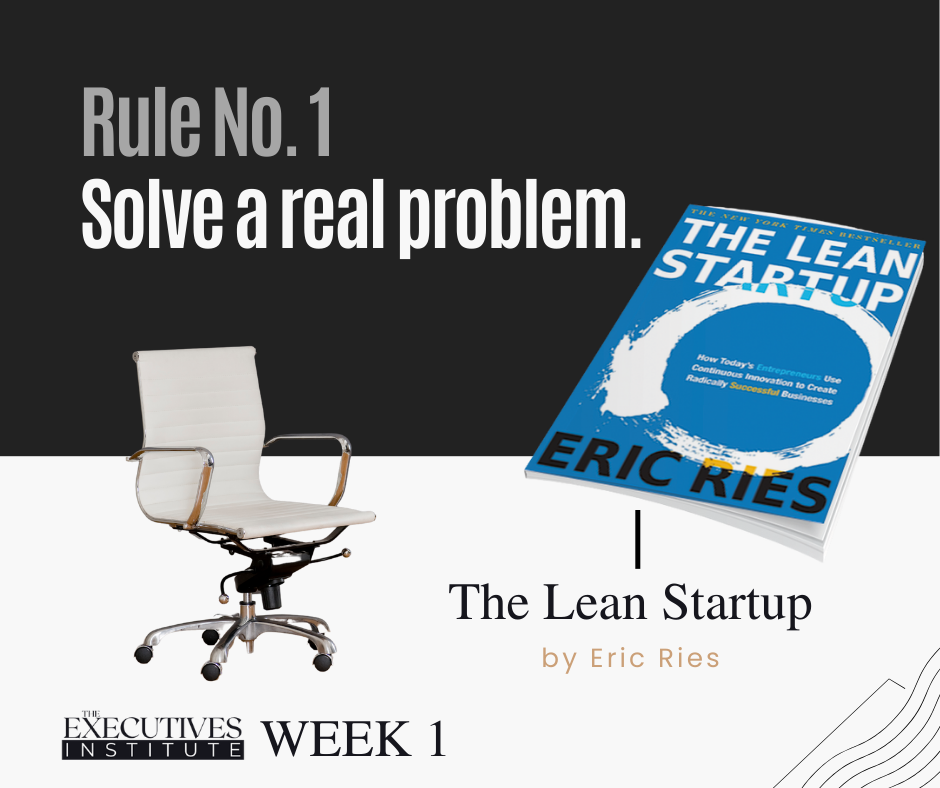
📌 Rule No. 1 —Solve a real problem.
Any business that is going to last, begins here: Identify the problem your customers can’t ignore, and prove that your solution matters. If you can’t do that, nothing else you build is going to matter.
The first question every business has to answer; Ask Yourself: 🔍 What problem does our business truly solve?
The most successful businesses I’ve studied are built on a simple truth: someone had a genuine problem, and the founders refused to lose focus until they understood it completely. Are you solving a problem your customers can actually feel? For enduring success, it must be something that costs them time, money, stress, risk, or reputation? Because if the problem isn’t real to them, it doesn’t matter how polished your solution is.
Rule No. 1 summary: If your solution (your product, service or strategy) isn’t solving a real problem for a real person, it’s just a vanity project, not a business. Smart founders start with the pain. Painkillers outperform vitamins every time. Rule No. 1 is where you have to begin: Identify the problem your customers can’t ignore —and prove that your solution matters more than anyone else’s.
✍️ This Week’s Edge: Draft your “Core Problem Statement”.

Professionally printed hardcover versions of theLEDGER will be available Q4 2026, with a $100 contribution to The Institute. It’s being designed to stay on your desk for a year and on your bookshelf for a lifetime, as a lasting record of growth and a reflection of your leadership. It will also make a very cool gift for a young entrepreneur!
yourWeeklyEdge — WEEK 2
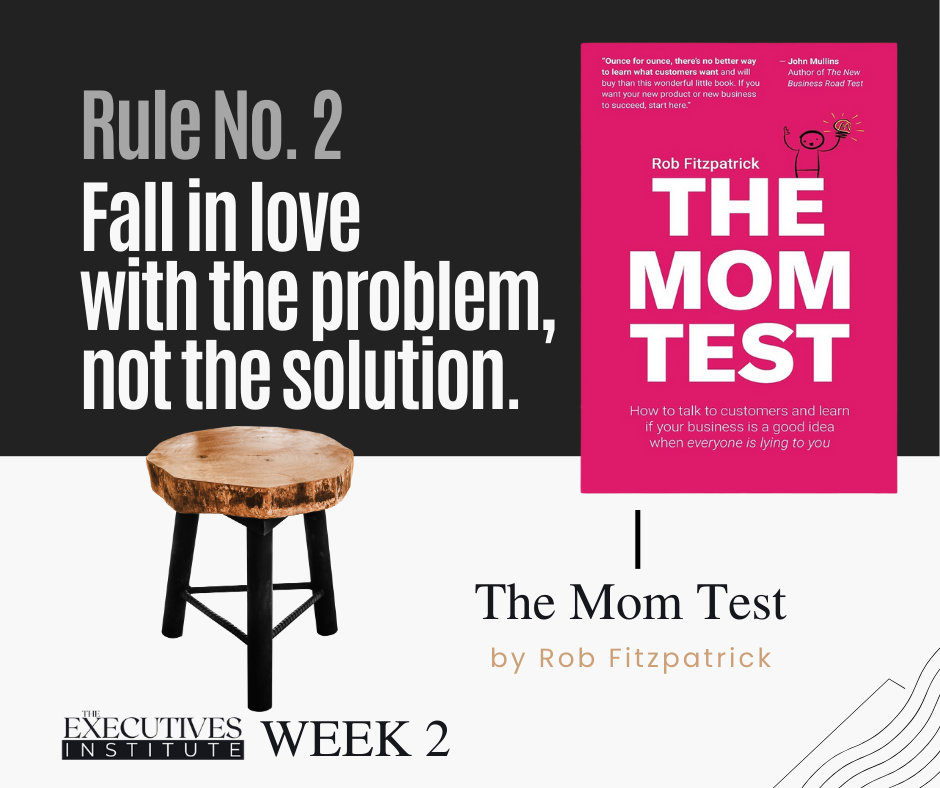
📌 Rule No. 2 —Fall in love with the problem, not the solution.
Now that we’ve identified your customer’s real problem, I’m going to challenge you with this question (one that requires a little ego check)…
🔍 Ask Yourself: Are we actually solving our customer’s real need, or are we continually defending our solution?
This is a trap that many founders fall into. Often times, the smarter the founder, the more dangerous the trap. Intelligent people are excellent at building compelling arguments. They can rationalize a product direction with logic that sounds airtight. They can explain why the market needs what they’ve built. They can find evidence to support almost any conclusion they’ve already reached. This is exactly the problem. As business owners, we don’t get paid for being right about our ideas, we get paid for solving problems that matter. First, you commit to solving something real. Then you guard yourself against ego. Rule No. 2 keeps you customer-centered, meaning it forces you to keep listening, keep validating, and stay willing to pivot, no matter how much you’ve already invested. Remember, solutions change —the problem worth solving rarely does.
Rule No. 2 summary: Solutions come and go, but a deep understanding of the real problem creates lasting value. Focus on the true needs and challenges of your customers (not your preconceived ideas). By anchoring yourself to the problem, you remain flexible, innovative, and better positioned to deliver meaningful solutions. This is near the top, again, because it keeps you customer-centered, not ego-driven.
✍️ This Week’s Edge: Spend the week Learning Instead of Pitching.

yourWeeklyEdge — WEEK 3
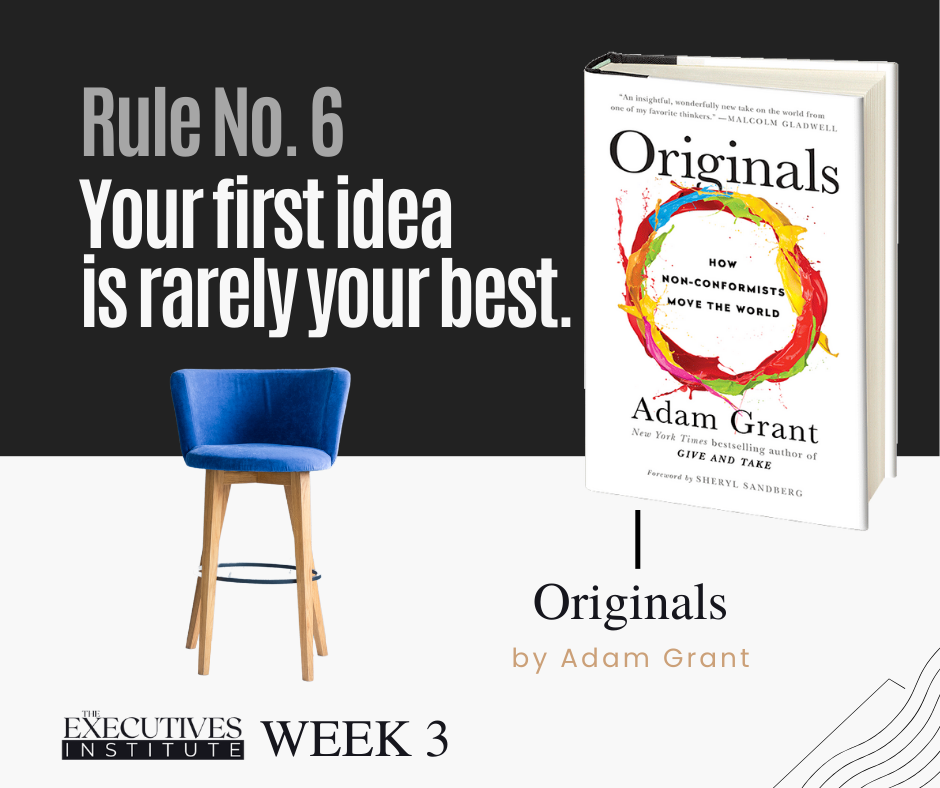
📌 Rule No. 6 —Your first idea is rarely your best.
In business, there will always be enormous pressure to decide quickly and execute. “Speed is a virtue” they’ll tell you. It is, but speed applied to the wrong idea simply compounds the mistake. Your real strength, as the leader of your team, is having the discipline to pause and ask, “What else?” Not because you’re indecisive, but because the stakes are too high to build on the obvious. Because you’re the leader, people will rally around the first idea you voice. If you don’t intentionally open the door for second and third opinions and options, no one else will.
🔍 Ask Yourself: In our organization, are decisions being made too quickly, built on the first idea that hits the table?
The first idea is usually the most obvious one, that’s why it’s the most dangerous —everyone else has had it too. This week isn’t about slowing down your business. It’s about sharpening it. Here’s the advice: treat your first idea like a rough draft, not a decision. Write it down, set it aside, and force yourself to come back with two more approaches. The discipline we build in comparing ideas is where our better judgment is built. The first idea usually wins because it’s convenient, not because it’s necessarily the best one. It sounds decisive. It feels productive. Everyone nods, and you move on it. Remind your team that speed can be a mask of shallow thinking. Stop. Think deeper.
Rule No. 6 summary: The most original thinkers don’t settle for their first solution —they generate many. The best idea often emerges later in the creative process, after your initial concepts have been tested, challenged, or discarded, Persistence and revision usually lead to better solutions. Quantity breeds quality when you’re willing to rethink, revise, and persist beyond the obvious.
✍️ This Week’s Edge: Challenge the First Answer.

“We must all suffer from one of two pains: the pain of discipline or the pain of regret.” – Jim Rohn | jimrohn.com
yourWeeklyEdge — WEEK 4
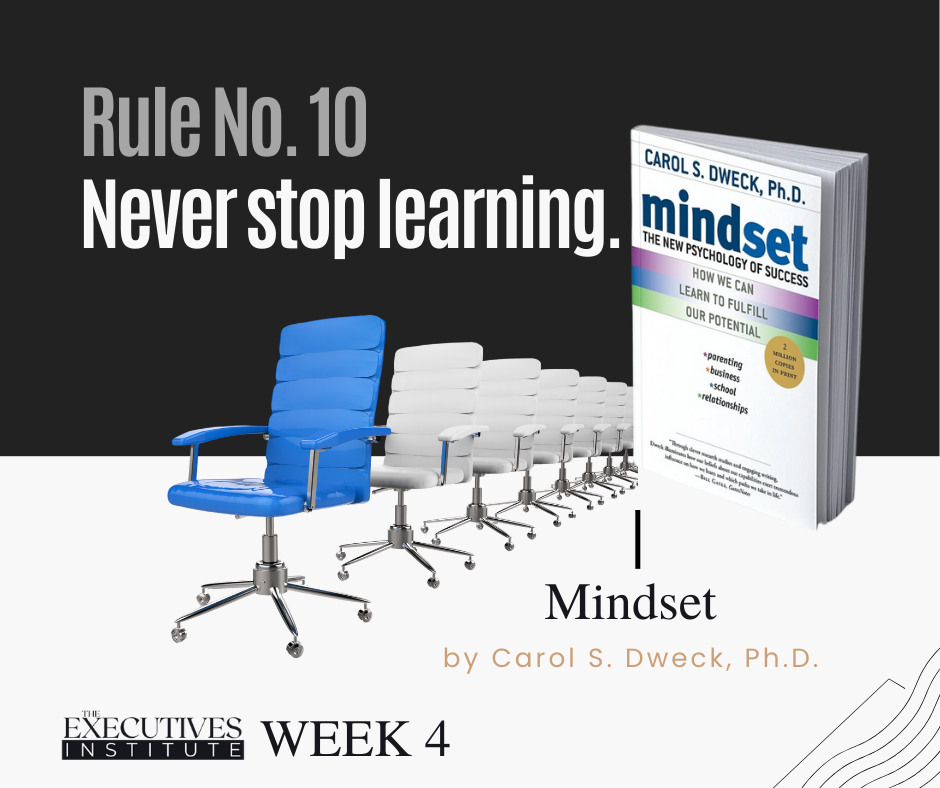
📌 Rule No. 10 —Never stop learning.
“Old sayings” get to be old sayings, typically because they’re true. For example; “What got you here won’t get you there”. This simply means that experience is valuable, but it can also be dangerous. The older you get, the longer you lead, the easier it becomes to lean on our instincts and our experience. When a small business owner is describing their latest challenge, I can quickly recognize a pattern and I can confidently solve today’s problem with yesterday’s answer. That will work again and again, brilliantly…until it doesn’t.
🔍 Ask Yourself: Where are we operating on autopilot? or, Where am I relying on what I already know instead of pursuing what I need to know?
This is another Rule and Ask Yourself question that require a little gut check. If you can answer those questions with humility (and act on them) you will truly evolve your business. I’ve watched so many good businesses stall or plateau because their owners stopped stretching. It wasn’t that they became lazy, they became successful. WRITE THIS DOWN…Success is one of the more effective ways to stop learning. Success quietly convinces us that we’ve figured it out. We haven’t. Trust me. None of us have.
The best leaders I’ve ever known and most highly-respected, share two characteristics: they stay humble and they stay genuinely curious. They read a lot. They take notes on everything. They raise their hands and ask questions in rooms where the rest of us fully expected them to have all the answers. They’re not acting humbly for show, they genuinely want to learn and know what someone else thinks.
Rule No. 10 summary: A growth-minded leader embraces learning as a lifelong process, not a phase that we graduate from. Whether we’re in the boardroom or the breakroom, staying open to new ideas, learning new skills, and asking the best questions, separates those who evolve from those who become irrelevant. The best leaders never graduate from growth. They seek the brutal feedback others avoid; they explore ideas outside their wheelhouse; they view mistakes as opportunities, not setbacks.
Another great old saying, “If you’re not learning, you’re not leading. At least not for long.”
✍️ This Week’s Edge: Build a Learning Habit that Drives Growth.

yourWeeklyEdge — WEEK 5
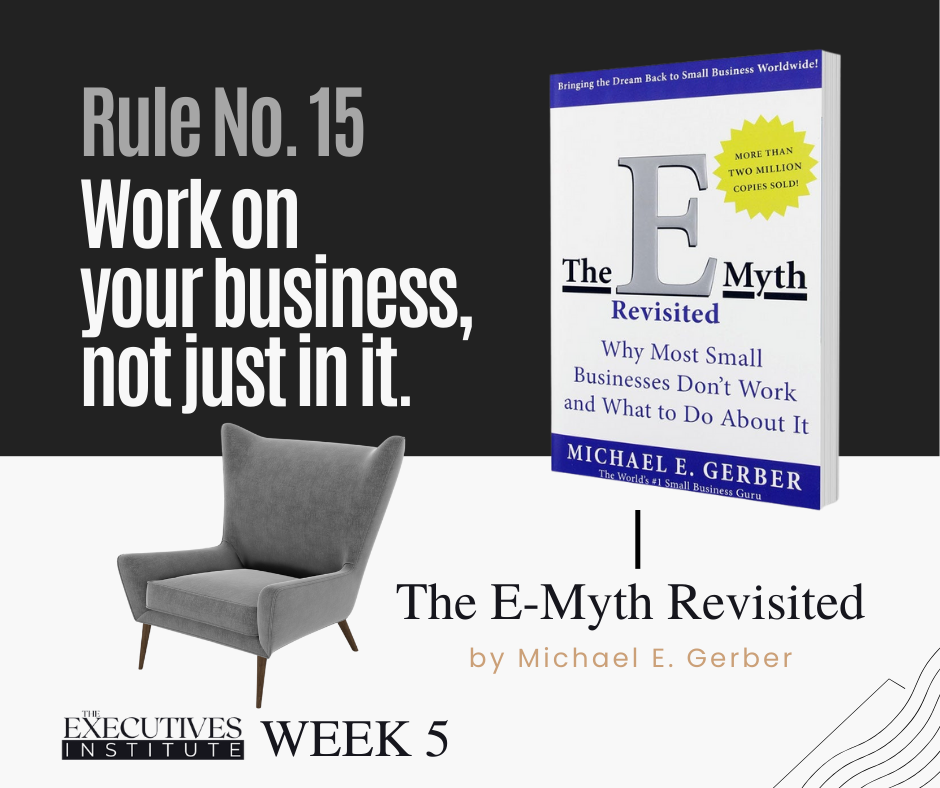
📌 Rule No. 15 —Work on your business, not just in it.
Here, at WEEK 5, we’re going to examine a Rule that some on our team said should be further down the list. I vetoed and moved it WAAAY toward the top, because I think this Rule should be practiced from day one. We’re going to examine the trap that catches so many business owners, especially founders…the leader who is literally indispensable to daily operations of the company.
If the only way your company works is because you’re there; performing every task, making every decision, putting out every fire, then you have NOT built a business, you’ve built a job. Plain and simple. Every week, you should be able to point to some task, some process, that you are properly documenting or strategically delegating. If you can’t point to something specific, then you’re just clocking hours at a company you happen to own.
🔍 Ask Yourself (and answer with complete honesty): What parts of my business still rely solely on me? and, What’s the cost?
Work on the business, not just in it is one of the clearest guiding principles of business, and possibly the most universally violated. Most of us know it’s true. Very few of us build the habit. Working on the business; improving systems, developing people, building for the future, requires time. That time has to be protected or it will be consumed by daily operation. I guarantee it. If you don’t deliberately improve the way the work gets done, the work will always own you. It’s the difference between being a great operator and a great owner. The goal isn’t to grind harder next month. The goal is to make next month easier because, this month, you built a better system. Build systems. Build processes. Or, one day, you’ll wake up and realize you built yourself a very demanding job.
Rule No. 15 summary: Most entrepreneurs don’t build businesses —they build traps. They start with a skill, launch into doing the work, and before long, they’re drowning in tasks, chained to the very thing they thought would give them freedom. Rule No.15 draws a hard line: if you’re always working in your business, it will never grow beyond you.
✍️ This Week’s Edge: Build One System that Outlast You.

yourWeeklyEdge —WEEK 6
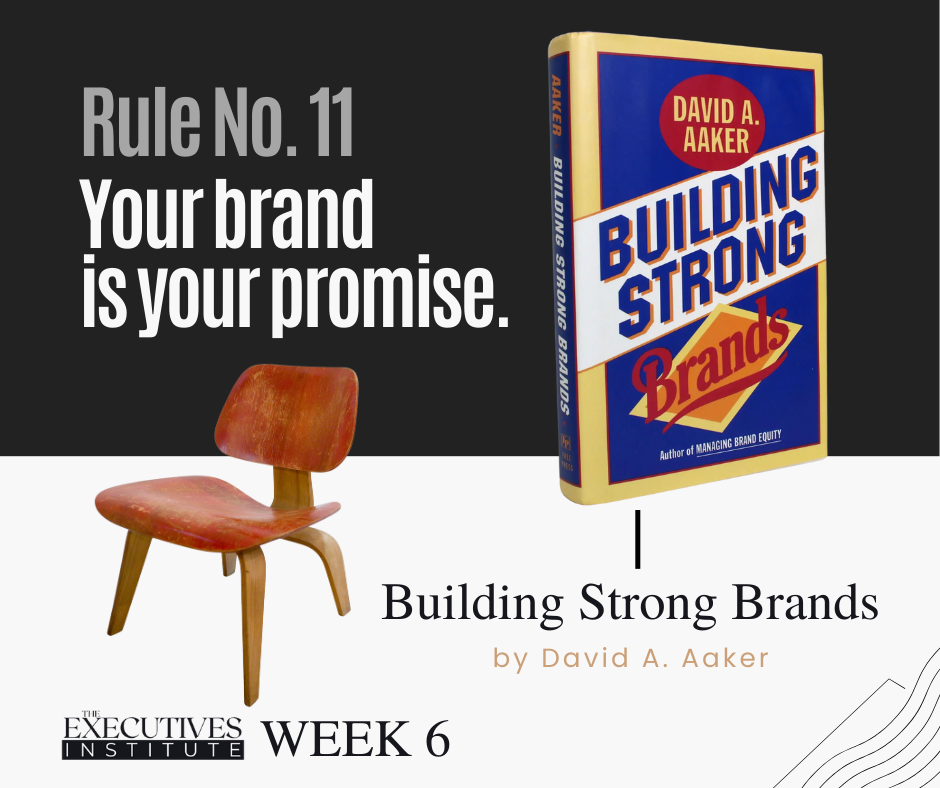
📌Rule No. 11 —Your brand is your promise.
Every touchpoint with your customer either reinforces that promise, or chips away at it. Strong brands are built by leaders who keep their word — even when it’s inconvenient, costly, or hard. And, one thing that took me years to fully understand and most business leaders underestimate: trust compounds. The longer you keep your word, the stronger your reputation becomes. Referrals increase. Pricing pressure decreases. Loyalty deepens. But the opposite is also true. Small inconsistencies, tolerated over time, will erode your credibility until you’re just out there competing on price instead of principle. Rule No. 11 matters because your brand is your bond. And in business, once your word stops meaning something, everything else gets harder.
🔍 Ask Yourself: Does every customer interaction in our organization, strenthen or weaken trust in that promise?
Rule No. 11 summary: Your brand is the unspoken contract you sign with the world —break it, and you’re just another company people stop trusting. Your brand isn’t your logo or slogan —it’s the consistent promise you make and keep to your customers, shaping what they expect from every experience with your business. This rule is a reminder: your brand is your bond. Honor it.
✍️ This Week’s Edge: Conduct a “Brand Promise Audit”.

yourWeeklyEdge —WEEK 7
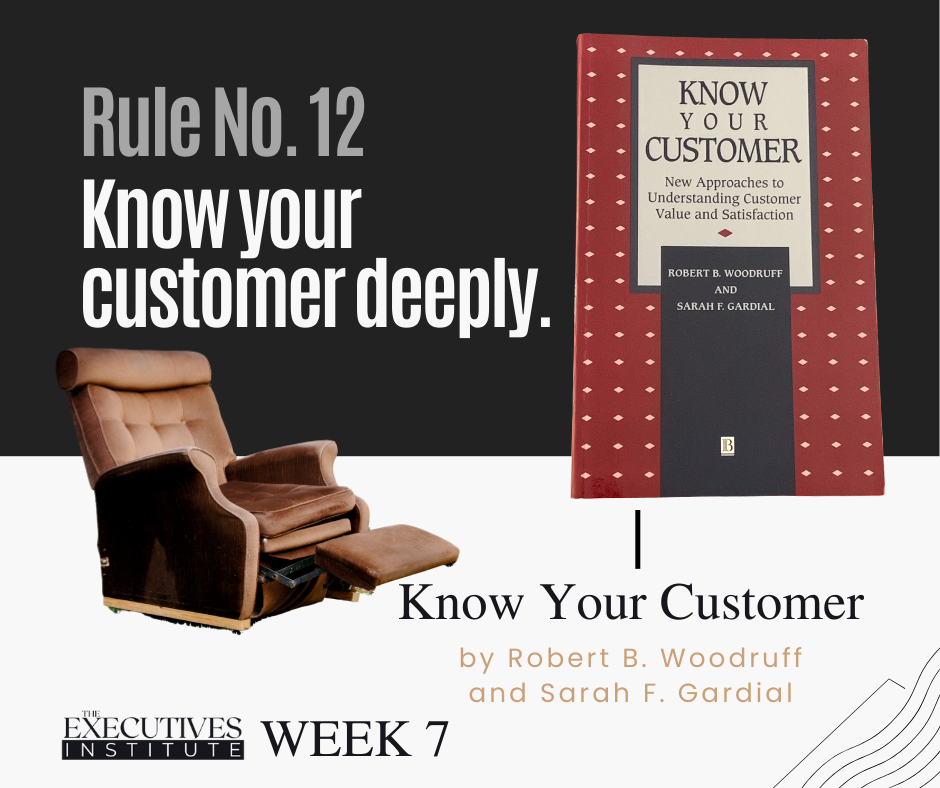
📌 Rule No. 12 —Know your customer deeply.
You know who buys from you. But do you really understand why they buy from you? Do you understand what they are accomplishing or willing to tolerate when they buy from you. Do you understand why they believe your option is better than the others? Most business problems aren’t necessarily execution problems. They’re understanding problems. Rule No. 12, Know your customer deeply, exists because clarity in this area, real understanding, sharpens everything else in your business —strategy, messaging, product development, service levels, growth, etc. Ask most business owners who their best customer is and they will tell you. Ask what that customer values most, and the answer gets a little harder.
🔍 Ask Yourself: How much of our customer’s daily reality do we truly understand?
This seems like a simple question, but a lot of business leaders will struggle to answer. When was the last time you sat down in-person, face-to-face with a one of your customers and just listened? Without pitching anything or promoting something, just listened. This Rule is a BIG reminder that know your customer deeply is not a suggestion to spend more time on market research. It’s a reminder that customer insight is a leadership responsibility, not a department function. This is your responsibility. The more sales, the more success, the easier it becomes to distance yourself from your customers. Remember this —businesses that last are led by executives who stay close to their customers long after success has given them an excuse not to. The company that understands its customers better than any of their competitors will always find a way to win. This Rule earns its place near the top because it’s foundational. It’s the difference between pushing what you want to sell and delivering what customers actually value.
Rule No. 12 summary: When you know your customer deeply, everything changes. Your marketing and messaging becomes clearer. Your growth becomes more purposeful. Your sales take on more relevance. Most of all, you stop wasting time solving the wrong problems. This rule demands the discipline to listen more than you speak. It demands humility. It demands proximity to your end users. Those three things can be intentional, the more successful you become. It is the foundation of every lasting business. Anyone could serve your customers, real success, your differentiator, comes when you truly understand them. Customer service versus customer understanding.
✍️ This Week’s Edge: Get Out of the Office.

yourWeeklyEdge —WEEK 8
📌 Rule No. 18 —Your calendar reflects your priorities.
This Rule follows Know your customer deeply for good reason. Every company claims to be customer-focused. You’ll hear a lot of business owners say, “Our customer is our number one priority”. But, if we sat down and looked closely at most business owner’s weekly schedules, we’d usually see almost no direct customer interaction, time on the floor or in the field. No time blocked for customer feedback. No strategic sessions dedicated to reviewing customer experience. Yet they will insist the customer comes first. Every leader claims to be customer-focused, but their calendars tell the truth. Your calendar is a confession. It always tells the truth about your priorities, by looking at how you allocate your time. If you truly know and value your customer, your calendar will show it. There will be time invested in understanding their reality.
🔍 Ask Yourself: If a stranger looked at my calendar, what would they say my top priorities are? and, How does that compare to what I say they are?
I have seen this week’s task of conducting a calendar audit, change the focus and lives of several leaders, almost overnight, along with the trajectory of their companies. Each week of theLEDGER has space for three top priorities. Really give them some serious thought each week. What’s most-important this week? If they don’t reflect what you say your priorities are, you’re lying to yourself.
Rule No. 18 summary: If you want to know what truly matters to a person, don’t ask them —look at their calendar. This rule confronts the lie we tell ourselves that “we didn’t have time,” when in reality, we simply didn’t make it a priority. It is not about time management tools. It’s about discipline and alignment. We can’t “make time”, you have to protect it.
✍️ This Week’s Edge: Conduct a “Calendar Audit”.

yourWeeklyEdge —WEEK 9
📌 Rule No. 21 —Clarity creates confidence.
It’s common for us to put our company’s challenges into categories; a sales slump, a marketing failure, an onboarding or retention problem, whatever we choose to call it. On the surface that may be accurate, but in reality, when we dig deeper, the challenge is usually a clarity problem. Customers hesitate to buy, campaigns fall short, team progress stalls and top performers leave —all because the message wasn’t clear.
As leaders, we tend to assume we’ve been clear because we understand what we said. But clarity isn’t measured by how well we spoke, it’s measured by how well everyone else understood. If meetings end with “Can you explain that again?” and follow-up emails or side conversations —the issue isn’t your team’s intelligence. It’s your lack of precision. When customers clearly understand what you do, why you do it and how it helps them, they buy with confidence. When clarity is missing, you’re the bottleneck, and no legitimate business can scale that way.
🔍 Ask Yourself: If I were seeing my company for the first time as a customer, would I immediately understand what makes us different, or would I leave confused and uncertain? or, If I stepped away from my business for 30 days, would my team move forward with confidence, or freeze waiting for clarification?
Strong teams need unmistakable direction. Purpose. Value. Mission. Message. etc. If you can’t explain it simply, neither can your team.
Rule No. 21 summary: Confusion is expensive. When you communicate with precision, your team knows where we’re going, and why it matters. Your customers know why they’re there. Clarity cuts through the noise and eliminates confusion. In business, a vague message leads to hesitation, misalignment, and wasted effort. But if your ideas are simple and specific, teams move fast, they move together, they move with confidence.
✍️ This Week’s Edge: Examine your Business Through Two Different Lenses: your Team and your Customer.

yourWeeklyEdge —WEEK 10
📌 Rule No. 22 —Hire slow, fire fast.
The phrase “right person, right seat” was popularized by Jim Collins in Good to Great, and formalized by Gino Wickman through EOS, because the wrong person in the wrong seat will cost you more than almost any other mistake you’ll ever make in business. Strong companies aren’t built by filling seats quickly. They’re built by raising the bar on who even gets a seat, and having the courage to act when the wrong person is sitting in it. Most organizations do the opposite. We hire on gut instinct or simply because we got impatient, and then we manage the consequences.
Scenario…the workload is piling up, your team is stretched thin, and you convince yourself the next decent candidate will “probably work out.” Sometimes they do. More often, they don’t. And when we know someone isn’t the right fit, we just give it some more time. We hope things will turn around. Meanwhile the rest of the team sees it, feels it, and quietly wonders why our standards aren’t being enforced. The top performers have already left. We become what we tolerate.
🔍 Ask Yourself: Am I keeping someone on the team right now who I already know doesn’t belong here? If so, what’s stopping me from making the call?
Rule No. 22 summary: The strength of your team determines the strength of your business. Hiring slow means committing to a disciplined process —one that prioritizes fit, capability, and character over speed or convenience. It means refusing to lower the bar just to fill a seat. Firing fast means addressing misalignment or underperformance decisively before it corrodes culture, morale, or momentum. Tolerating the wrong hire too long is more costly than taking the time to hire the right one. Right person, right seat, right now, or nothing.
✍️This Week’s Edge: Create your one-page “Hiring Scorecard”.

yourWeeklyEdge —WEEK 11
📌 Rule No. 24 —Own your mistakes.
If you’re leading, you’re going to lose, you’re going to make mistakes, you’re going to fail —now and again. We all do. Every idea isn’t brilliant and not every gamble pays off. When it hits the fan, our instinct, human nature, is to explain it away, justify it or quietly shift the blame. But leadership demands the opposite. The quality of a leader is often most visible in how they respond to failure. Owning your mistakes in these moments separates real leaders from those just holding the title. It’s not about being the fall guy, it’s about being the kind of leader who earns the right to lead again tomorrow.
🔍 Ask Yourself: If my team copied the way I handle mistakes, would we be stronger, or weaker, as an organization?
In leadership circles, we often talk about accountability, but not as often do we talk about or confront what it really looks like when the stakes are high, the optics are bad, and the blame could easily fall elsewhere. When you own the mistake, fully, visibly, and without excuses, you don’t lose credibility. You gain it. The leader who owns everything earns the trust that makes everything else possible.
Rule No. 24 summary: Owning your mistakes is the foundation of credibility, respect, and real accountability. In any failure, you either make excuses or you make progress, never both. The strongest leaders don’t hide from failure; they stand in front of it, learn from it, and lead forward. That’s not just responsibility —that’s extreme ownership.
✍️ This Week’s Edge: Own One Mistake.

yourWeeklyEdge —WEEK 12
📌 Rule No. 31 —Delegate outcomes, not tasks.
Early in my career, I thought delegation meant handing someone a list of things to do and checking back to make sure they did them (and, did them the way I would have). Eventually, I came to realize, that isn’t delegation, it’s just supervision. If you want to build capable people around you, you have to stop assigning to-do’s (tasks), and start assigning responsibility for the result (outcomes). Tell them what success looks like. Set the parameters, then get out of the way and let them think. They won’t always do it the way you would. Sometimes they’ll do it better. And sometimes they’ll struggle, which is exactly how leaders are made. If the group can’t move without you, you haven’t built a team yet. You’ve built a staff, waiting for orders.
🔍 Ask Yourself: Am I giving people responsibility for results, or just instructions for work?
Most leaders think they’re empowering their teams by delegating, but they’re really just offloading. When you hand someone a task list, you’re still doing the thinking for them. Real leadership means trusting others with the destination, not just the directions. When you delegate outcomes, you create space for ownership, innovation, and decision-making at every level. That’s how you grow leaders, not followers, and how your organization stops depending on you for every answer.
Rule No. 31 summary: Don’t just assign to-dos, transfer the responsibility. When you delegate outcomes instead of tasks, you empower people to think, act, and lead with ownership. It’s the difference between creating followers and developing leaders.
✍️ This Week’s Edge: Shift from Tasks to Outcomes.

yourWeeklyEdge —WEEK 13
📌 Rule No. 49 —People over processes.
The way you think about people determines almost everything about how you lead. If you treat people like problems, like something that needs to be “managed”, they’ll act like it. If you treat them like partners in the mission, they’ll deliver, often beyond expectation. Your management philosophy will shape your company’s reality.
Too many companies hide behind processes. When something breaks, they add another form, another system, or another rule. But binders full of processes won’t make up for poor leadership. They also won’t compensate for a lack of trust in your people. The truth is, great companies are built by humans, not handbooks. When you invest in your people and give them the freedom to think, decide, and act, they’ll outperform the processes every time. Some leaders use bureaucracy as an easy way out. Leadership is hard, but wins every time.
🔍 Ask Yourself: If I truly trusted my people, what process would we no longer need?
Rule No. 49 summary: Processes should serve people, not control them. Organizations thrive when they trust and invest in people, not just when they refine processes. Over-relying on systems, procedures, and checklists shows a lack of trust in your people and their judgement. Over-processed companies will never be the leading companies. They will dominate the middle. Processes are important, but give your people ownership and watch them drive results.
✍️ This Week’s Edge: Demonstrate Trust Over Bureaucracy.

yourWeeklyEdge —WEEK 14
📌 Rule No. 3 —Differentiate or die.
Pick any industry; banking, beverages, entertainment, automobile manufacturing, and watch the patterns. You’ll see most of the companies copying each other’s features and matching each other’s pricing. Some of them are good enough to carve out a tiny share of a dilluted market and survive for awhile, but “good enough” companies also go under every day. Because competition is expensive, yet most companies choose it anyway. The alternative isn’t easy, but it is simple: find the space where you are not competing with anyone at all. Create value in a way that makes comparison difficult. Build something specific enough that a particular customer says, ‘That was built for me.’ If your customers can’t easily explain why you’re different, you aren’t. It’s that simple.
🔍 Ask Yourself: Where are we competing by default, rather than by design?
In their book, Blue Ocean Strategy, W. Chan Kim and Renée Mauborgne called this the red ocean —a space so crowded and competitive that margins bleed out and growth becomes a war of attrition. Differentiation is not a marketing exercise. It is a strategic choice that has to be made at the level of product, service, culture, and business model. Not ‘be different for the sake of it.’ Be meaningfully different in ways that matter to the people you intend to serve. Why: Because, if you look like everyone else, you’ll be commoditized. The graveyard of businesses is full of companies that were good enough.
Rule No. 3 summary: If your business blends in, it’s already falling behind. In crowded markets, blending in is a slow death. The only way to lead, not just survive, is to break away from the pack by creating clear, compelling differentiation. This isn’t about being slightly better. It’s about being meaningfully different in a way that customers recognize, value, and talk about.
✍️ This Week’s Edge: Find Your Difference.

yourWeeklyEdge —WEEK 15
📌 Rule No. 4 —Play the long game.
The leaders I’ve known who build strong companies think in terms of decades, not just months and quarters. They make hiring decisions, pricing decisions, and culture decisions based on where they want the company to be in ten years, not on what relieves this month’s pressure. Playing the long game doesn’t mean that you ignore urgency. It means understanding which urgencies are real and which are just bumps in the road. The business that’s still here in twenty years will be the one that kept that perspective.
Short-term decisions are dangerous, mostly because they seem reasonable at the time. Nobody wakes up and says “We’re going to sacrifice our 10 year plan to hit this quarterly number.” The sacrifice usually happens through a series of individual decisions that (again, seem reasonable at the time) compound in the wrong direction. Great companies focus on building something that lasts, not just something that performs today. Sustainable advantage requires patience.
🔍 Ask Yourself: Am I making decisions that serve the next quarter or the next decade?
Rule No. 4 summary: Too many leaders treat business like a game to be won; chasing quarterly numbers, market share, or quick headlines. But real leadership isn’t about beating the competition. It’s about building something that lasts. The best companies outlast the trends and adapt with purpose. They prioritize trust, resilience, and long-term value. Playing the long game isn’t just a strategy —it’s a mindset.
✍️ This Week’s Edge: Conduct a “Long Game Audit”.


yourWeeklyEdge —WEEK 16
📌 Rule No. 5 —Make fewer, bolder moves.
Could you bet on every horse and win? Of course, one would win, but overall you’d have a net loss. I’ve watched a lot of companies try to bet on everything, spreading themselves thin across every “priority” project, chasing small wins, but avoiding the tough decisions. This Rule, Make fewer, bolder moves, demands the opposite. It pushes you to stop hedging and start committing —to fewer initiatives, bigger bets, and clearer strategic choices.
🔍 Ask Yourself: What are we doing that looks productive, but isn’t actually moving the needle?
Real strategy requires discipline and courage. Discipline in your strategy means choosing what you will not do and saying no more often than yes. In the real world, most strategic plans end up accomplishing nothing,because they tried to do everything. Executives who build great businesses understand one bold move executed with full commitment and resources, beats five smaller, more modest moves done with divided attention. What if you make the wrong choice?! This strategy requires courage. If you’re serious about real results, make fewer, bolder moves and stand behind them.
Rule No. 5 summary: Focus beats frenzy. Spread too thin, you risk mediocrity everywhere. Bold, deliberate moves, rooted in strategy, not reaction, create real advantage. Commit to fewer initiatives, but back them fully. Win where it matters.
✍️ This Week’s Edge: Conduct a “Strategic Elimination” Exercise

yourWeeklyEdge —WEEK 17
📌 Rule No. 25 —Ask better questions.
Remember this throughout your career…most leaders are trained to answer, not to think. That maybe sounds a little harsh, but it’s very true. From early in their careers, high performers are rewarded for decisiveness, speed, and having the solution. Over time, that habit becomes a liability. They stop questioning assumptions, stop challenging direction, and start operating inside problems that were never clearly defined in the first place.
This rule earns its place in the first 50 because it sits upstream of everything else. Strategy, innovation, culture, execution, they all depend on whether you’re asking the right questions at the right time. Companies that separate themselves move faster —but they also pause long enough to ask, Are we still solving the right problem? They challenge what everyone else accepts and create space for uncomfortable questions that expose blind spots before they become costly mistakes. Great answers start with uncomfortable questions.
🔍 Ask Yourself: What’s the real question we’re not asking? and, Where are we mistaking answers for understanding?
Great leaders know that progress begins with curiosity, not with certainty. By learning to ask better questions, we unlock clarity, challenge assumptions, and open the door to smarter strategies and stronger teams. The discipline is to ask questions with genuine curiosity rather than as a rhetorical device —not to lead the room to the conclusion you’ve already reached, but to actually explore what you don’t yet know. It is a simple instruction with significant implications for leadership style, team culture, and decision quality. The leader who asks the right question at the right moment is often more valuable than the one who has all the answers.
Ignore this rule, and you’ll stay busy solving the wrong things.
Apply it, and you change the trajectory of decisions before they’re made.
Rule No. 25 summary: The quality of your outcomes is directly tied to the quality of your questions. Leaders who ask better questions don’t just get better answers, they uncover blind spots, surface assumptions, and spark clearer thinking in themselves and others.
✍️ This Week’s Edge: Question One Assumption

yourWeeklyEdge —WEEK 18
📌 Rule No. 26 —Define it. Measure it. Achieve it.
Most company goals have good intent, but fail because the goal was never defined clearly enough to be measurable. Improve customer satisfaction is not a goal. Increase our NPS by fifteen points by end of Q3 is a goal —one you can build a plan around, assign ownership to, and evaluate honestly.
Having the discipline to assign measurement makes success and failure visible. That visibility is uncomfortable for leaders who prefer the ambiguity that allows them to declare partial success. But it is the only way to get honest feedback and drive real improvement. Companies that measure clearly also move faster. There are fewer debates about what success looks like, fewer disagreements about whether something worked, and less energy spent on managing the narrative.
🔍 Ask yourself: What exactly are we trying to achieve and is it specific enough to be measured? Plus, Who owns each result and how often are we reviewing progress?
Define it. Measure it. Achieve it. is a guiding principle because clarity of objective is one of the most direct levers of organizational performance. Vague goals produce vague results. What gets measured gets done.
Rule No. 26 summary: Vague goals don’t move organizations forward —clear objectives do. This rule reminds executives that without defining what success looks like and establishing the right metrics, progress is merely hope in disguise. Define the outcome. Tie it to measurable key results. Then hold the line until it’s achieved.
✍️ This Week’s Edge: Replace One Vague Goal with a Measurable Commitment

yourWeeklyEdge —WEEK 19
📌 Rule No. 7 —Momentum beats motivation.
Every leader knows the feeling: there are days when your work feels inspired, clear and almost effortless. And there are many more days when it just doesn’t. The difference between businesses that grow and businesses that stall is rarely about having more good days than bad ones. It’s more accurately about doing the work anyway.. In his book The War of Art, Steven Pressfield writes about this in the context of the arts, creative work, but the principle applies equally to business leadership. He called the enemy Resistance —the force that whispers reasons to delay, to perfect, to wait for better conditions.
🔍 Ask Yourself: Where am I waiting to feel motivated, when I could, instead, build momentum by taking action?
Experienced business operators know that the conditions rarely become better on their own. They start anyway. They make the call, finish the task, have the conversation. And the act of starting generates something that waiting never can: momentum. Momentum lowers friction. It changes the character of all of the decisions that follow. Teams that are moving make faster decisions than teams that are not. Leaders who are moving see more clearly than those waiting for clarity before they begin.
This is why Momentum beats motivation. This Rule is a reminder that the discipline of showing up daily, regardless of inspiration, is what separates the operations that grow from the ones that don’t.
Rule No. 7 summary: Don’t wait to feel inspired. Show up, act anyway, and let discipline build momentum. Waiting to feel inspired is a trap. Progress happens when you show up consistently, especially when you don’t feel like it. Motivation is fleeting; momentum is earned.
✍️ This Week’s Edge: Build Momentum Before Monday Builds Your Calendar

yourWeeklyEdge —WEEK 20
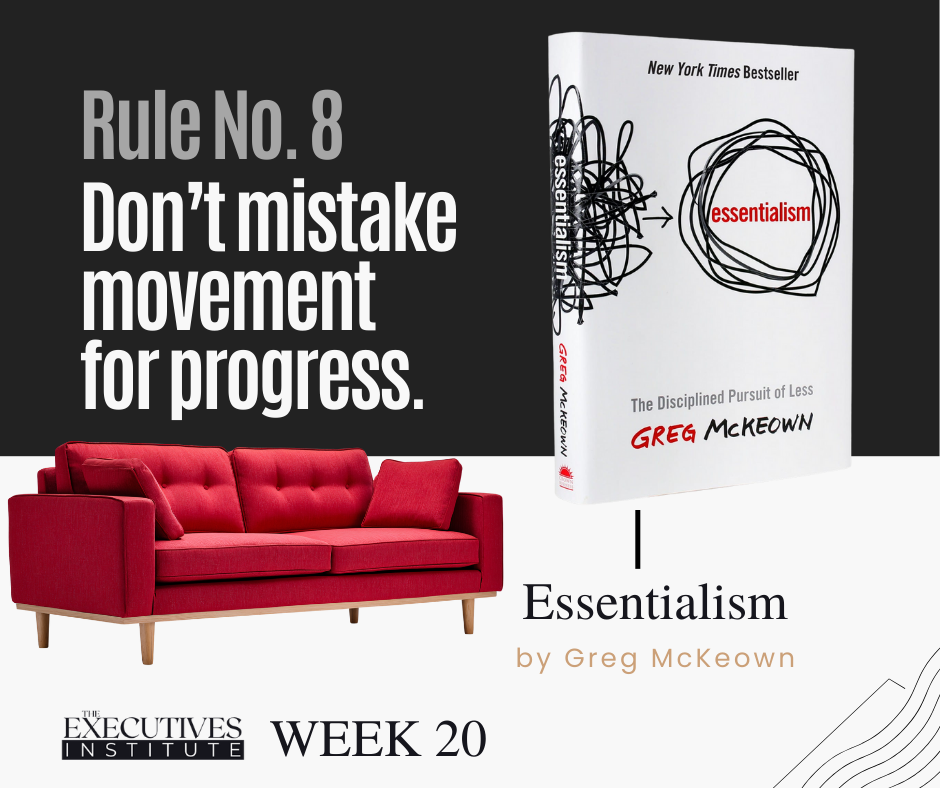
📌 Rule No. 8 —Don’t mistake movement for progress.
Don’t mistake movement for progress. It is one of the most common failure modes in growing organizations, and it is almost invisible until you’ve stepped far enough back to see it. A full calendar and an empty strategy happen together constantly. Companies fall into this trap often and often don’t even realize it. Meetings happening daily. Urgent projects launched continually and end without a real clear outcome. Everyone is working their butts off, and nothing is really moving the needle.
🔍 Ask Yourself: Am I spending more time in motion than on meaningful outcomes? and, What change could I make this week that would create the biggest forward movement in my work?
Greg McKeown spent years studying the difference between people who accomplish significant things and people who are simply very busy. His conclusion is uncomfortable for most leaders: busyness is often a defense mechanism, a way to avoid the harder discipline of choosing what actually matters. The discipline of essentialism is not about working less. It is about being ruthlessly honest about what moves the needle and allocating resources accordingly —at the expense of everything else. This requires saying no to things that are good but not essential. That is harder than it sounds in an organization where people have built their roles around those activities. Activity fills a day. Progress builds a business.
Rule No. 8 summary: We live in a culture that rewards hustle, glorifies busyness, and often confuses motion with momentum. But constant activity isn’t the same as meaningful progress. This rule invites you to slow down, get clear, and focus your effort where it actually counts. Because doing more is not the goal —doing what matters is.
✍️ This Week’s Edge: Eliminate One. Elevate One.
Why Some Rules Seem Similar
You might notice that a few Rules touch on related ideas. That’s intentional. We noticed that as we built the list, but didn’t want to remove every instance that seemed similar, since, hopefully, some “overlap” strengthens the importance and application of the Rules. In business, a single principle can influence different areas of your company, your team, and your decision-making. Seeing the same concept from multiple angles helps to reinforce it, making it easier to act on consistently.
“We try and operate so that … no matter what happens, we’ll never have to ‘go back to go.’” – Charlie Munger
yourWeeklyEdge —WEEK 21
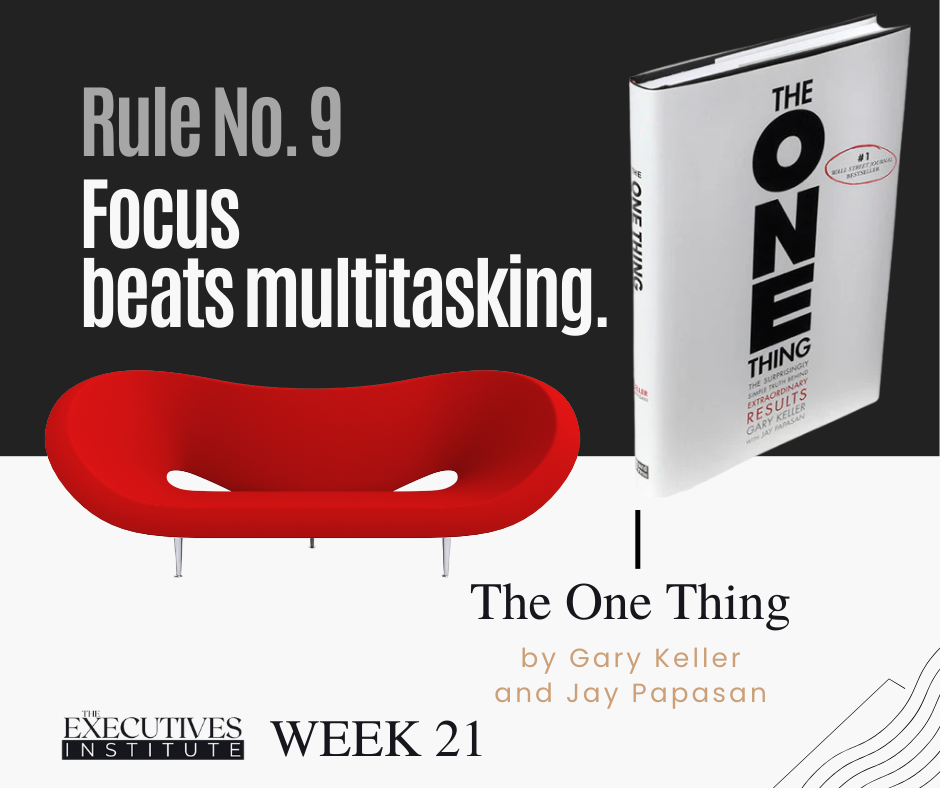
📌 Rule No. 9 —Focus beats multitasking.
Neuroscience settled this question a long time ago. The human brain does not actually perform two cognitive tasks simultaneously. It switches rapidly between them, and each switch carries a cost: context lost, attention degraded, quality reduced. What’s true for individuals is amplified within companies. Leaders that pursue twelve priorities simultaneously often find, at the end of the year, that they’ve made some progress on all twelve and decisive progress on none.
🔍 Ask Yourself: What is the one thing I can do right now that will make everything else easier or unnecessary? and, What distractions or obligations do I need to eliminate (or say “no” to) so I can fully commit to what matters most?
Multitasking is the most expensive myth in business. The businesses I’ve watched struggle most often have the same root issue: they are trying to be too many things at once, often for reasons of fear; fear of missing an opportunity, fear of narrowing too much, fear of being wrong about the focus they chose.
Focus relentlessly on the one task that will move the needle most. Guard your attention as your most valuable asset —everything else is secondary. Focus beats multitasking is one of our core principles because it runs directly against the cultural current of most businesses. And yet it is among the most empirically supported ideas in organizational performance.
Concentrate. Then concentrate more.
Rule No. 9 summary: Multitasking is a myth. Every time you split your attention, you dilute your effectiveness. This rule reminds us that meaningful progress doesn’t come from doing more things —it comes from doing the right thing with undivided attention.
✍️ This Week’s Edge: Choose One. Finish One.

yourWeeklyEdge —WEEK 22
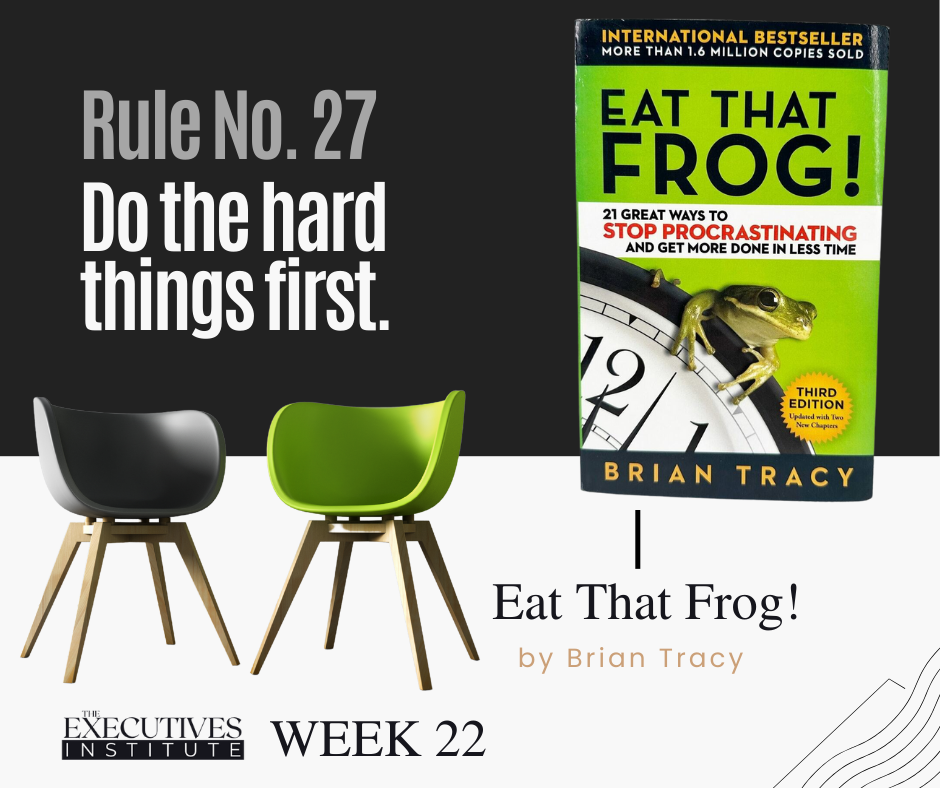
📌 Rule No. 27 —Do the hard things first.
The leaders I’ve met who are most effective at execution have developed a simple but demanding habit: they identify the most important priority at the start of each day or each week, and they work on it before they check anything else. Do the hard things first is a principle that seems obvious, but very few executives practice it. The reason is that it means overriding our natural preference for comfort and building momentum with easy wins.
🔍Ask Yourself: Do I let urgent, easy tasks steal time from what’s most important, and am I willing to break that pattern? plus, If I only accomplished one thing today, which task would have the greatest long-term impact on my business?
Every leader has a list of things they’ve been meaning to address. The difficult task, the hard conversation, the strategic decision gets deferred. Smaller tasks fill your day, while the important things waits.The list grows slowly and quietly until it becomes a problem. In Eat That Frog!, Brian Tracy’s advice is deceptively simple: identify the most important, most difficult task in front of you, and do it before anything else. The frog on your desk doesn’t get easier to eat if you wait. The psychological relief of completing small tasks is real. But it creates an illusion of productivity that is costly at the strategic level. The things that tend to wait are often the things that most directly affect whether the business advances. The frog doesn’t shrink. Eat it early.
Rule No. 27 summary: The tasks we avoid are often the ones that matter most. “Do the Hard Things First” is a call to disciplin —tackle your toughest, highest-impact priorities before everything else. It’s not about doing more, it’s about doing what matters when your mind is sharp, your willpower is high, and your excuses haven’t shown up yet. In leadership and business, procrastination on the hard stuff is procrastination on progress.
✍️ This Week’s Edge: Identify your frog.

yourWeeklyEdge —WEEK 23
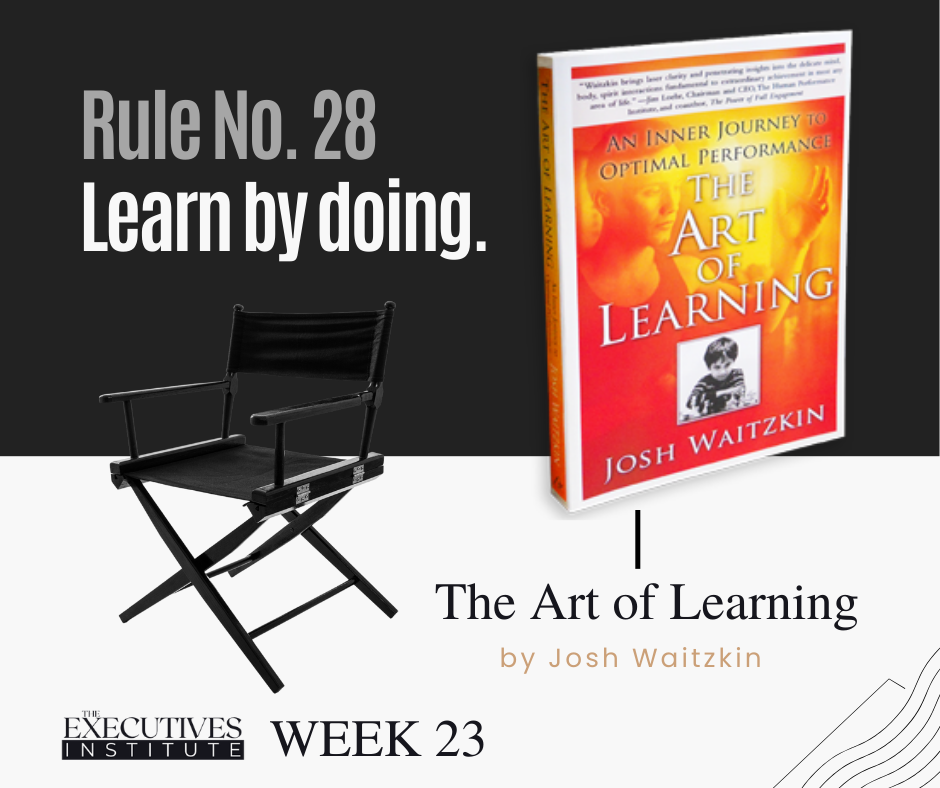
📌 Rule No. 28 —Learn by doing.
If you want your organization to perform at a higher level, stop chasing hacks and start building capabilities in yourself and your team through real-world experiences. Not classroom training, conference room discussions or zoom meetings, but hands-on learning —there is no substitute for the knowledge that comes from actually doing the thing. Leaders who build a culture of “learning by doing” move faster, they adapt quicker, and they outperform organizations who get stuck in theory. Don’t wait for the conditions to be perfect, they never will be. Take action and learn by doing.
🔍 Ask Yourself: Where am I over-preparing instead of executing? and, Are we rewarding experimentation in our organization, or just ideas?
There’s a moment in every leader’s journey when classroom theory runs out, and reality begins. You can’t think your way to mastery, and you can’t strategize your way around experience. Learn by doing is about trading perfection for progress and stepping into the arena where real growth happens. Whether you’re launching a new project or developing your next leader, the fastest way forward is almost always hands-on. In school, you’re taught a lesson and then given a test. In life, you’re given a test that teaches you a lesson.
Rule No. 28 summary: Real mastery doesn’t come from theory —it comes from action. Learn by doing means getting your hands dirty, embracing failure as part of the process, and internalizing knowledge through lived experience. The most transformative growth comes when you stop preparing and start practicing under real conditions. This rule is a call to engage directly, iterate quickly, and let action teach you what thinking never could.
✍️ This Week’s Edge: Start before you’re ready

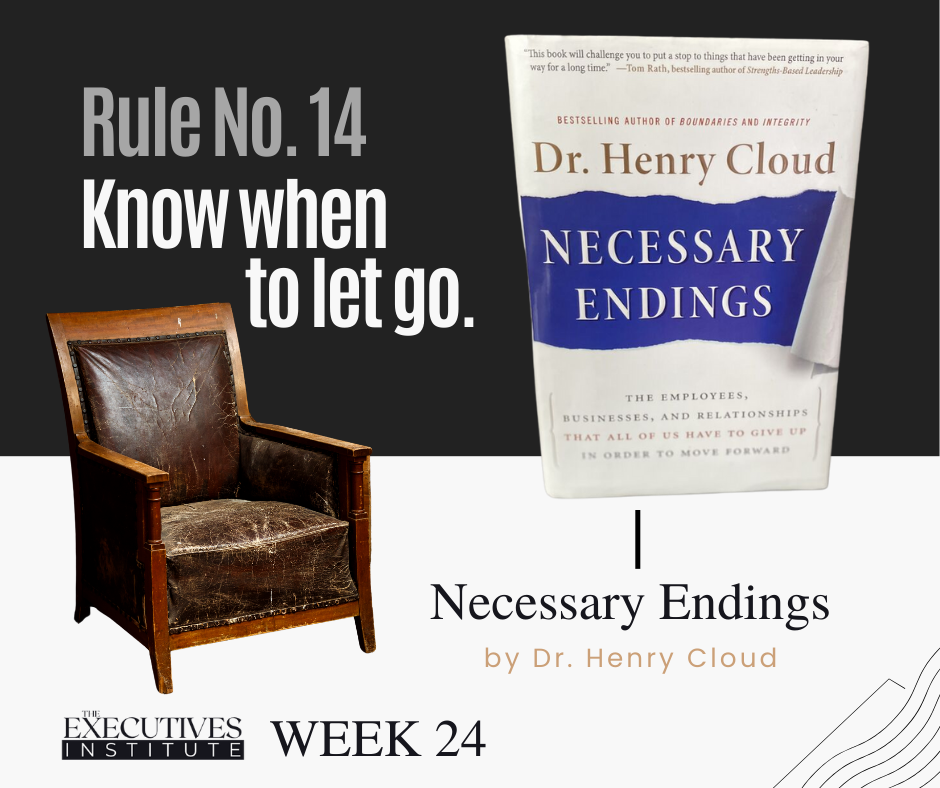
yourWeeklyEdge —WEEK 24
📌 Rule No. 14 —Know when to let go.
Business leaders are good at starting things. Most of us, not so good at ending them. The hardest decision you’ll ever make in business, may be knowing when to let go. Every business carries dead weight; a product line that’s run its course, a hire who never quite fit, a strategy that used to work but no longer does. Maybe it’s even a partnership that was beneficial in the beginning, but feels like a burden now. This rule challenges you to stop avoiding the hard decisions and start making the necessary ones. Because growth doesn’t just require starting things —it also, and often, requires ending them too.
🔍 Ask Yourself: What am I keeping alive that’s actually holding me back? or, What am I holding onto out of comfort or obligation, rather than value or vision? Then ask, What is this costing us —not just in dollars, but in momentum, morale, or missed opportunity?
The instinct to persist isn’t always wrong. Some of the best business outcomes in history came from leaders who refused to quit when things got tough. From the outside, persistence and avoidance look identical, but the distinction matters big time. The question to ask isn’t —Can this survive?, the question you need to ask is —Is this still serving the purpose it was meant to serve? Know when to let go is embedded in the principles because it is a form of strategic courage that is easy to admire and much harder to practice. Holding on too long is one of the most expensive (and common) mistakes an executive can make. What you choose to end often determines what you can begin.
Rule No. 14 summary: Good leaders don’t just build —they prune. Knowing when to let go of a person, product, process, or plan is a mark of maturity and strategic clarity. Holding on too long stifles progress. Letting go at the right time creates room for growth, health, and innovation. Endings aren’t failures —they’re often the first step toward something better.
✍️ This Week’s Edge: Cut one thing that no longer serves

yourWeeklyEdge —WEEK 25
📌 Rule No. 42 —Feedback is a gift.
This is tough one. Most of us say we want feedback, until we actually get it. Because, most of us have not learned how to properly receive feedback. Our first reaction is usually defensiveness. It’s our nature to defend our behavior. But, as the leader, if defending your position becomes the norm, your team eventually stops providing the feedback. The loop closes and your company becomes polite and stagnant. Growth stops. But, if you can learn to ignore the discomfort, and hear the message, you unlock a level of growth that most leaders never reach. Receiving feedback well doesn’t mean you have to agree with everything you hear. It means you have to listen, separate your emotional response from the information, and ask yourself honestly —is this true? The feedback you resist the most is often the feedback you need the most.
🔍 Ask Yourself: What’s one thing I’m doing that I don’t see, but others do? and, Is there something I used to do well, but have let slip?
The most important information about your leadership often exists in the minds of people who will not tell you. The leaders I’ve known with the best judgment, are the ones who have built relationships and teams where hard truths are spoken regularly. They have created the conditions that make it safe to be honest. Feedback is a gift. The gift is not always delivered how we’d like, and it’s often unwrapped awkwardly, and the contents aren’t what you hoped for. But, receive it as what it is: information that can make you better.
Rule No. 42 summary: The truth is, most leaders aren’t wired to receive feedback well, even when they desperately need it. But feedback, when accepted without defensiveness and viewed as fuel, not fire, is a shortcut to growth, clarity, and leadership maturity. Ignore it, and you stay stuck. Embrace it, and you evolve.
✍️ This Week’s Edge: Ask. Listen. Apply.

July 30, 2026 ⚠️ The rest of yourWeeklyEdge is currently under development and will be fully available on our official launch day, January 4, 2027. After launch, it will continue to evolve through real-world experience, member contributions, and timeless business principles—because great leaders never stop learning.
“Slow down. Practice the Principles. Build something that lasts.” – The Executives Institute
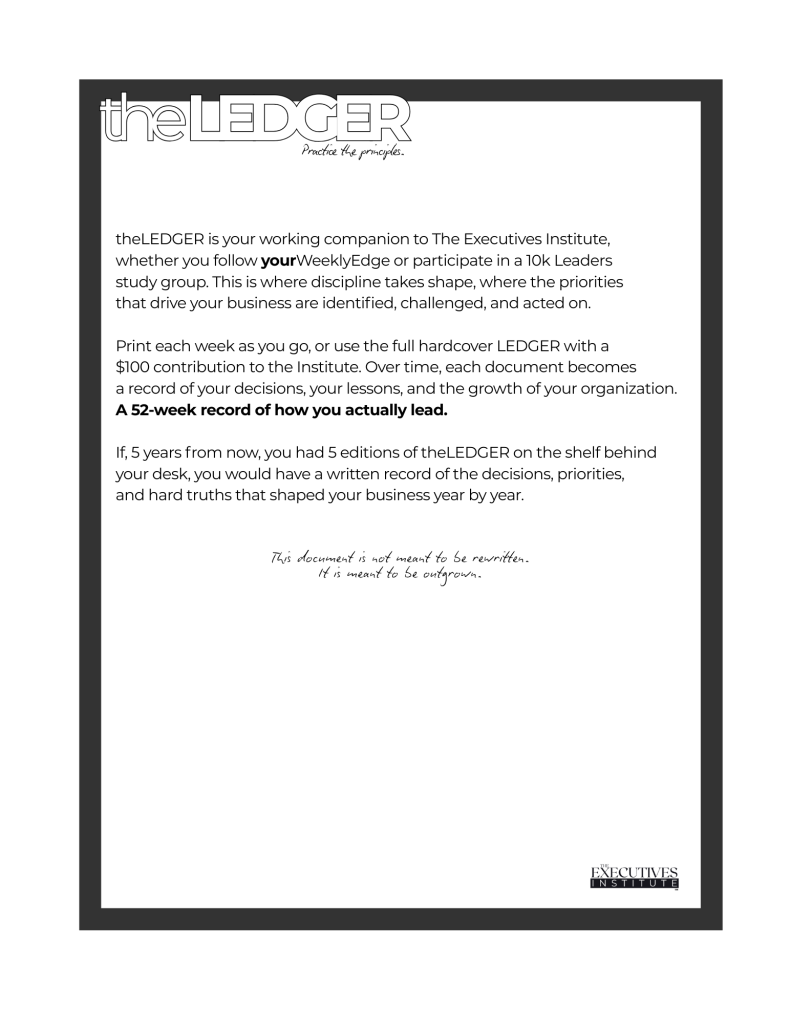
Start anytime. Just start.
yourWeeklyEdge begins whenever you’re ready. If you prefer to follow a week-by-week discussion with fellow executives, the next 50-week cycle will begin at our LinkedIn page, Monday, January 4, 2027. Follow our LinkedIn page.
The Institute teaches.
theLEDGER records.
yourWeeklyEdge WEEK 26
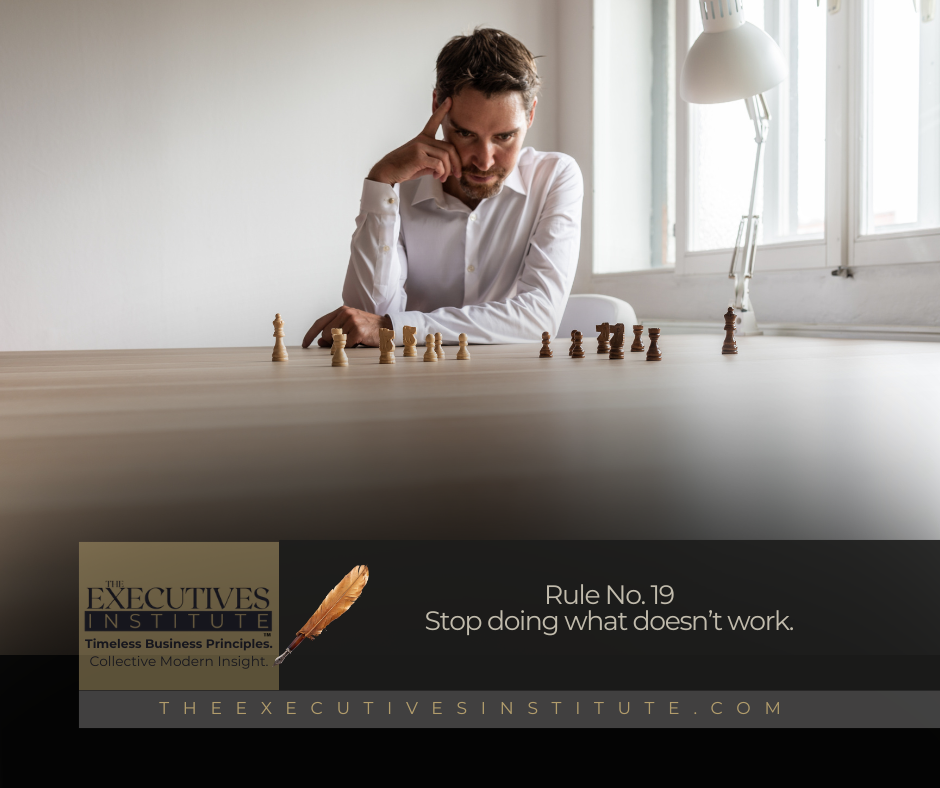
📌 Rule No. 19 —Stop doing what doesn’t work.
— The Behaviors That Built Your Success Are Limiting Your Future
Rule: Stop doing what doesn’t work.
Source: What Got You Here Won’t Get You There by Marshall Goldsmith
Success has a shadow side. It makes you confident in the behaviors that produced it, even when those behaviors have stopped working.
Marshall Goldsmith spent decades coaching senior executives and identified something precise: the habits and behaviors that drove leaders to the top are often the same ones preventing them from reaching the next level.
The executive who succeeded by being the smartest person in the room often becomes the leader who doesn’t listen. The founder who succeeded by making every decision often becomes the CEO who can’t delegate. The operator who succeeded by relentless intensity often becomes the executive who burns out every team below them.
The instinct to keep doing what worked is natural and, in many contexts, sensible. But the business environment changes. The scale of the organization changes. The leadership challenges change. What got you here is not a reliable guide to where you need to go next.
This requires a specific kind of honesty that is rare in high achievers: the willingness to look clearly at which behaviors are serving the organization and which are serving the image you have of yourself as a leader.
Stop doing what doesn’t work is part of The Executives’ Institute’s core principles. Not as a criticism, but as a discipline of honest evaluation.
The best leaders are the ones who can look at themselves with the same clarity they bring to the businesses they’re analyzing.
coming Monday, June 29, 2026
Success can become its own trap. The habits, strategies, and mindsets that helped you reach your current level often become blind spots as you aim higher. This rule demands the discipline to let go of outdated behaviors—especially the ones that feel familiar, comfortable, or once-effective. It’s about recognizing that yesterday’s wins may be today’s liabilities. Real growth starts not just by adding new tactics—but by subtracting what no longer serves you or your business.
yourWeeklyEdge WEEK 27
📌 Rule No. 50 —If you’re going to eat shit, don’t nibble.
— On Doing Hard Things With Full Commitment
Rule: If you are going to eat shit, don’t nibble.
Source: The Hard Thing About Hard Things by Ben Horowitz
Some of the most important decisions in business are not complicated. They are simply hard.
Ben Horowitz wrote the most honest book about being a CEO that I’ve encountered. He didn’t write about the frameworks and the frameworks and the playbooks. He wrote about the decisions that have no good options, the moments when there is no right answer — only less wrong ones.
His advice about difficult decisions is blunt: when you’ve determined that something difficult must be done, do it fully and do it quickly. A layoff that drags out over months costs more — in morale, in productivity, in trust — than one that is done swiftly and with dignity. A strategic pivot that is communicated in hedged, partial language creates more confusion than the clear statement of what has changed and why.
The instinct to soften, delay, and hedge difficult decisions is understandable. It comes from a real desire to protect people from pain. But in most cases, the delay makes the pain worse, not better.
Half measures in business are expensive. They extend the uncertainty. They signal ambivalence. They prevent the organization from moving forward because the decision has not actually been made.
This principle at The Executives’ Institute is the most direct one we carry: If you’re going to eat it, don’t nibble. Commit fully to the hard decision, execute it cleanly, and move forward.
The hardest things in business rarely get easier with time.

coming Monday, July 6, 2026
When the tough decision is inevitable, stop stalling. Stop dressing it up. Go straight at it. Half-measures just prolong the pain and erode your credibility. In business, you’ll occasionally have to do something unpleasant—fire a friend, shut down a product, take a public hit. Dragging it out or sugarcoating it only makes it worse. Swallow hard, take the full bite, and move on. Fast, direct action beats slow, “polite” decay.
yourWeeklyEdge WEEK 28
📌 Rule No. 23 —Simplicity scales.
— Why Complexity Is a Leadership Failure
Rule: Simplicity scales.
Source: Simple Rules by Donald Sull & Kathleen M. Eisenhardt
Complexity usually arrives quietly, in the form of exceptions that seemed reasonable at the time.
Sull and Eisenhardt studied how organizations navigate complex environments and found that the most effective ones don’t respond to complexity with more complexity. They respond with a small set of clear principles that guide decisions at every level.
Most organizations do the reverse. Each problem generates a policy. Each policy generates an exception. Each exception requires interpretation. Over time, the organization becomes harder to run and slower to move, not because the business has changed but because the internal complexity has grown beyond what the team can manage.
The leaders who build scalable businesses have developed an instinct for simplification. When a process has too many steps, they cut. When a policy covers edge cases that almost never occur, they eliminate it. When a decision requires too many approvals, they push authority down and accept the associated risk.
This is not recklessness. It is the recognition that organizations are already complex by nature, and the role of leadership is to reduce unnecessary complexity wherever possible.
Simplicity scales is a core principle at The Executives’ Institute because it is one of the things that separates businesses that can grow from businesses that collapse under their own weight.
The simplest version of a process that works is almost always better than a complicated version that also works.

coming Monday, July 13, 2026
Complexity kills execution. Simplicity isn’t just elegant—it’s efficient, repeatable, and scalable. The most effective strategies, decisions, and systems are grounded in a few clear rules that people can understand, remember, and act on. If it takes a whiteboard and a translator to explain, it won’t scale.
yourWeeklyEdge WEEK 29
📌 Rule No. 32 —Don’t scale chaos.
— The Growth Problem Nobody Talks About
Rule: Don’t scale chaos.
Source: Scaling Up by Verne Harnish
Growth solves some problems and amplifies others. Most leaders don’t know which kind they have.
Verne Harnish spent decades studying what separates businesses that scale successfully from those that grow their way into dysfunction. His conclusion: growth without foundational infrastructure doesn’t solve problems. It makes them bigger, faster, and more expensive.
A hiring process that works badly for a team of ten becomes a crisis for a team of a hundred. A communication pattern that creates confusion at a small scale creates organizational chaos at scale. A cultural dynamic that is merely uncomfortable becomes a structural liability as headcount grows.
The instinct in high-growth environments is to keep moving — to add people, expand markets, accelerate revenue — and to deal with operational problems when they become urgent. The consequence is that leaders are perpetually managing chaos they’ve created rather than building systems that prevent it.
The businesses that scale cleanly are the ones that fix the foundational issues before they scale. They slow down on purpose in order to build what growth will require. This takes restraint that is in short supply when momentum is building.
Don’t scale chaos is one of The Executives’ Institute’s core principles. It is advice that feels abstract until it isn’t.
Build the foundation before you build the floors above it.

coming Monday, July 20, 2026
Before you scale, get your house in order. Systems beat hustle. Chaos at a small size becomes a catastrophe at scale. Scaling a business with broken processes, unclear accountability, or misaligned culture only multiplies the dysfunction. Growth doesn’t fix chaos — it exposes and magnifies it.
yourWeeklyEdge WEEK 30
📌 Rule No. 36 —Build a business that runs without you.
— The Test of Whether You’ve Built a Business
Rule: Build a business that runs without you.
Source: Built to Sell by John Warrillow
A business that requires your presence to function is not a business. It is a job with overhead.
John Warrillow asked a pointed question: could you sell your business? Not whether you want to — but whether you could. Because the conditions that make a business saleable are precisely the conditions that make it worth owning.
A business that runs without the founder has documented systems. It has a team that can execute without daily direction. It has processes that produce consistent results regardless of who is in the room. It has a customer relationship that is tied to the business, not to one individual.
Most founder-led businesses fail this test. The founder is the key relationship. The founder holds the institutional knowledge. The founder makes the calls that nobody else is equipped to make. The business is valuable because of the founder and therefore loses value the moment the founder steps away.
Building a business that runs without you is not a retirement strategy. It is how you build organizational capacity, leadership depth, and the kind of institutional resilience that allows a business to survive the unexpected.
This principle is at the core of The Executives’ Institute’s philosophy: Build a business that runs without you. Because the goal of leadership is to eventually make yourself unnecessary.
Design the business to outlast your involvement.

coming Monday, July 27, 2026
If your business can’t thrive without you, you don’t own a company—you own a job. A self-reliant business is the ultimate test of leadership, systems, and strategic clarity. Whether you’re looking to sell, scale, or simply breathe, building a company that doesn’t depend on you is a sign of maturity, not detachment.
yourWeeklyEdge WEEK 31
📌 Rule No. 33 —Processes protect your time.
— Why the Most Important Work Needs a System
Rule: Processes protect your time.
Source: The Checklist Manifesto by Atul Gawande
The best professionals in the world use checklists. Not because they don’t know what to do. Because they know that memory is unreliable under pressure.
Atul Gawande made a compelling case from medicine and aviation: complex processes, when left to individual memory and judgment, produce inconsistent results. Systematic processes — even simple ones — reduce errors and improve outcomes, even among experts.
In business, this translates directly. The onboarding process that lives in the founder’s head will be executed differently every time and will deteriorate as the company grows. The sales process that each rep invents for themselves will produce wildly variable results. The financial review that happens when someone thinks of it will miss the moments when it matters most.
Processes are not bureaucracy. They are accumulated wisdom about how to do something well, documented so that the wisdom doesn’t leave when the person does. They protect time by eliminating the recurring decision of how to approach a recurring situation.
The leaders who resist process often believe they’re preserving flexibility. What they’re often doing is preserving inconsistency.
Processes protect your time is a principle at The Executives’ Institute that acknowledges a practical truth: the more consistently your business executes, the more time you have to focus on what actually requires your judgment.
Document what works. Repeat it reliably. Improve it over time.

coming Monday, August 3, 2026
Systems aren’t bureaucracy—they’re armor. In fast-paced environments where decisions pile up and mistakes cost time, solid processes safeguard your focus. A well-designed checklist isn’t about reducing thought—it’s about removing chaos, catching preventable errors, and freeing your mind for higher-level work. The right process protects what matters most: your attention, your energy, and your time.
yourWeeklyEdge WEEK 32
📌 Rule No. 13 —Know your numbers.
— The Numbers You Should Know Cold
Rule: Know your numbers.
Source: Financial Intelligence by Karen Berman & Joe Knight
You cannot manage what you do not measure. And you cannot measure what you do not understand.
Financial statements are not accounting documents. They are the language through which a business tells its own story. A leader who cannot read them fluently is operating with significant blind spots — no matter how strong their product instincts or leadership presence.
Berman and Knight made the point clearly: financial literacy is not just for the finance team. Executives at every level make decisions that affect the P&L, the balance sheet, and the cash flow statement. Those decisions should be grounded in an understanding of what the numbers are actually saying.
The specific numbers that matter vary by business, but the principle is universal. Gross margin, cash runway, customer acquisition cost, revenue per employee — whatever the critical indicators are in your model, a serious leader knows them, watches them, and understands what moves them.
What I’ve observed in struggling businesses is a pattern where leaders are surprised by their financial position. That surprise, when it comes at the wrong moment, is among the most dangerous situations a business can face.
Know your numbers is one of the Institute’s core principles because financial intelligence is a leadership skill, not a support function. The leaders who know their numbers are the leaders who make better decisions faster.
The numbers will tell you the truth, whether or not you’re listening.

coming Monday, August 10, 2026
If you don’t understand the numbers, you don’t understand the business. Knowing your financials isn’t just for accountants—it’s essential for every leader who wants to make smart decisions, allocate resources wisely, and build a business that lasts.
yourWeeklyEdge WEEK 33
📌 Rule No. 20 —Cash flow is king.
— The Number That Actually Runs Your Business
Rule: Cash flow is king.
Source: Simple Numbers, Straight Talk, Big Profits! by Greg Crabtree
Profitable businesses have failed. Not because the business model was wrong, but because the cash ran out first.
Greg Crabtree has spent his career helping business owners understand a distinction that accounting education often obscures: profit and cash flow are not the same thing. A business can be profitable on paper and insolvent in practice. The P&L does not tell you whether you can make payroll on Friday.
Cash flow is the operational reality of a business. It is the measure of whether the business can survive the gap between when it spends money and when it collects it. That gap, managed poorly, has ended more businesses than bad strategy.
The leaders who build durable operations are obsessive about this. They know their cash cycle. They understand how accounts receivable affects their position. They build reserves with intention. They make growth decisions with a clear picture of the cash implications, not just the margin implications.
This is not a finance department function. The CEO who doesn’t understand their cash position intimately is flying without instruments.
Cash flow is king is a founding principle at The Executives’ Institute because it is the most unforgiving truth in business. Revenue is theory. Cash is reality.
Run out of cash, and none of the other principles matter.

coming Monday, August 17, 2026
Forget vanity metrics. Forget top-line revenue. If your business doesn’t produce consistent, positive cash flow, it’s not healthy — it’s just temporarily surviving. This rule reminds us that cash is not just a financial metric; it’s the oxygen of a business. You can’t grow, pay your people, or weather a storm without it. Mastering cash flow isn’t an accounting detail — it’s leadership.
yourWeeklyEdge WEEK 34
📌 Rule No. 38 —Build once, sell forever.
— The Business Model Worth Designing For
Rule: Build once, sell forever.
Source: The Automatic Customer by John Warrillow
The best revenue is the revenue you don’t have to re-earn every month.
John Warrillow documented the economic difference between transactional businesses and subscription businesses with clarity. The subscription model — where a customer commits to an ongoing relationship in exchange for recurring value — produces more predictable revenue, higher lifetime customer value, and a business that is fundamentally easier to manage and grow.
But the subscription concept is larger than software or media. It is a mindset about how you design customer relationships. The business that creates a reason for customers to return, automatically and repeatedly, has built a compounding asset. The business that earns each transaction independently from scratch has a fundamentally higher cost of revenue.
The discipline is to think about what ongoing value you can create — what problem you can solve that recurs for your customer, what relationship you can build that makes your continued involvement natural rather than episodic.
Not every business converts cleanly to a subscription model. But every business can think about how to extend and deepen customer relationships rather than simply close and move on.
Build once, sell forever is a principle at The Executives’ Institute. The businesses that master this build compounding revenue curves that most transactional businesses can’t replicate.
Design the relationship. Not just the sale.

coming Monday, August 24, 2026
Most businesses are built on a treadmill—sell, deliver, repeat. This rule flips that model. Instead of chasing the next transaction, you design something once that can be sold repeatedly with minimal friction. It’s about creating scalable value that generates recurring revenue while freeing your time and multiplying your enterprise value. This isn’t theory—it’s the backbone of resilient, modern business models.
yourWeeklyEdge WEEK 35
📌 Rule No. 40 —Sell the vision, not just the product.
— What Customers Are Actually Buying
Rule: Sell the vision, not just the product.
Source: Start with Why by Simon Sinek
People don’t buy what you do. They buy why you do it.
Sinek’s observation has been cited frequently enough to have become a cliché — which is a shame, because the underlying truth is precise and actionable.
Most companies lead with features and specifications. They explain what the product does, how it works, and what it costs. The customer processes this information and compares it rationally against alternatives. It is a transaction.
The companies that build genuine loyalty lead with purpose. They communicate why they exist, what they believe, and what they’re trying to accomplish in the world. The customer who connects with that purpose becomes more than a buyer — they become an advocate. They don’t just purchase. They affiliate.
This is not a marketing instruction. It is a strategic one. You cannot communicate a compelling why unless you actually have one — unless the leadership has made genuine choices about what the company stands for and what it won’t compromise.
Sell the vision, not just the product is a principle at The Executives’ Institute. The leaders who understand it build businesses that customers feel connected to, not merely satisfied by.
The why is the competitive moat that features cannot replicate.

coming Monday, August 31, 2026
Don’t just push features — inspire belief. Customers don’t buy what you do; they buy why you do it. Great companies lead with purpose. When you sell the vision behind your product, you attract loyalty, not just transactions. Without a clearly communicated “why,” even the best offerings get lost in the noise.
yourWeeklyEdge WEEK 36
📌 Rule No. 34 —Great businesses outlive great products.
— What You’re Really Building
Rule: Great businesses outlive great products.
Source: Built to Last by Jim Collins & Jerry I. Porras
A great product is a milestone. A great business is an institution.
Collins and Porras studied the companies that endure across generations and found a consistent pattern: the ones that lasted were not built around a single product or a single market opportunity. They were built around a set of values and capabilities that allowed them to evolve as conditions changed.
The company that defines itself by its current product is vulnerable to the moment that product is obsolete. The company that defines itself by its values, its customer relationships, and its organizational capabilities has something that no competitor can simply copy.
Most founders and executives spend the majority of their energy on the product — understandably so. The product is what generates revenue, what customers experience, what is visible in the market. But the business around the product is what determines whether the company is still relevant in twenty years.
This is a long-term perspective that is easy to appreciate and difficult to maintain when the short-term demands of the business are constant.
Great businesses outlive great products is a principle at The Executives’ Institute that speaks to the deeper ambition of serious leaders: to build something that lasts, not something that competes for attention.
Think about the institution. Not just the product.

coming Monday, September 7, 2026
Legendary companies don’t hinge their future on any single product, service, or trend. They endure because they’re built on purpose, values, and systems that outlast market shifts and category obsolescence. While competitors chase what’s hot, enduring businesses invest in what’s timeless: culture, continuity, and core ideology. In other words—your best product should never be your identity. It’s just a chapter, not the whole story.
yourWeeklyEdge WEEK 37
📌 Rule No. 35 —Raise the bar, then raise it again.
— Why Good Is the Enemy of Great
Rule: Raise the bar, then raise it again.
Source: Good to Great by Jim Collins
The most dangerous moment in a business’s development is when it becomes comfortable.
Collins documented this with rigor: the companies that made the leap from good to great did not do so through a single dramatic move. They did so through sustained commitment to excellence — through a series of decisions that collectively pushed the standard higher, compounding over time.
What separates great companies from good ones is rarely a superior idea. It is a higher standard of execution applied consistently across every dimension of the business. It is the refusal to accept ‘good enough’ when ‘excellent’ is achievable.
Comfort is the natural resting place after success. The market share is stable. The team is productive. The processes work. The temptation to defend that position is strong. But the companies that endure don’t defend positions — they build new ones.
The leaders who sustain great organizations have developed an intolerance for stagnation. Not a restless, anxious energy that creates constant disruption, but a quiet insistence that the standard of excellence continues to rise.
Raise the bar, then raise it again is a core principle at The Executives’ Institute. It is not a call to exhaustion — it is an expectation that serious leaders never accept a permanent ceiling.
Good is where great goes to die.
coming Monday, September 14, 2026
Great companies don’t settle. They refuse to be lulled by early wins or fooled by temporary success. They build a culture where good isn’t good enough — and even great becomes the new baseline to surpass. This rule reminds leaders that the bar is never fixed. Raise it, reach it, and then raise it again. Because in enduring businesses, the pursuit of better never ends.
yourWeeklyEdge WEEK 38
📌 Rule No. 46 —Don’t outgrow your values.
— The Moment Culture Starts to Break
Rule: Don’t outgrow your values.
Source: The Advantage by Patrick Lencioni
Culture doesn’t break all at once. It drifts, one exception at a time.
Patrick Lencioni has spent decades studying organizational health, and one of his clearest findings is this: the companies that lose their culture rarely do so through a dramatic event. They do so through gradual, incremental compromise — small decisions that each seemed defensible in isolation.
The values that were stated at founding get tested at growth. A key hire is made who is exceptionally talented but doesn’t quite fit the culture. A profitable customer is retained even though the relationship violates the stated commitments of the business. A behavior is tolerated from a high-performer that would not be tolerated from anyone else.
Each exception teaches the organization what the values actually are — as opposed to what the leadership says they are. The gap between stated values and lived values is the most accurate measure of organizational health.
The leaders who maintain culture through growth do so by making the values concrete, by holding them visibly in their own behavior, and by being willing to make the painful decisions — the ones that cost something — that demonstrate the values are real.
Don’t outgrow your values is a principle at The Executives’ Institute. Scale changes everything. Values shouldn’t be one of them.
What you tolerate becomes what you stand for.

coming Monday, September 21, 2026
Growth is good. Scale is exciting. But when an organization gets bigger, faster, or more successful, the first casualty is often its core values. What was once instinctive becomes negotiable. This rule is your reminder that values aren’t a phase — they’re your foundation. Ignore them at your peril.
yourWeeklyEdge WEEK 39
📌 Rule No. 16 —Time is your most precious asset.
— What the Calendar Doesn’t Lie About
Rule: Time is your most precious asset.
Source: The Time Trap by Alec Mackenzie
Capital can be raised. Talent can be hired. Time cannot be recovered.
Alec Mackenzie studied time management with the rigor most people apply to financial analysis, and his conclusion was uncomfortable: most of the things that steal an executive’s time are not external impositions. They are habits, defaults, and decisions that the executive themselves has allowed.
The executive who feels overwhelmed by meetings they didn’t choose to attend has, in some meaningful sense, chosen to attend them by failing to protect the alternative. The inbox that drives the day is a prioritization default, not an external mandate.
Managing time at the executive level is fundamentally about protecting the highest-leverage activities and being ruthlessly realistic about what doesn’t deserve your attention. Every yes is implicitly a no to something else. The question is whether you’re making those trade-offs consciously.
One of the most reliable indicators of leadership quality I’ve encountered is how an executive spends their unscheduled time. Do they default to activity, or do they protect space for thinking?
Time is your most precious asset appears in The Executives’ Institute’s principles not as inspiration, but as a management discipline. The leaders who take it seriously treat their calendar as a reflection of their strategy.
Your schedule tells the truth about what you actually value, whether or not you’ve said so.

coming Monday, September 28, 2026
Time is the only resource you can’t earn back. Money can be recovered. Opportunities can be replaced. But once time is gone, it’s gone. This rule reminds executives that how they spend their time is how they lead. Protecting it, structuring it, and aligning it with your highest priorities is not optional — it’s foundational. Those who fail to guard their time are not running their business. Their business is running them.
yourWeeklyEdge WEEK 40
📌 Rule No. 17 —Speed matters.
— The Cost of Waiting for Certainty
Rule: Speed matters.
Source: Fail Fast, Fail Often by Ryan Babineaux & John Krumboltz
The market does not wait for you to be confident.
There is a version of caution that is legitimate — the discipline of not deploying capital to an unvalidated idea, of not hiring ahead of the revenue that supports it. That caution has preserved many companies.
But there is another version of caution that is simply fear wearing a reasonable disguise. The plan that needs one more revision. The hire that needs one more interview. The product that needs a few more features before it’s ready to show customers.
Babineaux and Krumboltz studied how fast action — and fast learning from the consequences — outperforms careful planning followed by delayed execution. The organizations that learn fastest are the ones that act quickly, observe clearly, and adjust without ego.
Speed is not recklessness. Speed is the recognition that every week of delay is a week of learning you don’t have, a week where a competitor is moving, a week where the market shifts in a direction you’re not tracking because you’re still planning.
Speed matters is a principle we hold at The Executives’ Institute not because urgency is inherently virtuous, but because thoughtful, deliberate speed is a genuine competitive advantage.
Get the learning. Then act on it.

coming Monday, October 5, 2026
Speed beats perfection when it comes to momentum, innovation, and decision-making. In a world where hesitation is often more dangerous than error, moving quickly allows you to test, adapt, and improve in real time. Most breakthroughs don’t come from overthinking — they come from action. The leaders who win are the ones who out-learn and out-adjust, not just out-plan. When in doubt, make a move. You can correct course faster than you can create a flawless plan.
yourWeeklyEdge WEEK 41
📌 Rule No. 29 —Protect your downside.
— What Separates Experienced Investors from Optimists
Rule: Protect your downside.
Source: Rich Dad’s Guide to Investing by Robert Kiyosaki
Experienced operators think about what can go wrong before they think about what can go right.
This is not pessimism. It is a discipline that comes from watching enough ventures fail to understand that the upside almost always takes care of itself if the downside is properly managed.
Kiyosaki’s framing centered on investing, but the principle extends to every significant business decision. Before you make a move, understand what the realistic worst case is. Can you survive it? Is the downside bounded and recoverable, or is it catastrophic? What is the expected value of the decision when you weight both the upside and the downside by their probabilities?
Many business failures were not failures of vision or effort. They were failures of risk management — decisions made with full attention on the potential reward and insufficient attention on the conditions under which things go wrong.
The leaders who build durable businesses are not the most aggressive. They are the most disciplined. They take risks — significant ones — but they protect the floor. They preserve optionality. They don’t make bets that, if lost, remove their ability to keep playing.
Protect your downside is a principle at The Executives’ Institute that distinguishes experienced judgment from enthusiasm.
Asymmetric risk is the enemy of longevity. Respect it.

coming Monday, October 12, 2026
Great investors and business leaders don’t just chase upside — they prepare for the downside. They understand that losses are more damaging than missed opportunities. Protecting your downside means preserving capital, limiting exposure, and designing strategies that survive worst-case scenarios. It’s not fear — it’s discipline.It’s playing defense before going on offense.
yourWeeklyEdge WEEK 42
📌 Rule No. 39 —Your network is your net worth.
— The Asset That Doesn’t Show on Your Balance Sheet
Rule: Your network is your net worth.
Source: Never Eat Alone by Keith Ferrazzi
The quality of your relationships often determines the ceiling of your business more directly than the quality of your product.
Keith Ferrazzi made a point that is easy to misunderstand: he wasn’t advocating for transactional networking, the kind where people collect contacts and treat relationships as a resource to extract. He was describing something closer to the opposite — generosity extended broadly, without calculation, over years.
The leaders who have built the most powerful networks I’ve observed don’t think about what they’re getting. They think about what they’re giving. They make introductions, share information, provide access, and invest time in other people’s success.
The return on this — when it comes — comes in unexpected forms. The call that arrives from an old contact at a moment when you need it most. The partnership opportunity that emerges from a relationship you cultivated a decade earlier. The talent referral from someone who trusted you enough to send a good person your way.
This cannot be engineered in the short term. It is an investment that compounds over years, and the compounding is heavily dependent on the authenticity with which you approach it.
Your network is your net worth is a principle at The Executives’ Institute. Not as a strategy for extraction, but as a discipline of genuine investment in the people around you.
Give more than you expect to receive. The return will come.

coming Monday, October 19, 2026
Your success is tied to the strength and depth of your relationships. No matter how sharp your skills or solid your product, if you’re not connected to the right people, you’re playing small. Business still runs on trust—and trust is built through connection. The most valuable currency in business? Who will take your call.
yourWeeklyEdge WEEK 43
📌 Rule No. 30 —Profit is not a dirty word.
— The Misunderstood Purpose of Business
Rule: Profit is not a dirty word.
Source: Profit First by Mike Michalowicz
A business that does not profit does not survive. And a business that does not survive cannot serve anyone.
There is a pattern in entrepreneurial culture that treats profit as something to apologize for — a concession to the market rather than the point of the enterprise. Mission-driven organizations sometimes fall into this trap most deeply, believing that the quality of their purpose exempts them from the discipline of their economics.
Mike Michalowicz approached profit not as a philosophical statement but as an operational system. His core insight is that profit needs to be designed into the business, not hoped for as the residual after everything else is accounted for.
Profitable businesses can invest in their people, develop better products, build reserves against downturns, and pursue the mission that motivated their founding. Unprofitable businesses, regardless of their intent, are borrowing time.
The leaders who build enduring companies treat profitability as a responsibility — to their team, to their customers, and to the community that depends on them. Not as a ceiling to limit ambition, but as the foundation that makes everything else possible.
Profit is not a dirty word is a principle at The Executives’ Institute because it is a truth the market enforces regardless of whether leaders are comfortable with it.
Take the margin seriously. It is the oxygen of the business.

coming Monday, October 26, 2026
Profit isn’t a reward you hope for at year-end—it’s a discipline you practice from day one. In too many businesses, “profit” is treated like a dirty word—something to downplay, hide, or sacrifice in the name of growth. But no matter how noble your mission, if your business isn’t sustainably profitable, it won’t last. Profit is not greed—it’s oxygen. Prioritize it. Protect it. Bake it into your system, not just your spreadsheet.
yourWeeklyEdge WEEK 44
📌 Rule No. 47 —The bottleneck is at the top.
— Where Problems Actually Come From
Rule: The bottleneck is at the top of the bottle.
Source: The Five Dysfunctions of a Team by Patrick Lencioni
Most organizational problems are leadership problems in disguise.
Lencioni’s team dysfunction model begins at trust and ends at accountability, and what’s true of each layer is that the tone is set at the top. Teams that lack trust often have leaders who have not been vulnerable enough to model it. Teams that avoid conflict often have leaders who have not demonstrated that honest debate is safe.
The executive who looks at the dysfunction in their organization and sees a people problem is often missing the reflection. The dysfunction is downstream of something that started in the leadership. The team learned, over time, what was actually acceptable — and they adjusted accordingly.
This is not a comfortable observation. It requires leaders to apply to themselves the same analytical rigor they apply to the businesses they’re trying to diagnose. The questions are hard: Where am I creating the constraint? What behavior am I modeling that is producing this outcome?
The leaders who make the most significant organizational improvements often start not with the team but with themselves — with the honest identification of where their behavior is creating the conditions they’re trying to change.
The bottleneck is at the top of the bottle is a principle at The Executives’ Institute. It is among the most confronting truths in organizational leadership.
Look in the direction that’s hardest to look.

coming Monday, November 2, 2026
When a team is underperforming, the root cause usually isn’t “down there.” It’s at the top. Culture, clarity, accountability—these flow from leadership. If something’s stuck, stalled, or sideways, odds are high that the real issue starts with the leader. Not the team. Not the market. You.
Strong leadership fixes dysfunction. Weak leadership fuels it.
yourWeeklyEdge WEEK 45
📌 Rule No. 41 —Reputation compounds.
— The Asset That Takes Decades to Build and Days to Destroy
Rule: Reputation compounds.
Source: The Reputation Economy by Michael Fertik & David C. Thompson
Reputation is not managed. It is earned, one decision at a time, over a long time.
Fertik and Thompson wrote about reputation in the context of a world where information travels instantly and permanently. What was once a local consequence can now become a global one overnight. The business that mishandles a customer, a partner, or a public moment finds the record of it is not easily erased.
But the more profound truth about reputation is not about the damage control side. It is about the compounding nature of positive reputation over time. A business that consistently does what it says, treats people well, and delivers on its commitments builds a credibility that functions as a durable competitive advantage.
Customers trust it before the sales conversation begins. Partners engage with less friction. Talented people want to work there. Vendors offer their best terms. The compounding is real, and it accelerates in ways that are difficult to quantify and impossible to shortcut.
The discipline this requires is consistency over a very long time. Not excellence in public moments, but reliability in the ordinary ones — the interactions that nobody is watching, the decisions that will never appear in a press release.
Reputation compounds is a principle at The Executives Institute. The leaders who understand this protect it with the same seriousness they apply to financial capital.
It took years to build. Protect it accordingly.

coming Monday, November 9, 2026
In business, reputation is rarely built in big leaps—it’s forged in small, consistent moments of credibility, integrity, and delivery. Like interest on capital, your reputation accrues or erodes over time based on the decisions you make, the relationships you honor, and the problems you either solve or ignore. Today’s digital transparency amplifies everything—good and bad. If you’re not actively building your reputation, you’re leaving it to chance.
yourWeeklyEdge WEEK 46
📌 Rule No. 44 —Own your edge.
— Why Safe Is the Riskiest Strategy
Rule: Own your edge.
Source: Purple Cow by Seth Godin
In a crowded market, the average is invisible. Only the remarkable gets noticed.
Seth Godin’s observation was simple and accurate: the marketing era when you could reach everyone through mass media and win through volume is over. The businesses that cut through the noise today are the ones that have made a genuine choice to be remarkable in a specific way.
Remarkable does not mean extravagant. It means worth remarking on — specific enough, distinctive enough, or valuable enough that the people it’s designed for feel compelled to share it.
The instinct in most organizations runs toward the middle. Decisions are made by committee to avoid offending anyone. Products are designed to appeal to the broadest possible audience. The result is something that bothers nobody and excites nobody.
The irony is that the safe, average position carries the most risk in a competitive market. It requires spending money on advertising to reach people who don’t care about you. It competes on price with everyone else who has made the same undifferentiated choice.
Own your edge is a principle at The Executives’ Institute. The competitive advantage that comes from genuine distinctiveness is far more durable than anything built on price or volume.
Be something specific. For someone specific. Completely.

coming Monday, November 16, 2026
The marketplace is flooded with average. If you’re not remarkable, you’re invisible. Own Your Edge means knowing exactly what sets you apart—and leaning into it with confidence, clarity, and consistency. Your edge isn’t a liability. It’s your leverage.
yourWeeklyEdge WEEK 47
📌 Rule No. 37 —Build trust before selling.
— The Hidden Variable in Every Business Transaction
Rule: Build trust before selling.
Source: The Speed of Trust by Stephen M.R. Covey
Trust is not a soft concept. It is a hard economic variable.
Stephen M.R. Covey made a case that has only grown stronger with time: trust, when present, accelerates every transaction, every negotiation, every partnership. When it is absent, everything slows down and everything costs more.
The business that has built genuine trust with its customers does not have to compete primarily on price. The team that trusts its leader executes faster, with less friction and less verification overhead. The partnership between organizations that trust each other requires fewer lawyers, fewer audits, and fewer protection clauses.
Trust is built through consistent behavior over time. It cannot be manufactured quickly, and it cannot be substituted for by marketing. Customers understand, at some level, the difference between a brand that has earned credibility and one that is performing it.
The short-term pressure in most organizations runs against trust-building. There is always a sale to close, a deal to push, a number to hit. The discipline is to take the longer view — to understand that the customer who trusts you will buy more, stay longer, and refer others.
Build trust before selling is a principle at The Executives’ Institute because it is the foundation of every durable customer relationship.
Trust is the currency that outlasts every other competitive advantage.

coming Monday, November 23, 2026
Trust isn’t a “soft” value—it’s a hard business asset. Selling without trust is like planting seed in concrete: no matter how good your pitch is, it won’t grow. When trust is high, decisions happen faster, friction drops, and influence increases. When it’s absent, suspicion rises and every deal drags or dies.
This rule reminds us that in any meaningful transaction—whether with customers, employees, or partners—trust must be earned before it can be leveraged.
yourWeeklyEdge WEEK 48
📌 Rule No. 43 —Run your race.
— The Discipline of Ignoring the Wrong Competition
Rule: Run your race.
Source: Can’t Hurt Me by David Goggins
Most executives are competing with the wrong people.
David Goggins built his philosophy around a single idea: the only meaningful competition is with the version of yourself that is capable of more than you’re currently delivering. Everything else is noise.
In business, this translates directly. The leaders who spend significant energy watching competitors, benchmarking against industry averages, and optimizing for market position relative to others are often distracted from the more honest question: Are we as good as we’re capable of being?
There are markets where competitive intelligence is genuinely important — where you need to understand what others are offering to price and position effectively. But this is different from letting others define your ambition. The competitor sets a bar. Your actual ceiling may be substantially higher.
The businesses I’ve watched achieve genuine breakthroughs rarely do so by outmaneuvering the competition. They do so by building something that reflects their own capabilities and convictions more fully than anything the market has seen.
Run your race is a principle at The Executives’ Institute because the most important standard you can meet is the one you set for yourself based on what you actually believe is possible.
The competition is a reference point. Not the destination.

coming Monday, November 30, 2026
Don’t waste energy trying to beat someone else at their game. Your greatest competition isn’t the business next door — it’s your own untapped potential. Discipline, endurance, and grit win in the long run, not comparison. Run your race. Fully. Relentlessly. On your terms.
yourWeeklyEdge WEEK 49
📌 Rule No. 45 —Protect your mental bandwidth.
— The Rarest Resource in Modern Business
Rule: Protect your mental bandwidth.
Source: Deep Work by Cal Newport
The ability to concentrate deeply on difficult work is becoming more valuable as it becomes more rare.
Cal Newport made a distinction that has only grown more relevant: shallow work — the emails, the messages, the meetings that respond to immediate demands — expands to fill whatever time is available. Deep work — the concentrated, cognitively demanding effort that produces real intellectual output — requires intentional protection.
For senior leaders, the demands on attention are relentless. Every decision is urgent in someone else’s experience. Every message implies a response. Every meeting feels necessary to the person who called it.
The leaders who produce the most significant thinking and the most consequential decisions have learned to protect blocks of time for uninterrupted work. They have, in some cases, restructured their environments to reduce the availability of interruption.
This is not a productivity optimization. It is a leadership imperative. The strategic thinking that determines whether the business succeeds in five years cannot happen in fifteen-minute intervals between meetings. It requires sustained, uninterrupted attention.
Protect your mental bandwidth is a principle at The Executives’ Institute because the quality of your thinking determines the quality of your decisions — and the quality of your thinking is inseparable from the conditions under which it occurs.
Guard the time. Do the deep work. Nothing replaces it.

coming Monday, December 7, 2026
Your time isn’t your most valuable asset—your focus is. In an economy dominated by distractions and shallow work, the ability to consistently carve out deep, uninterrupted thinking time is a superpower. If you’re constantly switching contexts, reacting to every notification, or multitasking under the illusion of productivity, you’re bleeding cognitive energy. Protecting your mental bandwidth is not a luxury—it’s a discipline.
yourWeeklyEdge WEEK 50
📌 Rule No. 48 —Give more than you take.
— The Business Philosophy That Actually Works Long-Term
Rule: Give more than you take.
Source: The Go-Giver by Bob Burg & John David Mann
The transactional mindset wins deals. The generous mindset wins relationships. Relationships outlast deals.
Burg and Mann told the story of a shift in business philosophy — from focusing on what you can extract from a situation to focusing on what you can contribute to it. The observation they built their narrative around is one that experienced business builders recognize from long careers: the people and companies that give generously, without calculation, consistently build more durable success than those who optimize every interaction for their own return.
This plays out in customer relationships, in team culture, in vendor partnerships, and in the broader network of relationships that surrounds a business. The customer who feels that a company is genuinely invested in their success stays longer and refers more. The team member who feels genuinely supported performs better and stays.
Generosity in business is not naivety. It is a long-term investment strategy with returns that are difficult to attribute directly and impossible to deny at scale.
The discipline is to maintain the orientation toward giving even when the short-term incentives point in the other direction — especially when the short-term incentives point in the other direction.
Give more than you take is a principle at The Executives’ Institute. It is how individuals build reputations, how companies build loyalty, and how leaders build the kind of trust that makes everything else possible.
Give generously. Then give more.

coming Monday, December 14, 2026
In a world obsessed with getting ahead, the most successful leaders and businesses flip the script. They give—value, time, insight, connection—first and consistently. Not as a tactic, but as a principle. Because when your reputation is built on contribution, trust follows. And trust drives everything. Give more than you take. Always.
— What a Year of Business Fundamentals Teaches Us
Rule: All 50 Rules.
Source: The Executives’ Institute
A year of returning to fundamentals reveals something important: none of this is new.
The principles we’ve explored over the past fifty weeks were not invented recently. Most of them were documented decades ago by people who studied business with rigor and care and codified what they observed into language that has held up across generations.
Solve a real problem. Know your customer. Know your numbers. Hire well. Build trust. Manage cash. Work on the business. Give more than you take. Own your mistakes. Play the long game.
These ideas are not complicated. They are not cutting-edge. They do not require a subscription to a trend-tracking service or attendance at a conference about the future of business. They require something simpler and harder: the discipline to practice them consistently, at the expense of the shortcuts that seem attractive in the moment.
The Executives Institute was built around a simple conviction: that the most important business principles are not the newest ones. They are the ones that have been proven across enough time and enough conditions to be called timeless.
We exist to preserve them, discuss them, and pass them to the generation of leaders who will build what comes next.
Thank you to every leader who has followed along this year. The work continues.
Timeless Business Principles. Collective Modern Insight.
We’d love to hear from you. We invite you to share how The Weekly Edge has impacted you and your business — and if you’re willing, send a short testimonial and you may be featured here, on our site, or social media. Email us anytime at thedean@theexecutivesinstitute.com
Thank you!