
Released Monday, March 9, 2026
Rule No. 22 —Hire slow, fire fast.

Rule No. 22 sumary: The strength of your team determines the strength of your business.
Hiring slow means committing to a disciplined process—one that prioritizes fit, capability, and character over speed or convenience. It means refusing to lower the bar just to fill a seat.
Firing fast means addressing misalignment or underperformance decisively before it corrodes culture, morale, or momentum. Tolerating the wrong hire too long is more costly than taking the time to hire the right one.
Right people, right roles, right now—or nothing.
WEEK 10 | Ask Yourself —
Are we keeping someone on the team right now who I already know doesn’t belong here—if so, what’s stopping me from making the call?

WEEK 10 | Action Step —
Before your next hire, create a one-page Hiring Scorecard that defines exactly what success looks like in the role—skills, cultural fit, and measurable outcomes. Share it with your leadership team and commit to not making an offer until a candidate meets the majority of those standards.
This forces clarity and slows down impulse hiring.
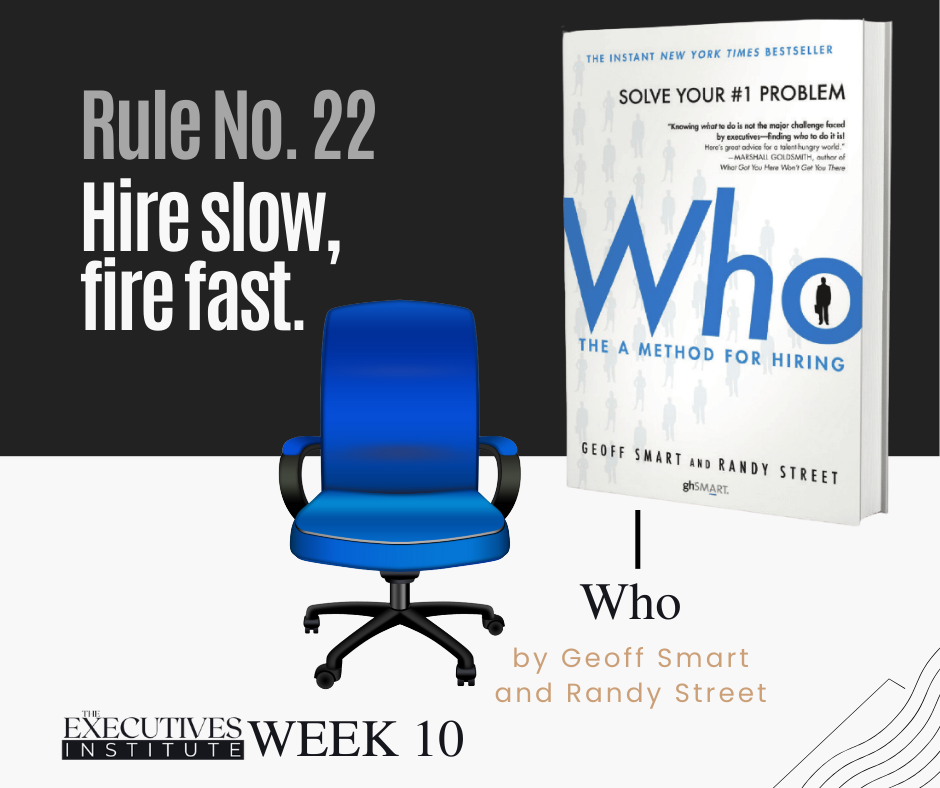
WEEK 10 | Recommended Reading —
Who by Geoff Smart & Randy Street
“Nothing will accelerate your success more than getting the right team in place. And nothing will derail it faster than keeping the wrong people too long.” — Geoff Smart
Executive Takeaway
Your biggest competitive advantage isn’t your product, your market, or your strategy—it’s your people. Stop gambling on hiring and start treating it like your most important process. The wrong “who” costs years. The right “who” multiplies results.

Rule No. 22 —Hire slow, fire fast helps business leaders…
- Avoid Costly Misfires: A bad hire isn’t just expensive—it’s contagious. This rule helps you spot red flags earlier and avoid long-term headaches.
- Build a Culture of Accountability: When people see you act decisively, they know standards matter—and mediocrity won’t be tolerated.
- Improve Talent Acquisition: By slowing down the front end, you improve your ability to find, assess, and secure A-players who actually fit.

5 Red Flags you might be ignoring Rule No. 22
You’re hiring to relieve pain, not to pursue excellence.
—Filling a seat because the workload is heavy or the pressure is high usually leads to regret. Desperation clouds judgment.
You talk yourself into candidates instead of out of them.
—If you find yourself making excuses for gaps, behavior, or fit — you already know the answer. Trust your instincts, not your justifications.
Your team has “workarounds” for a poor performer.
—When others quietly adjust to someone’s incompetence or attitude, the damage is already being done.
You’re keeping someone because you “owe them” or “don’t want to hurt them.”
—That’s empathy turned into avoidance. You’re protecting your comfort, not your culture.
There’s no clear, consistent hiring process.
—Every hire is a roll of the dice when you don’t define what a great hire looks like or how you’ll know it when you see it.

Members only, can access Boardroom 22 —Hire slow, fire fast.
- Member Insights
- Leadership Team Discussion
- Actionable Strategies
- Rules to Results Workshop
- Who Book Summary
- Key Executive Takeaways
- Real World Scenarios
- + more