

Rule No. 26 summary:
Vague goals don’t move organizations forward—clear objectives do.
This rule reminds executives that without defining what success looks like and establishing the right metrics, progress is merely hope in disguise.
Define the outcome. Tie it to measurable key results. Then hold the line until it’s achieved.
Too many leaders confuse motion with momentum. Teams get busy, meetings pile up, and everyone feels like they’re “doing a lot”—but no one can clearly define what success actually looks like. That’s a leadership failure. This rule draws a hard line: If you can’t define the outcome and measure progress, you can’t expect to achieve it. Vague goals lead to vague results. The best organizations operate with relentless clarity—on objectives, metrics, and ownership. Everything else is noise.
If you’ve fought battles that became lessons — this is where we collect them.
The insight you share might be the turning point someone else is waiting for.
 Write this down…
What gets measured gets managed. What gets ignored gets worse.

STUDY 📌Rule No. 26 —Define It. Measure It. Achieve It.
📓My Edge
My Edge is the recommended companion to your weekly study through The Weekly Edge. Each week includes a printable PDF designed to help you plan with intention, apply the Rule in real time, and record the decisions, priorities, and lessons that shape your leadership. You can print one week at a time and begin anytime throughout the year, or choose the full professionally printed spiral-bound hardcover Edge for a complete year of disciplined growth and reflection.
— The Edge Volume 1 will be available this Summer 2026 through this site
This Rule helps you with:
- Setting Strategic Objectives: It forces clarity around what you’re aiming for—no fluff, just focus.
- Driving Accountability: With defined metrics, performance isn’t based on gut feel or charisma—it’s measurable.
- Tracking Progress: You’ll know what’s working, what’s lagging, and where to recalibrate.
- Aligning Teams: Everyone rows in the same direction when the destination and milestones are clearly outlined.
- Avoiding Misplaced Effort: Helps prevent chasing activity for activity’s sake—only what moves the needle matters.
📚 Recommended Reading
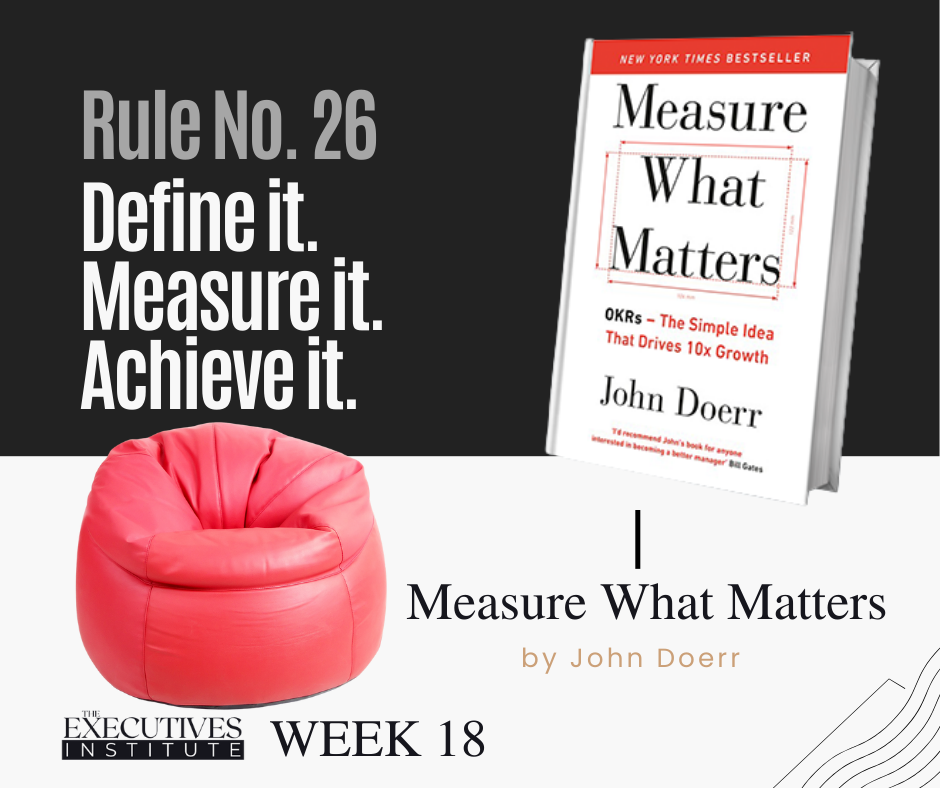
Measure What Matters
by John Doerr
“Ideas are easy. Execution is everything. And it takes a team to win.” — John Doerr
📘 Book Summary
Measure What Matters introduces the OKR (Objectives and Key Results) framework—a simple but unforgiving system built to drive clarity, alignment, and execution. Doerr shows how companies like Intel, Google, and nonprofits used OKRs to cut through noise, set bold objectives, define measurable outcomes, and create a rhythm of accountability. The message is clear: organizations don’t rise to their level of ambition; they rise to the level of what they measure and review consistently.
🔑 Key Executive Takeaway
You can’t manage what you don’t measure. If your objectives aren’t specific, measurable, and regularly reviewed, you’re not leading—you’re guessing. Executives who adopt OKRs gain a system that forces real focus, exposes drift early, and turns strategy into results.
🛠️WE ARE STILL BUILDING THIS RULE. CHECK BACK
Rule No. 26 helps you with…


Progress starts with asking better questions. Use this section and these prompts throughout The Institute to challenge assumptions, surface blind spots, and drive clearer thinking.
Use these questions, in particular, to spark clarity in your goals and discipline in execution:
 What exactly are we trying to achieve—and is it specific enough to be measured?
Example: Instead of “grow the business,” is the objective “increase revenue from recurring services by 20% this year”?
What are the 2–5 key results that would clearly prove we’re on track?
Example: “Launch new client portal by Q3,” or “Maintain churn rate below 5% for 6 consecutive months.”
Are we measuring what matters—or just what’s easy to track?
Example: Tracking social media likes might be convenient, but are those tied to pipeline growth or client engagement?
Who owns each result—and how often are we reviewing progress?
Example: Are key metrics buried in a quarterly slide deck, or discussed weekly with accountable owners?
💬Executive Discussion

Most organizations have goals, but few define them so clearly that performance becomes unmistakable. When objectives are fuzzy or key results are missing, teams default to busyness instead of progress.
This rule is a gut check for leadership: Are we measuring what actually matters—and does everyone know it?
Think of one current objective your team is working toward. Could a new team member walk in today and understand, without explanation, what success looks like and how it’s being measured? If not, what needs to be defined or redefined?
 This Rule isn’t finished—and it never will be. Business changes, leaders learn, and our Members keep sharpening the edges with real stories and hard-won lessons. What you see here is today’s version. Tomorrow’s will be better, clearer, and backed by more lived experience.
Thank you for being here and bringing your perspective—add your insight, share a story, or challenge what’s written. Together, we keep these Rules alive and relevant