

the principle 🎓 Being busy doesn’t mean you’re getting important things done. You don’t get extra credit for a full calendar or a long day. Figure out what matters most and put your time and energy there. Doing more isn’t the goal. Doing what matters is. Stop the grind. Slow down, get clear, and focus your effort where it actually counts.
Don’t mistake movement for progress.
the hard truth 📌 Busy people feel productive. Focused people are. —The reality is, meetings, phone calls and full calendars aren’t output. If the product isn’t better at the end of the day, all you did was walk in circles.
Executive insights 👥 Let me tell you how that played out in my company.
Essentialism challenges us to eliminate the nonessential so we can focus our energy on what really matters. Tell us how this Rule has impacted your leadership and your organization.
🏛️ Content Integrity Statement
To preserve the quality and credibility of The Executives Institute, all submissions must be attributed to a real person. We do not accept anonymous contributions. Our goal is to build a trusted platform grounded in lived experience, not vague opinions or internet commentary. Every insight published on this site comes from a real business owner or leader willing to stand behind their words, helping protect the value of the Institute for all Members. Contributors may contact us at any time to edit or remove their submission. We respect your voice and your choice to participate. At the same time, The Executives Institute reserves the right to remove any submission at our discretion, including in cases of public misconduct, reputational harm, or behavior that compromises the integrity of the platform and its contributors.
- Contributors verification by LinkedIn profile and/or company websites
- Those companies must be based in the United States
- Your submissions must be in English
- We do not email our contributors
- We do not sell or share their information
Not every submission will be published
Your insights (if approved), along with your name, company, website and/or LinkedIn profile may be added to any specific Rule’s page, bringing valuable exposure for you and your organization to 1000s of U.S. business leaders. Every time you share an insight, you don’t just strengthen the Institute, you elevate your brand. Leaders talk. Leaders refer.
By submitting content to The Executives Institute, you agree that:
- your submission is your own work
- you have the right to share it
- your submission may be edited for clarity, length, or formatting
- your submission may be published on the Site or in related materials
By submitting content, you grant The Executives Institute a non-exclusive, perpetual license to display and distribute that content as part of the Institute’s mission. The Executives Institute Terms of Use + Privacy Policy
the Rules matter.
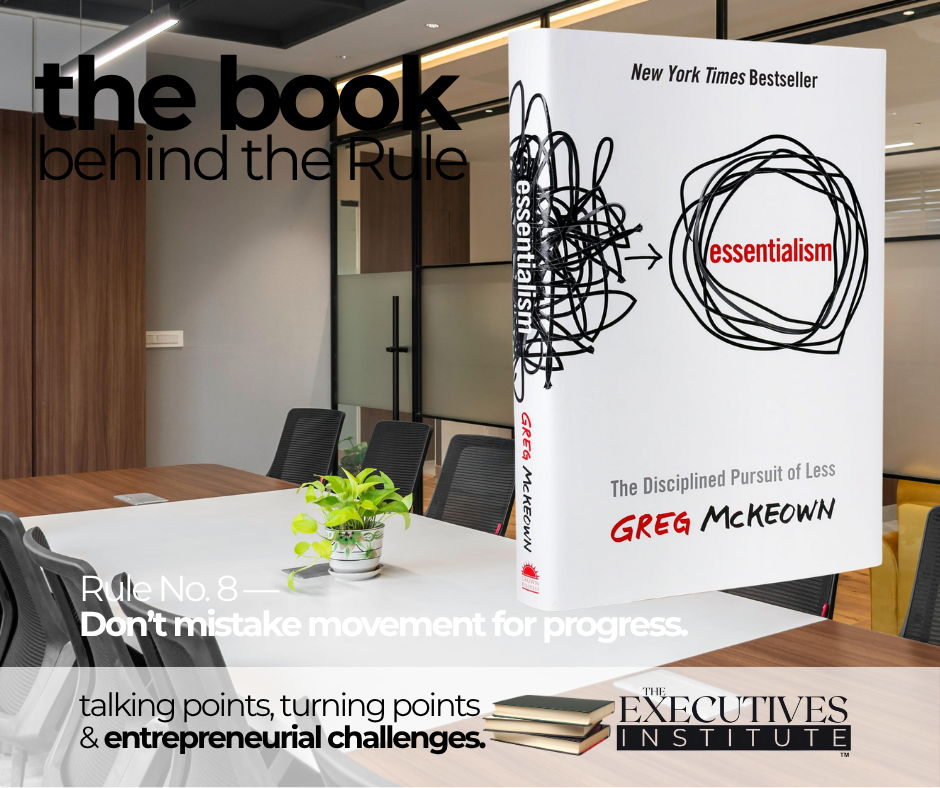
📖 the book behind the Rule
Essentialism: The Disciplined Pursuit of Less, by Greg McKeown
Essentialism is about embracing clarity, boundaries, and purpose. Through stories, research, and practical tools, he helps readers identify what truly matters and eliminate what doesn’t. The result is a mindset shift, from reactive busyness to intentional living. This book is a powerful guide for leaders and teams who want to achieve more by doing less, but doing it better.
Executive Takeaway: Focus will drive results. Leaders who prioritize the essential over the trivial many not only free their own time and energy, they enable their teams to achieve more with less distraction. Progress is measured by impact, no activity.
“What if we stopped celebrating being busy as a measure of importance?” — Greg McKeown


turning points 📈 executive study
Don’t confuse a full calendar with a successful business. At the end of the day, nobody cares how busy you were, they care about what you accomplished. As leaders, our job isn’t to keep everyone moving. It’s to make sure we’re moving in the right direction. Meetings, emails, and activity are not results. If you can’t point to a measurable outcome at the end of the week, you were busy, not productive. There’s a difference.
Most of us have fallen into the trap (along with our companies) and not even realized it —we’re all scrambling, working our butts off, and nothing is really moving the needle. Everyone has a full calendar, meetings are happening every day and “urgent” projects are continually being launched. Yet, there’s never a real clear outcome. You’re exhausted and going nowhere. Stop. This Rule urges you to hit pause, assess what’s working, then move deliberately, not reactively.
A) Where are you seeing the most activity in your business that isn’t producing enough progress? What are you and your team spending too much time doing?
B) What is something you know you should stop doing, but haven’t?
What’s keeping you from letting it go?
C) When your team is extremely busy but the results aren’t there, how do you recognize it? And, what do you do about it? Tell us about a time when you had to stop the motion and change direction.
🥊 challenge the Rules | contrarian view for a healthy debate
Sometimes movement is progress. The danger in this rule is taking it too far. Not every productive activity produces an immediate, measurable result. Sales calls, networking, research, employee development, experimentation, and just showing up every day can look like “busy work” until the payoff comes later. A company that constantly stops to question whether every activity is producing visible progress may become so focused on efficiency that it loses momentum, opportunity, and resilience.
The real question may not be whether we’re busy. It’s whether we’re busy doing things that have a reasonable chance of moving us forward.
Around the table:
- Are you eliminating unnecessary activity, or are you using “focus” as an excuse to avoid the work?
- Think of three activities in your calendar every month, putting one into each of these categories: essential, optional, or just distracting.
Leadership team discussion:
- What meetings, habits, or tasks could we eliminate without losing real value?
- If we could only focus on one initiative this quarter, what would have the highest impact?
- What is one change we could make this week that would create the biggest forward movement in my work or our team?
This could be a turning point.
📔 Week 8: Eliminate one. Elevate one.
This week, don’t try to accomplish more.
Instead, improve the quality of your focus.
Read the Rule. Then study it. The full Rule page takes you deeper, with hard-earned insights from business leaders across the U.S., red flags to challenge your thinking, green flags to show you’re moving in the right direction, plus key terms, links, videos, and more. The goal isn’t to know the Rule. It’s to use it.
MASTER 🎓 Rule No. 8 —Don’t mistake movement for progress.
- When to Apply | Red Flags
- Rule Overview
- Ask the Right Questions
- Contrarian View
- Actionable Strategies
- Real World Scenarios
- Leadership Team Discussion
- Rules to Results Workshop
- The Right Track | Green Flags
- Key Terms
- Book Summary
- Author Links
- Executive Insights
- Worth Watching
- Related Reading
October 2026
This Master Class is in development.
Help us build each of the 50 Master Classes, by adding your insights and sharing your entrepreneurial stories.
Class begins Monday, January 4, 2027, with each Rule being built out as we go. Each will contain the study sections listed above and will continue to evolve through your contributions. As business leaders continue to challenge these ideas, the Institute becomes more and more valuable, not because it’s finished, but because it never will be.

The word “priority” came into the English language in the 1400s. It was singular. It meant the very first or prior thing. It stayed singular for the next five hundred years. Only in the 1900s did we pluralize the term and start talking about “priorities.” Illogically, we reasoned that by changing the word we could bend reality. Somehow we would now be able to have multiple “first” things. One leader told me of his experience in a company that talked of “Pri-1, Pri-2, Pri-3, Pri-4, and Pri-5.” This gave the impression of many things being the priority, but actually meant nothing was. An Australian nurse named Bronnie Ware, who cared for people in the last twelve weeks of their lives, recorded their most often discussed regrets. At the top of the list: “I wish I’d had the courage to live a life true to myself, not the life others expected of me.” A Nonessentialist thinks almost everything is essential. An Essentialist thinks almost everything is nonessential. Many capable people are kept from getting to the next level of contribution because they can’t let go of the belief that everything is important. But once we fully accept that a few things are so much more valuable than the rest, we start scanning our environment for those vital few — and eagerly eliminate the trivial many. Only then can we say no to good opportunities and say yes to truly great ones. Essentialism, pg 21
Greg McKeown, LinkedIn post March 25, 2026