

The Principle: You need good systems, but don’t let the systems become more important than the people using them. Hire people you trust. Give them clear expectations. Then give them room to think, make decisions, and do their jobs. A handbook can’t replace good judgment, and another rule isn’t going to fix poor leadership.
People over processes.
The Hard Truth
Processes don’t build businesses. People do.
Executive Insights 👥 Tell us how this Rule has played out in your company.
⚠️Content Integrity Statement
To preserve the quality and credibility of The Executives Institute, all submissions must be attributed to a real person. We do not accept anonymous contributions. Our goal is to build a trusted platform grounded in lived experience, not vague opinions or internet commentary. Every insight published on this site comes from a real business owner or leader willing to stand behind their words, helping protect the value of the Institute for all Members. Contributors may contact us at any time to edit or remove their submission. We respect your voice and your choice to participate. At the same time, The Executives Institute reserves the right to remove any submission at our discretion, including in cases of public misconduct, reputational harm, or behavior that compromises the integrity of the platform and its contributors.
- Contributors verification by LinkedIn profile and/or company websites
- Those companies must be based in the United States
- Your submissions must be in English
- We do not email our contributors
- We do not sell or share their information
⚠️Not every submission will be published
Your insights (if approved), along with your name, company, website and/or LinkedIn profile may be added to any specific Rule’s page, bringing valuable exposure for you and your organization to 1000s of U.S. business leaders. Every time you share an insight, you don’t just strengthen the Institute, you elevate your brand. Leaders talk. Leaders refer.
By submitting content to The Executives Institute, you agree that:
- your submission is your own work
- you have the right to share it
- your submission may be edited for clarity, length, or formatting
- your submission may be published on the Site or in related materials
By submitting content, you grant The Executives Institute a non-exclusive, perpetual license to display and distribute that content as part of the Institute’s mission. The Executives Institute Terms of Use + Privacy Policy
the Rules matter.
Executive Insights 👥
I built our intake and matching system myself, and it can run end to end without a person touching it. A client describes what they need, the system scores clinicians, and a match goes out by text and email. I deliberately kept a human decision in that loop anyway.
The tempting version of this rule is that process scales and people do not. In most of the business that is true, and I automate everything I can. But matching someone with a therapist is the one moment where a wrong answer costs more than a slow one. A person who finally reached out after months of hesitation and gets a poor fit may not reach out again. The data can rank clinicians. It cannot always hear what the person was really asking for.
So the rule I work by is: automate the work, not the judgment. Let the process do the sorting, the scheduling and the reminders. Keep a person on the decision that carries the most weight for the human on the other end.
What I would tell another executive: before you automate a step, ask what a wrong answer costs the customer, not what a slow answer costs you. If the cost of wrong is high, keep a person on it, even when the software is good enough to take over. —Elijah
More about Elijah and CEREVITY
CEREVITY is a private-pay concierge network of independent licensed clinicians built for high achievers: executives, founders, physicians, attorneys and finance leaders. I am co-founder and CTO, with about 20 years in healthcare IT, including as director of IT operations at a national mental health company. connect with Elijah on LinkedIn

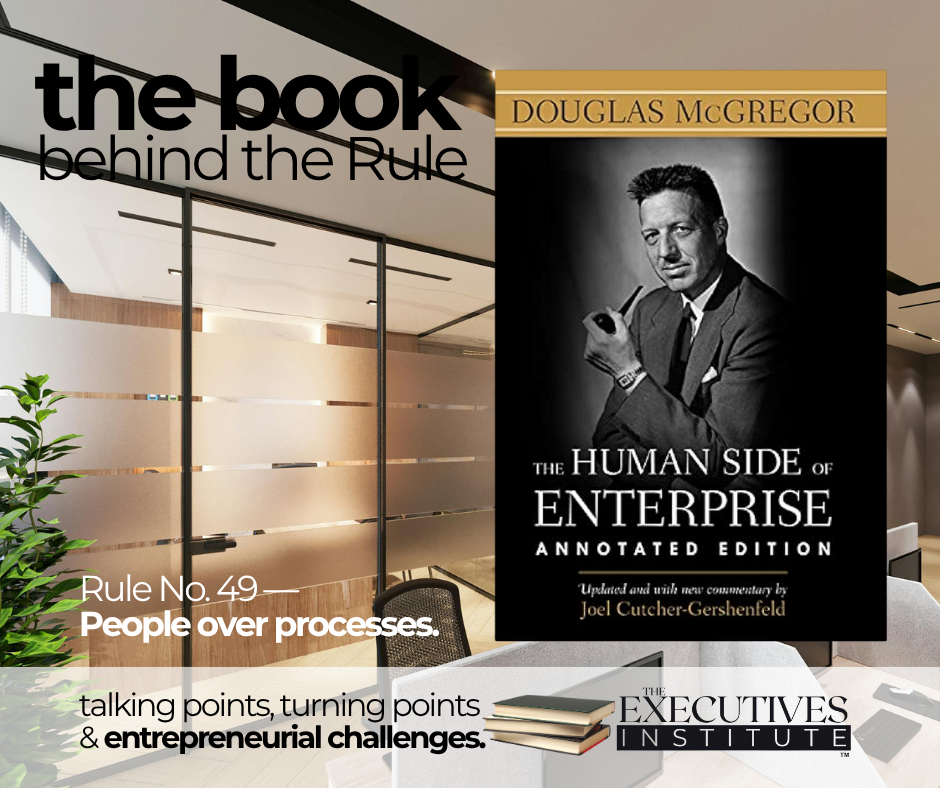
📖 the book behind the Rule
The Human Side of Enterprise, by Douglas McGregor
This book has reshaped modern management thinking by challenging the assumption that workers must be controlled, coerced, or constantly monitored. He introduced Theory X and Theory Y, two opposing views of human motivation.
- Theory X assumes people dislike work, avoid responsibility, and need strict supervision.
- Theory Y assumes people are self-motivated, seek meaning, and perform best when trusted and empowered.
McGregor argued that most organizations were built on Theory X assumptions, stifling potential and innovation. He made a compelling case that leadership grounded in trust, autonomy, and belief in human potential produces stronger results and healthier cultures.
Executive Takeaway: Your management philosophy shapes your company’s reality. If you treat people like problems to be managed, they’ll act like it. Treat them like partners in the mission and they’ll deliver beyond any process you could ever design.
“The ingenuity of people is far more reliable than the ingenuity of systems. Trust in people is not naïve…it’s essential.”
— Douglas McGregor
Douglas McGregor and his theories


Good processes make good people better. Bad processes make everyone’s job harder. Don’t keep adding new rules and procedures because you don’t trust your people to make good decisions. Hire people worth trusting, build systems that support them, and stop managing for the worst-case employee. People over processes.
🎓 MASTER Rule No. 49 —People over processes.
- When to Apply | Red Flags
- Rule Overview
- Ask the Right Questions
- Contrarian View
- Actionable Strategies
- Real World Scenarios
- Leadership Team Discussion
- Rules to Results Workshop
- The Right Track | Green Flags
- Key Terms
- Book Summary
- Author Links
- Executive Insights
- Worth Watching
- Related Reading
October 2026
This Master Class is in development.
Help us build each of the 50 Master Classes, by adding your insights and sharing your entrepreneurial stories.
Class begins Monday, January 4, 2027, with each Rule being built out as we go. Each will contain the study sections listed above and will continue to evolve through your contributions. As business leaders continue to challenge these ideas, the Institute becomes more and more valuable, not because it’s finished, but because it never will be.