

the principle 🎓 Don’t settle for the first solution that comes to mind. Ask questions. Try different approaches. Throw out ideas that don’t work and try again. The better answer is often (usually) the one you find after the obvious answer doesn’t work.
And remember, every bad idea costs money when you put it out into the real world.
Your first idea is rarely your best.
the hard truth 📌 Your first idea is probably the same one everyone else already had. —The reality is, your first version is just a rough draft with a logo on it. Expect to throw it out and be glad you did.
Executive insights 👥 Let me tell you how that played out in my company.
Have you ever moved forward with the first idea that seemed right, only to later realize a better option existed? What did you learn from that?
🏛️ Content Integrity Statement
To preserve the quality and credibility of The Executives Institute, all submissions must be attributed to a real person. We do not accept anonymous contributions. Our goal is to build a trusted platform grounded in lived experience, not vague opinions or internet commentary. Every insight published on this site comes from a real business owner or leader willing to stand behind their words, helping protect the value of the Institute for all Members. Contributors may contact us at any time to edit or remove their submission. We respect your voice and your choice to participate. At the same time, The Executives Institute reserves the right to remove any submission at our discretion, including in cases of public misconduct, reputational harm, or behavior that compromises the integrity of the platform and its contributors.
- Contributors verification by LinkedIn profile and/or company websites
- Those companies must be based in the United States
- Your submissions must be in English
- We do not email our contributors
- We do not sell or share their information
Not every submission will be published
Your insights (if approved), along with your name, company, website and/or LinkedIn profile may be added to any specific Rule’s page, bringing valuable exposure for you and your organization to 1000s of U.S. business leaders. Every time you share an insight, you don’t just strengthen the Institute, you elevate your brand. Leaders talk. Leaders refer.
By submitting content to The Executives Institute, you agree that:
- your submission is your own work
- you have the right to share it
- your submission may be edited for clarity, length, or formatting
- your submission may be published on the Site or in related materials
By submitting content, you grant The Executives Institute a non-exclusive, perpetual license to display and distribute that content as part of the Institute’s mission. The Executives Institute Terms of Use + Privacy Policy
the Rules matter.
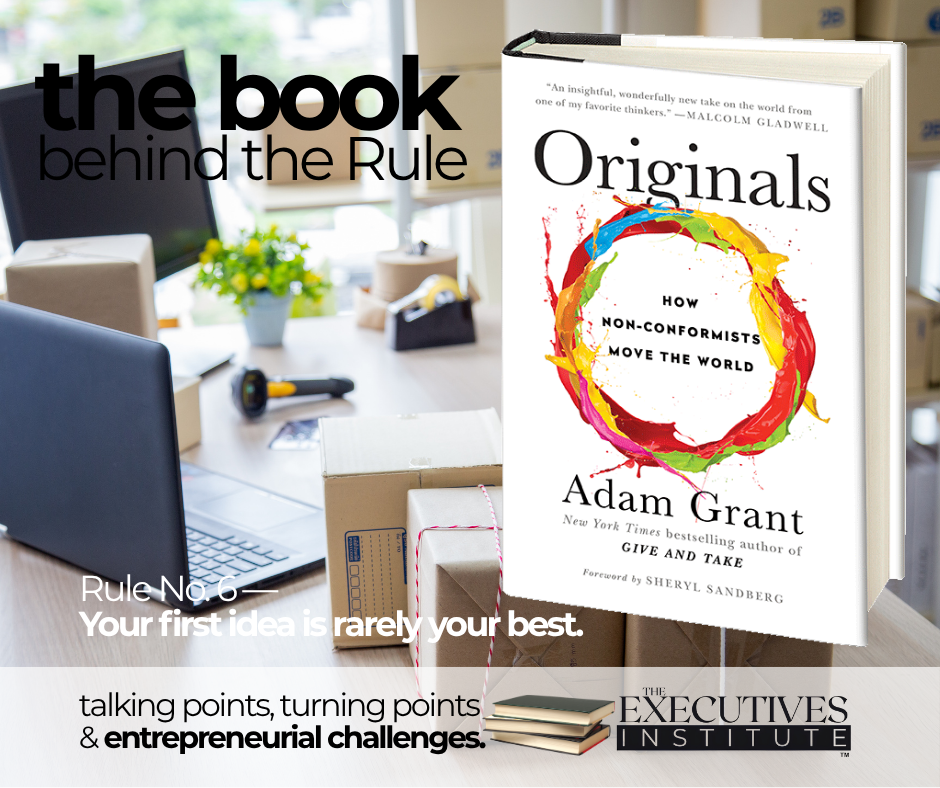
📖 the book behind the Rule
Originals: How Non-Conformists Move the World, by Adam Grant | Follow Adam at LinkedIn
Originals explores how individuals champion new ideas and drive change without waiting for permission or perfect timing. Adam Grant draws on research and real-world examples to reveal that originality isn’t just about creativity, it’s about courage, persistence, and strategic risk-taking. He explains how to recognize good ideas (and weed out bad ones), speak up effectively, build support, and overcome the fear of failure. The book challenges the myth of the lone genius, showing that innovation thrives through iteration, feedback, and a willingness to challenge the status quo.
Executive Takeaway: Originals shows that innovation isn’t about having a single lightning-bolt idea, it’s about generating many, challenging your own thinking, and refining until the best solution emerges. The most successful leaders aren’t the ones who act first, but the ones who think differently and persist long enough to get it right.
“The greatest originals are the ones who fail the most, because they’re the ones who try the most.” — Adam Grant


turning points 📈 executive study
The first idea is also usually the most obvious one. That’s why you should always question it. The businesses that break through are willing to ask, “What if we’re wrong?” or “What else could we do?” and keep looking, long after everyone else has stopped. Breakthroughs rarely come from the first answer. They come from the discipline to ask more and better questions. As leader, being the person with the answer isn’t nearly as important as being willing to question your own answer. Your first idea may be good. It may even be right. But don’t let your position, your experience, or your ego keep you from asking, “What else?” Give your team permission to challenge the first answer. Give yourself the same permission. The better idea may just be one conversation away.
A) As a decision-maker, how do you balance the urgency to act with the discipline to challenge your first idea, especially when others are ready to follow your lead?
B) Think about a big decision your company made in the past year. Did you choose the best idea, or the first idea that seemed workable? Would you do it differently today?
C) Why, or in what area, does your team tend to settle on the first idea? Is there a possibility that your are the bottleneck in the process?
D) What strategies do we have that could change the decision-making process to consistently bring more alternative ideas to the table?
🥊 challenge the Rules | take the contrarian view
Go with your gut. Your first idea is often your clearest, and overworking it could reduce speed, conviction, and competitive advantage.
- Are you really improving the idea, or just delaying the decision because you’re uncomfortable committing to it?
As a group, could we come up with 3-5 actionable strategies that put Rule No. 6 —Your First Idea Is Rarely Your Best into practice and help each of us turn this Rule into a habit?
One last word, before we wrap for the week…
In business, there will always be pressure for you to decide and execute quickly. Over and over you’ll hear “speed is a virtue”. It is, but speed applied to the wrong idea just makes a bigger mistake. Your real strength, as the leader of your team, is having the discipline to stop for a second and ask, “What else?”. Don’t build on the obvious (that also could have been the name of this Rule). We don’t build on the obvious because the stakes are high and, as the leader, people are going to rally around the first idea that you say out loud. If you don’t intentionally open the door for second and third opinions, and various options, no one else will.
This week isn’t about slowing down your business. It’s about sharpening it. Here’s the advice: treat your first idea like a rough draft, not a decision. Write it down, set it aside, and force yourself to come back with two more approaches. The discipline we build by comparing ideas is where our better judgment comes from. The first idea often wins just because it’s convenient, not because it’s the best. It sounds decisive. It feels productive. Everyone nods, and you move on it. Remind your team to think deeper. Ask them if everyone thought of this idea. That probably means your competitor did to. Stop. Think deeper.
See you next week. Take this Rule back to the office.
Leadership team discussion
- Where are we making decisions too quickly because the first idea sounds good enough?
- As a company, are we rewarding speed or thoughtful exploration of ideas?
- How could we invite 2nd, 3rd or 10th ideas, instead of just rallying around the first one?
Maybe this is a turning point for your company…
📔 Week 6: Start asking “what else could we do?”
Choose one real decision your business is currently facing and apply the “Three-Option Standard.”
By the end of the week, you should have one documented decision that improved because you deliberately pushed beyond the first idea.
The point of the exercise is to build the habit of challenging the obvious before it becomes expensive.
Keep going. Take a deeper dive into this Rule and see what it looks like in the real world. Hear how other business leaders have approached the issue, look for red flags and green flags in your own organization, and explore the additional terms, links, videos, and resources we’ve assembled.
MASTER 🎓 Rule No. 6 —Your first idea is rarely your best.
- When to Apply | Red Flags
- Rule Overview
- Ask the Right Questions
- Contrarian View
- Actionable Strategies
- Real World Scenarios
- Leadership Team Discussion
- Rules to Results Workshop
- The Right Track | Green Flags
- Key Terms
- Book Summary
- Author Links
- Executive Insights
- Worth Watching
- Related Reading
October 2026
This Master Class is in development.
Help us build each of the 50 Master Classes, by adding your insights and sharing your entrepreneurial stories.
Class begins Monday, January 4, 2027, with each Rule being built out as we go. Each will contain the study sections listed above and will continue to evolve through your contributions. As business leaders continue to challenge these ideas, the Institute becomes more and more valuable, not because it’s finished, but because it never will be.

Here are 5 warning signs you and your team may be ignoring Rule No. 6:
⚠️ Fast Consensus– Teams quickly agree on the first idea presented, with little debate or exploration of alternatives.
⚠️ Idea Fatigue – Leaders discourage “too many” suggestions, signaling that efficiency is valued over creativity.
⚠️ Fear of Rework – Projects push forward even when flaws emerge, because revisiting the concept is seen as wasted effort.
⚠️ Overconfidence in the Pitch – A strong initial presentation is mistaken for a strong long-term solution, without deeper testing.
⚠️ Lack of Iteration – Products, strategies, or campaigns are launched without pilots, prototypes, or scenario testing.