

Rule No. 31 SUMMARY:
Don’t just assign to-dos—transfer responsibility. When you delegate outcomes instead of tasks, you empower people to think, act, and lead with ownership.
It’s the difference between creating followers and developing leaders.
When you delegate outcomes, you create space for ownership, innovation, and decision-making at every level. That’s how you grow leaders, not followers—and how your organization stops depending on you for every answer.
Why? Empowered teams outperform micromanaged ones.
Most leaders think they’re empowering their teams by delegating—but they’re really just offloading. When you hand someone a task list, you’re still doing the thinking for them. Real leadership means trusting others with the destination, not just the directions.
Tell us about a time you handed someone full ownership of an outcome and they handled it differently than you would have. What did you learn from letting them solve the problem their way?
What was a moment in your career when you trusted someone with a result, not just the work—and it changed how you lead today? What did that experience teach you about control, trust, and leadership?
When did you realize you were the bottleneck in your own organization? What happened that made you recognize you were delegating tasks but still holding the thinking and decision-making yourself?
If you’ve fought battles that became lessons — this is where we collect them.
The insight you share might be the turning point someone else is waiting for.
 Write this down…
When people own the outcome, they stop waiting for instructions.
This fundamental Rule helps leaders with:
Building Accountability: Shifts the mindset from “I was told what to do” to “I own the result.”
Developing Leaders at Every Level: Encourages critical thinking and decision-making throughout the organization.
Freeing Up Executive Bandwidth: Prevents micromanagement and allows leaders to focus on strategy, not babysitting execution.
Creating a Culture of Trust and Empowerment: Teams perform better when they feel trusted to deliver—not just to obey.
Clarifying Intent vs. Action: Forces clarity on what success looks like, rather than how to get there.
Ask Yourself —
Am I giving people responsibility for results, or just instructions for work?
If your team consistently comes back to you for the next step, chances are you’re still delegating tasks. If they come back with solutions, you’re delegating outcomes.

Here’s a scenario…
A mid-sized manufacturing company is losing key accounts because its delivery timelines are slipping. The CEO assigns the operations manager, Laura, to “fix production delays.” Normally, she would make a checklist for her team: schedule more overtime, call suppliers, reorder materials sooner, update spreadsheets. Instead, she applies Rule No.31.
What Laura Does Differently:
She doesn’t assign the steps. She assigns the outcome.
Authority Granted: Adjust schedules, change internal workflows, speak directly with suppliers, and make process changes without bringing every decision back to her.
Outcome: “By the end of the quarter, 95% of all client orders must ship on or before the promised date. You own the result.”
Constraints: No significant increase in labor costs. Quality standards cannot be compromised.
What Happens:
Instead of waiting for instructions, her team starts solving.
- One supervisor redesigns the shift handoff process to reduce downtime.
- Another team member renegotiates a faster delivery agreement with a local supplier.
- A machine operator suggests reorganizing raw material storage to cut retrieval time in half.
Three weeks later, they’re already at 92% on-time delivery with no added expense — and the team feels ownership, not compliance.
📂Lesson for Executives:
When Laura stopped delegating tasks and started delegating responsibility for the result, her team stopped being workers and started being problem-solvers. She didn’t just fix a production issue—she built a culture of leaders.
🚩 Here are 5 Red Flags You’re Still Delegating Tasks, Not Outcomes
1. People constantly ask, “What do you want me to do next?” If your team needs step-by-step permission or direction, they don’t own the result — they’re just checking boxes.
2. Projects stall the moment you’re unavailable. If progress depends on your input, review, or sign-off at every stage, you haven’t delegated ownership — you’ve just redistributed labor.
3. Updates sound like activity reports, not results. When employees report, “We sent the emails,” or “We held the meeting,” instead of, “Here’s what we achieved,” they’re focused on tasks, not outcomes.
4. Employees execute perfectly—but the result still fails. That means they followed orders instead of thinking. Compliance replaced judgment. They did the task, but didn’t own the mission.
5. Your high performers feel bored or trapped. Talented people want responsibility, not task lists. If they’re disengaged, it’s likely because you’re using them as hands instead of trusting them as minds.
To apply this rule effectively, executives must shift their questioning from activity-focused to outcome-driven. These questions help frame the mindset:
What does success look like for this initiative?
Instead of saying, “Send out the survey,” ask, “What insights do we need from our customers, and how will we use them?”
→ This helps clarify the purpose, not just the motion.
Who owns this outcome, and do they have authority to adapt?
Rather than “Who’s working on this?”, ask who is responsible for delivering results, and whether they can make decisions along the way.
→ Empowerment without authority is a setup for failure.
Are we solving for speed, quality, cost—or something else?
When delegating, clarify what trade-offs are acceptable.
→ “Get it done fast” isn’t the same as “Get it done right.” Define the true north.

Leadership Team Discussion
Too many executives unintentionally train their teams to wait for instructions, not take initiative.
This is especially true in organizations where tasks are handed down like a checklist and judgment is discouraged.
But when we delegate outcomes—clear, defined, measurable end goals—we force people to think, decide, and lead. And that’s when real growth happens.
DISCUSS: In our current leadership structure, are we delegating tasks or outcomes?
Share a recent example.
What would have changed if we had delegated the end result instead of the steps to get there?
How can our organization start building a culture where outcome ownership is the norm, not the exception?

WEEK 12 Action Step —
This week, pick one project or responsibility you normally delegate as a set of tasks. Instead, delegate only the desired outcome. Be explicit about what success looks like, the non-negotiables, and where they have freedom to decide. Then step back—resist the urge to dictate the how—and watch how your team handles the ownership.

Rules to Results Workshop – Rule No.31: Delegate Outcomes, Not Tasks
✅ Total Time: 45 Minutes
1. Opening & Framing the Rule (5 minutes)
Facilitator Briefing Points (keep it sharp):
- Most leaders think they’re delegating — they’re really just assigning to-do lists.
- Delegating a task creates compliance.
- Delegating an outcome creates ownership.
- This rule is about building thinkers, not task-rabbits.
Opening Question to the Room:
“How much of your day is spent giving answers instead of expecting ownership?”
2. Core Concept Breakdown (5 minutes)
Explain the Difference Clearly:
| Delegating Tasks | Delegating Outcomes |
|---|---|
| “Send the report by Friday.” | “Ensure the board clearly understands where we’re ahead, behind, and why — by Friday.” |
| “Post on LinkedIn daily.” | “Increase industry visibility and generate inbound interest from prospects.” |
| “Schedule the meetings.” | “Make sure all departments are aligned on the new process by next week.” |
Tie to Book: Turn This Ship Around — shifting authority to where the information is.
3. Personal Assessment Exercise (Individual – 5 minutes)
Prompt:
On paper, list one responsibility you delegated in the past 30 days. Write:
- What you delegated (task or outcome?)
- Did they deliver the result or just complete the steps?
- What question did they ask you during it — “What should I do?” or “Here’s what I’m planning to do — thoughts?”
Silence. No group talk yet. Force reflection.
4. Small Group Discussion (10 minutes)
In groups of 2–3, share:
- One example where you delegated a task and became the bottleneck.
- What outcome you should have delegated instead.
- What authority or decision-making you would need to hand over for true ownership.
Facilitator Cue: Keep them from rambling into excuses. Keep it outcome-focused.
5. Apply It – Outcome Rewriting Exercise (10 minutes)
Step 1: Have each executive pick a real task they’re about to delegate next week.
Step 2: Rewrite it as an outcome using this structure:
“You own achieving ____ by ____. Success looks like ____. Here are the boundaries: ____.”
Example:
“You own ensuring 90% of customer onboarding happens within 7 days by end of quarter. The process is up to you. Don’t exceed current budget.”
Step 3: Share 2–3 aloud. Push for clarity and courage.
6. Commitment & Next Steps (5 minutes)
Ask Each Leader to Decide:
- Who will I delegate an outcome to this week?
- What authority will I give them immediately?
- How will I measure success — not activity?
Final Reflection Prompt (read aloud slowly):
“If you keep delegating tasks, your team will always need you. If you start delegating outcomes, they won’t. Which future do you want?”
7. Close with the Quote (30 seconds)
“Don’t move information to authority. Move authority to the information.”
— L. David Marquet
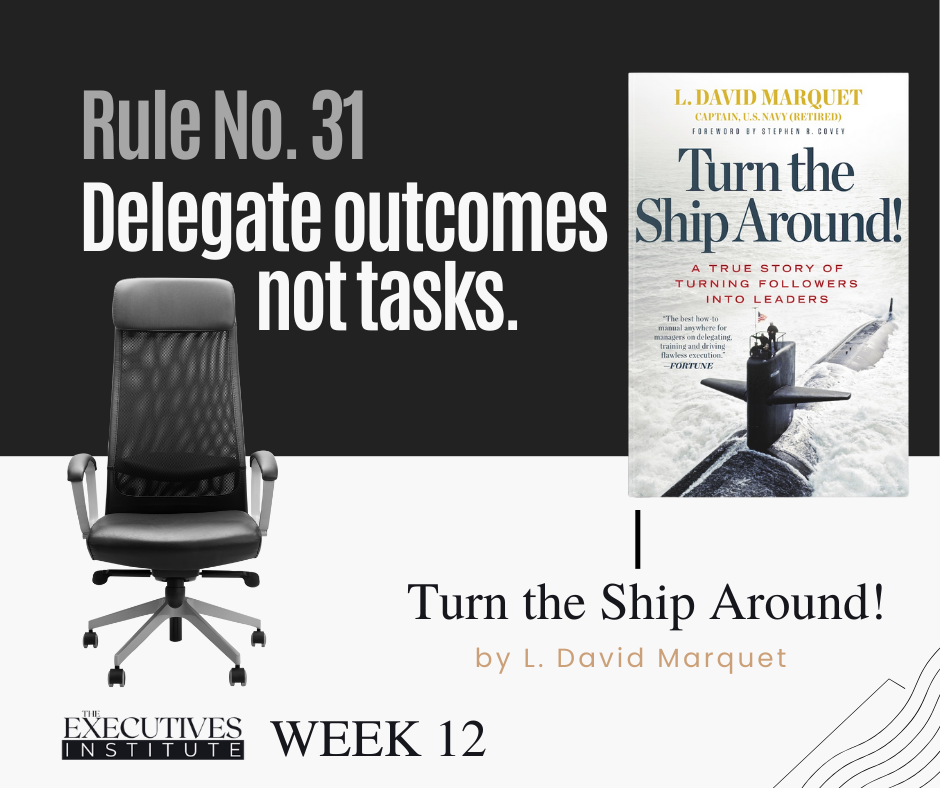
WEEK 12 Recommended Reading —
Turn the Ship Around! by L. David Marquet
“Don’t move information to authority. Move authority to the information.” — David Marquet
This principle flips traditional command-and-control leadership on its head. When those closest to the action are trusted with the outcome—and given the authority to act—you unlock a level of initiative, accountability, and agility that no checklist can replicate.
📘Book Summary
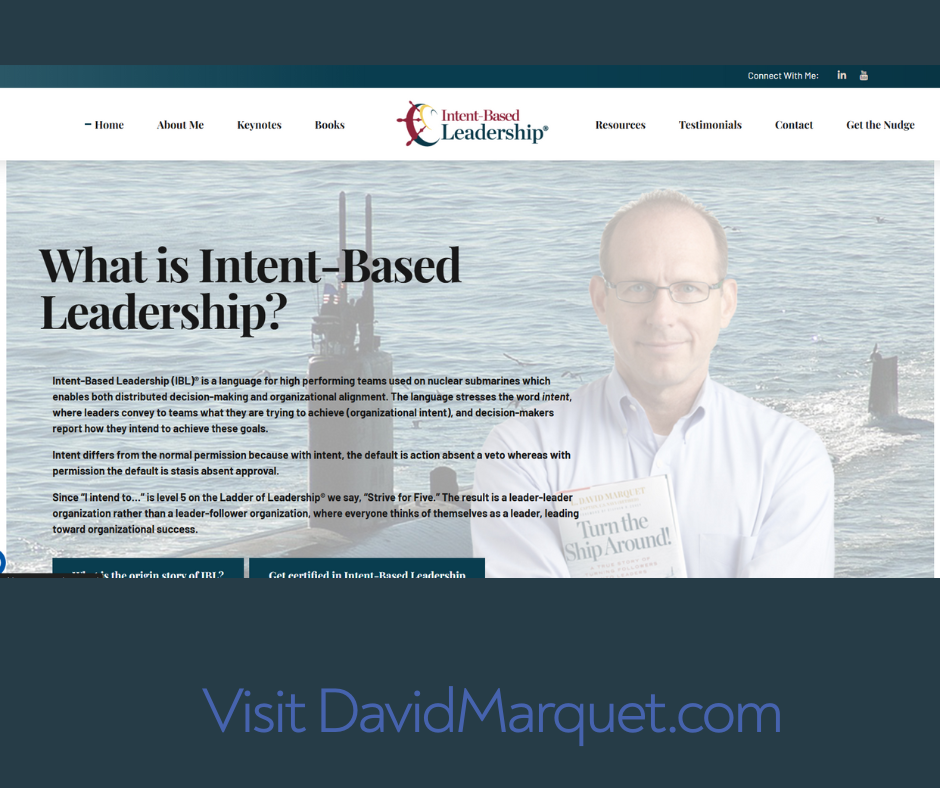
Turn This Ship Around is the true story of how Captain L. David Marquet transformed the USS Santa Fe from the worst-performing submarine in the U.S. Navy into one of the best. Instead of relying on the traditional top-down command structure, Marquet introduced a leadership model built on intent, accountability, and decentralized decision-making. He stopped giving orders and instead created leaders at every level — empowering his crew to think, decide, and own the outcomes.
Key Takeaway for Executives
Control is not the answer — ownership is.
If you want better performance, don’t tighten your grip. Push authority to where the information lives — closer to the people doing the work. When you delegate outcomes instead of tasks, you stop being the bottleneck and start building a team that leads, solves problems, and drives results without waiting for permission.
“Leadership is communicating to people their worth and potential so clearly that they are inspired to see it in themselves.”
“One of the things that limits our learning is our belief that we already know something.”

“You may be able to ‘buy’ a person’s back with a paycheck, position, power, or fear, but a human being’s genius, passion, loyalty, and tenacious creativity are volunteered only.”
This Rule isn’t finished—and it never will be. Business changes, leaders learn, and our Members keep sharpening the edges with real stories and hard-won lessons. What you see here is today’s version. Tomorrow’s will be better, clearer, and backed by more lived experience.
Thank you for being here and bringing your perspective—add your insight, share a story, or challenge what’s written. Together, we keep these Rules alive and relevant.