

Rule No. 33 summary:
In fast-paced environments where decisions pile up and mistakes cost time, solid processes safeguard your focus.
A well-designed checklist isn’t about reducing thought—it’s about removing chaos, catching preventable errors, and freeing your mind for higher-level work. The right process protects what matters most: your attention, your energy, and your time.
Systems aren’t bureaucracy—they’re armor. We don’t rise to the level of our ambition—we fall to the level of our systems.
⚠️ This Rule is currently under development and will be fully available on our official launch day, January 4, 2027. After launch, it will continue to evolve through real-world experience, member contributions, and timeless business principles—because great leaders never stop learning.
Too many leaders try to outwork inefficiency instead of eliminating it. When everything depends on memory, hustle, or the right person being in the room, you’re not building a business—you’re juggling one. The truth is, strong processes don’t slow you down; they free you up. They protect your time, reduce errors, and make excellence repeatable. Ignore them, and you’ll spend your best hours fixing avoidable problems.
If you’ve fought battles that became lessons — this is where we collect them.
The insight you share might be the turning point someone else is waiting for.
 Write this down…
If something happens more than twice, it deserves a process.
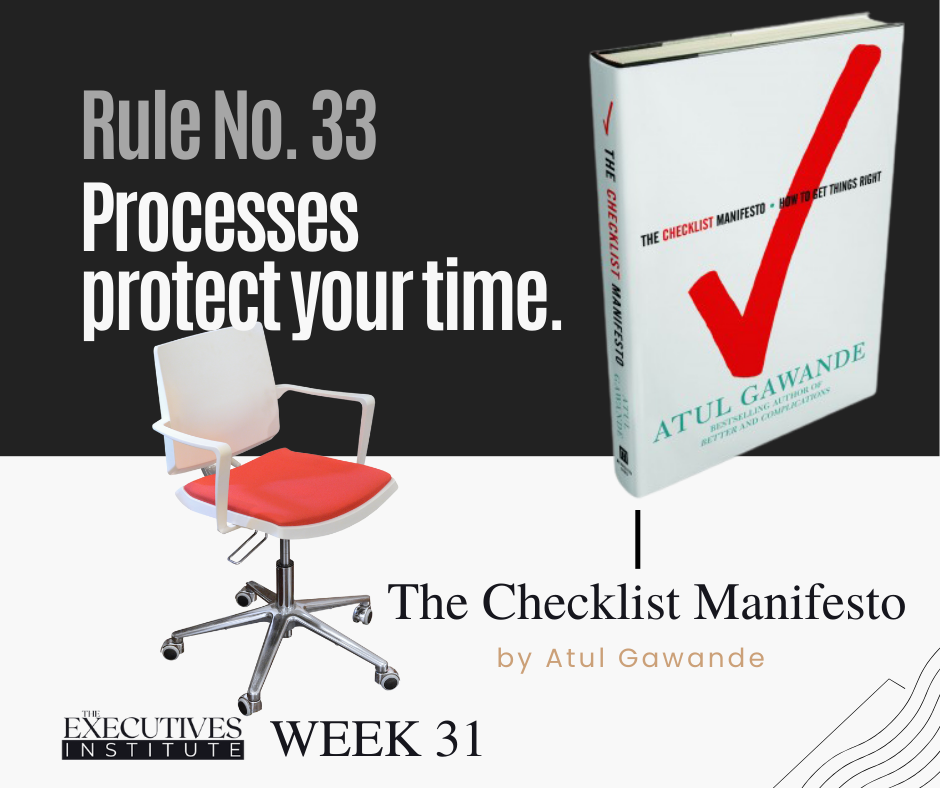
📚 Recommended Reading
The Checklist Manifesto
by Atul Gawande
“Checklists turn out to be one of the most effective tools available to improve performance.”—Atul Gawande
WE ARE STILL BUILDING THIS RULE. CHECK BACK
🧭 THIS RULE HELPS YOU WITH
- Avoiding preventable mistakes in routine or complex operations
- Freeing leadership from micromanagement and firefighting
- Building consistency without sacrificing adaptability
- Protecting executive focus for strategic thinking
- Scaling operations without scaling confusion
🔍 ASK THE RIGHT QUESTIONS
“Progress starts with asking better questions. Use this section and these prompts throughout The Institute to challenge assumptions, surface blind spots, and drive clearer thinking.”
 Where do we rely on memory, habit, or heroic effort—when a simple process would serve us better?
If your team is “just trying to remember” how things are done, you’re gambling with time and quality.
What recurring issues or delays could a basic checklist prevent?
Even small missteps—missed handoffs, skipped steps, rework—compound and erode confidence and margin.
Are we mistaking ‘process’ for ‘red tape’?
Many executives reject structure in the name of agility, but end up drowning in inefficiency disguised as freedom.
🖋️ Executive Discussion Prompt
Executives often complain about time scarcity—yet overlook where their time is bleeding out. It’s not always in meetings or emails. Often, it’s in the absence of structure. When basic tasks are reinvented daily or left to chance, it eats at your focus and your bottom line. A smart process isn’t rigid—it’s reliable. And the best leaders don’t just tolerate structure—they insist on it.

Where in our organization do we depend on people to remember, when we should depend on a process to repeat?
Follow up:
What’s the cost of continuing to operate without structure in those areas?
“Good checklists, on the other hand, are precise. They are efficient, to the point, and easy to use even in the most difficult situations. They do not try to spell out everything—they provide reminders of only the most critical and important steps…”
—Atul Gawande, The Checklist Manifesto
 This Rule isn’t finished—and it never will be. Business changes, leaders learn, and our Members keep sharpening the edges with real stories and hard-won lessons. What you see here is today’s version. Tomorrow’s will be better, clearer, and backed by more lived experience.
Thank you for being here and bringing your perspective—add your insight, share a story, or challenge what’s written. Together, we keep these Rules alive and relevant.