
Rule No. 41 summary:
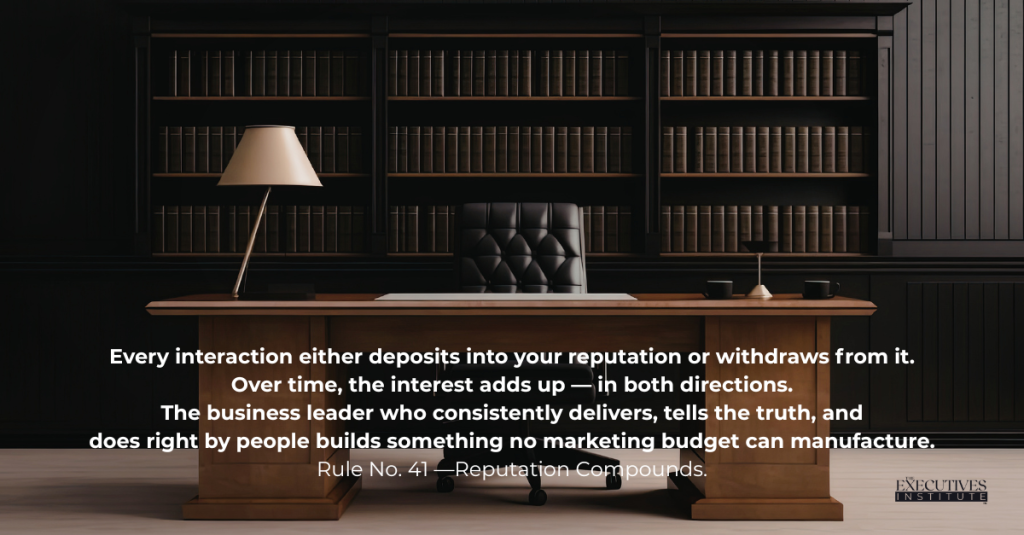
In business, reputation is rarely built in big leaps—it’s forged in small, consistent moments of credibility, integrity, and delivery.
Like interest on capital, your reputation accrues or erodes over time based on the decisions you make, the relationships you honor, and the problems you either solve or ignore.
Today’s digital transparency amplifies everything—good and bad. If you’re not actively building your reputation, you’re leaving it to chance.
⚠️ This Rule is currently under development and will be fully available on our official launch day, January 4, 2027. After launch, it will continue to evolve through real-world experience, member contributions, and timeless business principles—because great leaders never stop learning.
You don’t get to decide whether you have a reputation—you already do. The only question is whether it’s working for you or against you. In today’s world, everything is transparent, searchable, and remembered. One lapse can spread faster than ten years of solid work. But the inverse is also true: every disciplined decision, every consistent delivery, every moment you show up with integrity—it all adds weight. Reputation doesn’t just open doors; it keeps them open. And in business, that kind of compounding asset is worth more than capital.
If you’ve fought battles that became lessons — this is where we collect them.
The insight you share might be the turning point someone else is waiting for.
 Write this down…
Reputation builds slowly, but it can collapse overnight.
📚 Recommended Reading
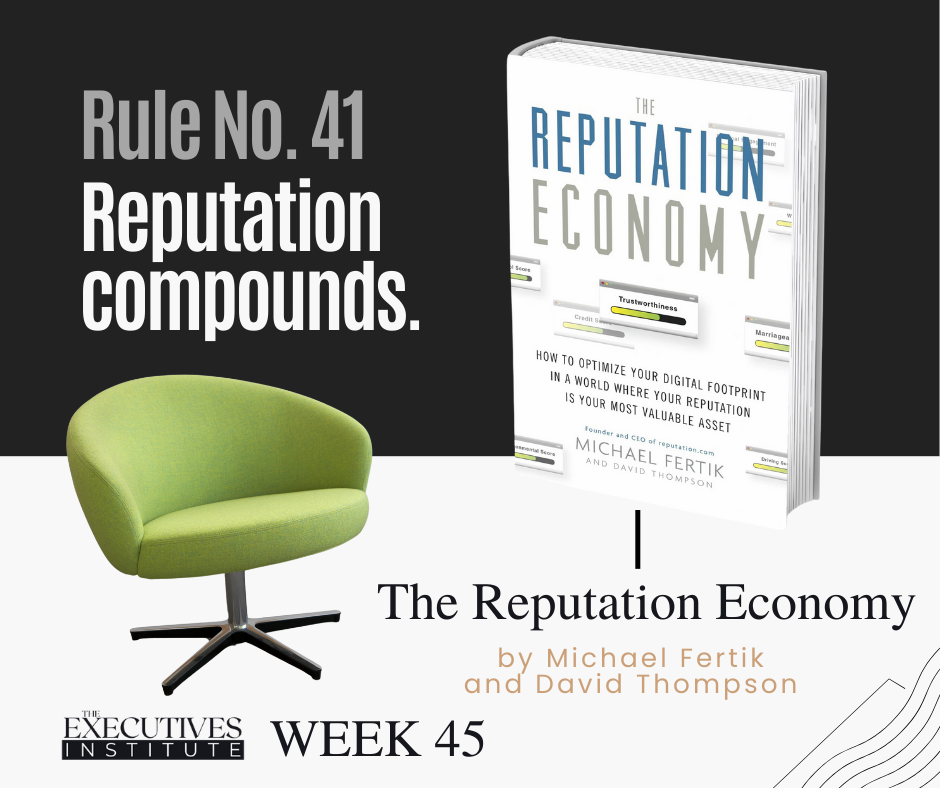
The Reputation Economy
by Michael Fertik and David Thompson
“In the Reputation Economy, your greatest asset is how others see you. Not just what you say you are, but what you prove you are—over and over again.”— Michael Fertik
April 9, 2026🛠️WE ARE STILL BUILDING THIS RULE. CHECK BACK
🧭 THIS RULE HELPS US WITH
- Building long-term trust in an era of short-term thinking
- Protecting the intangible asset that drives opportunity
- Managing how others perceive us before we need their support
- Making values visible and measurable
- Becoming the first call—not the last resort
🔍 ASK THE RIGHT QUESTIONS
“Progress starts with asking better questions. Use this section and these prompts throughout The Institute to challenge assumptions, surface blind spots, and drive clearer thinking.”
Reputation doesn’t just show up—it shows through. It reveals itself in how we treat people, how we respond under pressure, and whether we follow through when no one’s watching. To strengthen yours, start by asking the right questions:
 If a potential partner Googled us today, what would they find—and would we be proud of it?
Example: A prospective investor searched a founder’s name and found outdated reviews and an old lawsuit—even though the business had grown and improved dramatically since. They passed without asking a single question.
Where have we sacrificed long-term credibility for short-term wins?
Example: A company promoted a product heavily before it was truly ready, generating short-term buzz—but damaging customer trust for years to follow.
Are our actions and our messaging aligned—or are we sending mixed signals?
Example: A leadership team that speaks about “putting people first” but cuts employee benefits during a profitable quarter undermines its own credibility.
Who speaks on our behalf when we’re not in the room, and what are they likely saying?
Example: Former clients, vendors, and even ex-employees shape our reputation more than our marketing copy. One burned bridge can cost ten new ones.
Do we have a deliberate strategy for enhancing our reputation—or are we assuming good work will speak for itself?
Example: A small firm delivered stellar results for years but never asked for testimonials, built case studies, or leveraged referrals—leaving growth on the table.
🖋️Executive Discussion Prompt
Reputation used to be something managed through PR. Today, it’s baked into every decision we make.
In your leadership team, discuss: What are the top three drivers of our company’s reputation today—and are they the ones we want? Consider how reputation has helped (or hindered) growth over the past five years, and outline what’s changed about how trust is earned in your industry.

What are the top three drivers of our company’s reputation today—and are they the ones we want?
“In the Reputation Economy, your greatest asset is how others see you. Not just what you say you are, but what you prove you are—over and over again.” — Michael Fertik
 This Rule isn’t finished—and it never will be. Business changes, leaders learn, and our Members keep sharpening the edges with real stories and hard-won lessons. What you see here is today’s version. Tomorrow’s will be better, clearer, and backed by more lived experience.
Thank you for being here and bringing your perspective—add your insight, share a story, or challenge what’s written. Together, we keep these Rules alive and relevant.