

Rule No. 32 summary:
Before you scale, get your house in order.
Systems beat hustle. Chaos at a small size becomes a catastrophe at scale. Scaling a business with broken processes, unclear accountability, or misaligned culture only multiplies the dysfunction.
Growth doesn’t fix chaos — it exposes and magnifies it. If your business is already straining under broken processes, unclear roles, or duct-tape systems, growth will only amplify the dysfunction.
Everyone wants growth — until they realize what it actually demands. Scaling isn’t just about doing more. It’s about doing better, at scale. More people, more revenue, more moving parts — all of it moves faster, but none of it gets easier. The companies that thrive at scale are the ones that had the discipline to fix the chaos first. Otherwise, you’re not building a business — you’re building a mess, faster.
If you’ve fought battles that became lessons — this is where we collect them.
The insight you share might be the turning point someone else is waiting for.
⚠️ This Rule is currently under development and will be fully available on our official launch day, January 4, 2027. After launch, it will continue to evolve through real-world experience, member contributions, and timeless business principles—because great leaders never stop learning.
 Write this down…
Growth multiplies whatever system you already have—good or bad.

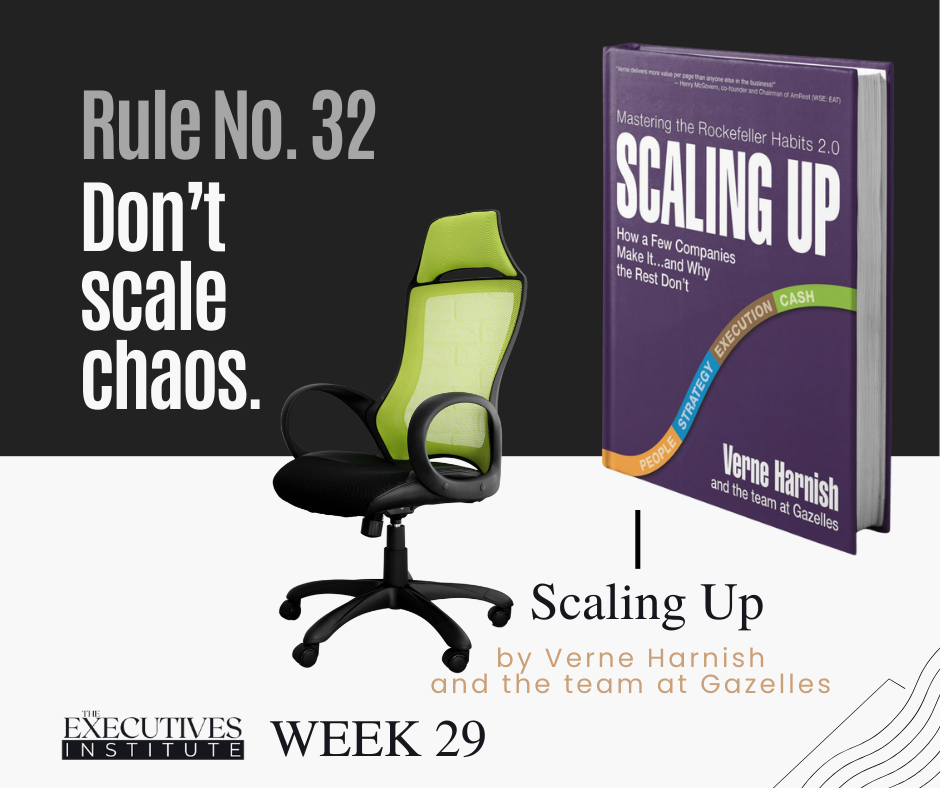
📚 Recommended Reading
Scaling Up
by Verne Harnish and the team at Gazelles
“Don’t try to scale a business that hasn’t nailed the basics. Otherwise, you’ll just get bigger problems.”— Verne Harnish
🧭 THIS RULE HELPS YOU WITH
- Avoiding growth that destroys value by ensuring your foundation is solid before expansion.
- Identifying and fixing operational bottlenecks that would cripple a larger organization.
- Creating repeatable systems so your team isn’t reinventing the wheel as you grow.
- Clarifying roles, accountability, and communication to avoid compounding confusion.
- Building a culture of operational discipline where execution keeps pace with vision.
🔍 ASK THE RIGHT QUESTIONS
“Progress starts with asking better questions. Use this section and these prompts throughout The Institute to challenge assumptions, surface blind spots, and drive clearer thinking.”
Use these to expose the cracks before you pour the concrete for growth:
 What recurring problems are we tolerating that will only get worse as we grow?
E.g., Do we have consistent project delays, missed handoffs, or unclear accountability already?
Which of our processes are person-dependent instead of system-dependent?
E.g., If a key team member left tomorrow, would things fall apart?
Do we have the right metrics in place to see, in real-time, where execution is breaking down?
E.g., Are we measuring process efficiency, not just financial results?
What part of our culture needs to mature before we scale?
E.g., Do we tolerate firefighting as a badge of honor instead of a red flag?
Are we scaling a clear model—or just trying to do more of everything at once?
E.g., Have we defined what success looks like at scale, or are we just chasing growth?
🖋️ Executive Discussion Prompt
Every leader has felt the temptation to chase growth, hoping that more revenue or more people will solve underlying problems. But Verne Harnish reminds us: you don’t fix chaos by scaling it—you institutionalize it.
This rule demands discipline, clarity, and humility: the willingness to stop, clean up, and systematize before pressing the gas pedal.

What are we doing right now that works at our current size—but would break if we doubled in size tomorrow?
Follow up:
And what hard decisions are we avoiding that would make scaling clean, not chaotic?”
“Don’t try to scale a business that hasn’t nailed the basics. Otherwise, you’ll just get bigger problems.” — Verne Harnish, Scaling Up
 This Rule isn’t finished—and it never will be. Business changes, leaders learn, and our Members keep sharpening the edges with real stories and hard-won lessons. What you see here is today’s version. Tomorrow’s will be better, clearer, and backed by more lived experience.
Thank you for being here and bringing your perspective—add your insight, share a story, or challenge what’s written. Together, we keep these Rules alive and relevant.