

Rule No. 30 summary:
Profit isn’t a reward you hope for at year-end—it’s a discipline you practice from day one.
In too many businesses, “profit” is treated like a dirty word—something to downplay, hide, or sacrifice in the name of growth. But no matter how noble your mission, if your business isn’t sustainably profitable, it won’t last.
Profit is not greed—it’s oxygen. Prioritize it. Protect it. Bake it into your system, not just your spreadsheet.
Somewhere along the way, “profit” became a word business leaders whisper rather than champion. In today’s climate, it’s fashionable to talk about purpose, scale, culture—but not profit. That’s a mistake. Because without profit, none of those things are sustainable. You can’t pay your people, reinvest in your future, or weather hard times if you’re constantly running on fumes.
Profit isn’t greed—it’s responsibility. It’s what allows a business to endure. Leaders who shy away from it out of guilt or optics are doing their organizations a disservice. The best companies bake profit into their operating rhythm—not as an outcome, but as a requirement.
If you’ve fought battles that became lessons — this is where we collect them.
The insight you share might be the turning point someone else is waiting for.
 Write this down…
Without profit, even the best mission eventually dies.
📚 Recommended Reading
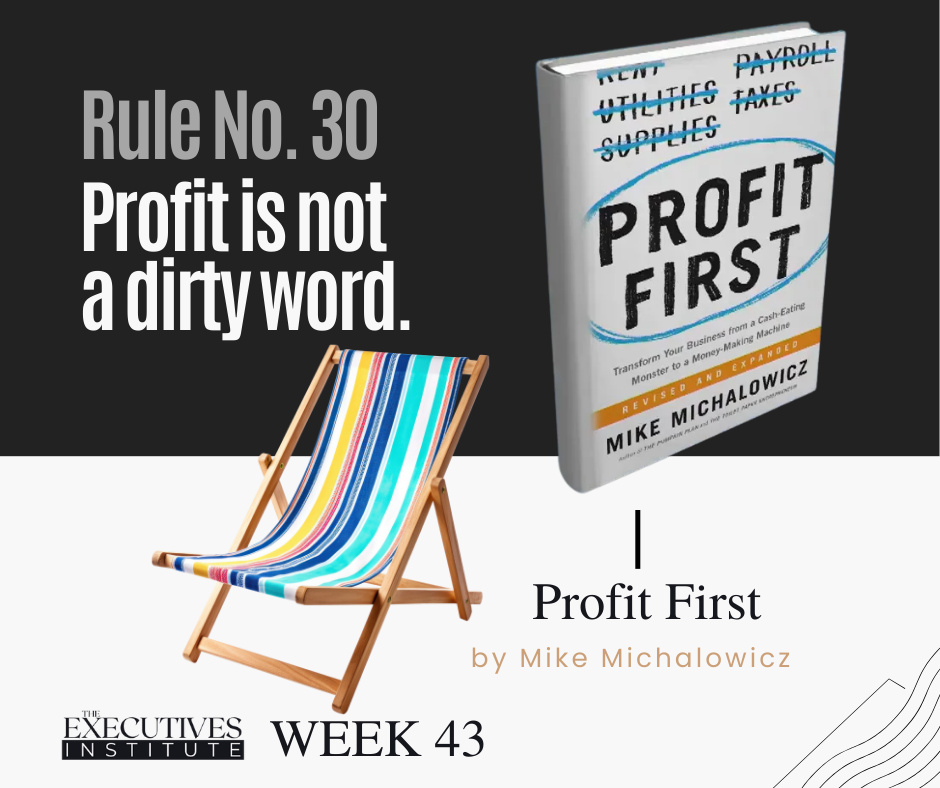
Profit First
by Mike Michalowicz
“Your business is supposed to serve you. If it’s not profitable, it’s broken.” – Mike Michalowicz
🛠️WE ARE STILL BUILDING THIS RULE. CHECK BACK
🧭 THIS RULE HELPS YOU WITH
- Building a financially resilient business that doesn’t rely on hope or high revenue alone
- Overcoming the “growth at all costs” trap by putting profit before vanity metrics
- Creating systems that force profitability through intentional cash allocation
- Changing your mindset from reactive accounting to proactive stewardship
- Staying in business long enough to fulfill your mission and serve your people
🔍 ASK THE RIGHT QUESTIONS
“Progress starts with asking better questions. Use this section and these prompts throughout The Institute to challenge assumptions, surface blind spots, and drive clearer thinking.”
Reflective and strategic questions to challenge your assumptions and sharpen your financial discipline:
- Are we rewarding top-line growth more than bottom-line health?
It’s easy to chase sales, headcount, and new locations—but are they profitable? Or are we just scaling dysfunction? - Do we have a repeatable system that ensures profit is taken first—not last?
Hope is not a strategy. Does your business model force profitability, or does it rely on what’s left over? - If profit feels “greedy” in our culture, what belief system is driving that—and is it serving us?
Many founders unconsciously adopt a martyr mindset. Are we unintentionally punishing ourselves for wanting to build something sustainable? - How would our business change if we treated profit as a fixed expense, not a leftover?
Would we cut faster, spend wiser, and price more intentionally if profit was non-negotiable?
🖋️ Executive Discussion Prompt
In many boardrooms, “profit” gets buried under talk of purpose, scale, or vision—but without profit, none of those survive. This rule isn’t about cutting corners or squeezing people; it’s about rejecting the dangerous myth that profit comes after everything else. For leaders who take their mission seriously, prioritizing profit isn’t just smart—it’s moral.

How does your leadership team currently define and defend profit?
What systems—or mindsets—need to change to ensure profit is non-negotiable in your business model, not an afterthought?
 This Rule isn’t finished—and it never will be. Business changes, leaders learn, and our Members keep sharpening the edges with real stories and hard-won lessons. What you see here is today’s version. Tomorrow’s will be better, clearer, and backed by more lived experience.
Thank you for being here and bringing your perspective—add your insight, share a story, or challenge what’s written. Together, we keep these Rules alive and relevant.