

Rule No. 29 summary:
Protecting your downside means preserving capital, limiting exposure, and designing strategies that survive worst-case scenarios.
Great investors and business leaders don’t just chase upside — they prepare for the downside. They understand that losses are more damaging than missed opportunities.
It’s not fear — it’s discipline. It’s playing defense before going on offense.
Too many leaders fall in love with the upside and forget that it’s the downside that kills. The best investors, operators, and founders all know one truth: survival is underrated. They don’t just ask “What could go right?” — they obsess over what could go wrong. Protecting your downside isn’t about playing scared. It’s about playing smart. Because in business, the winners aren’t always the boldest — they’re the ones who stay in the game long enough to capitalize when others can’t.
If you’ve fought battles that became lessons — this is where we collect them.
The insight you share might be the turning point someone else is waiting for.
 Write this down…
Smart entrepreneurs think about what could go wrong before celebrating what could go right.
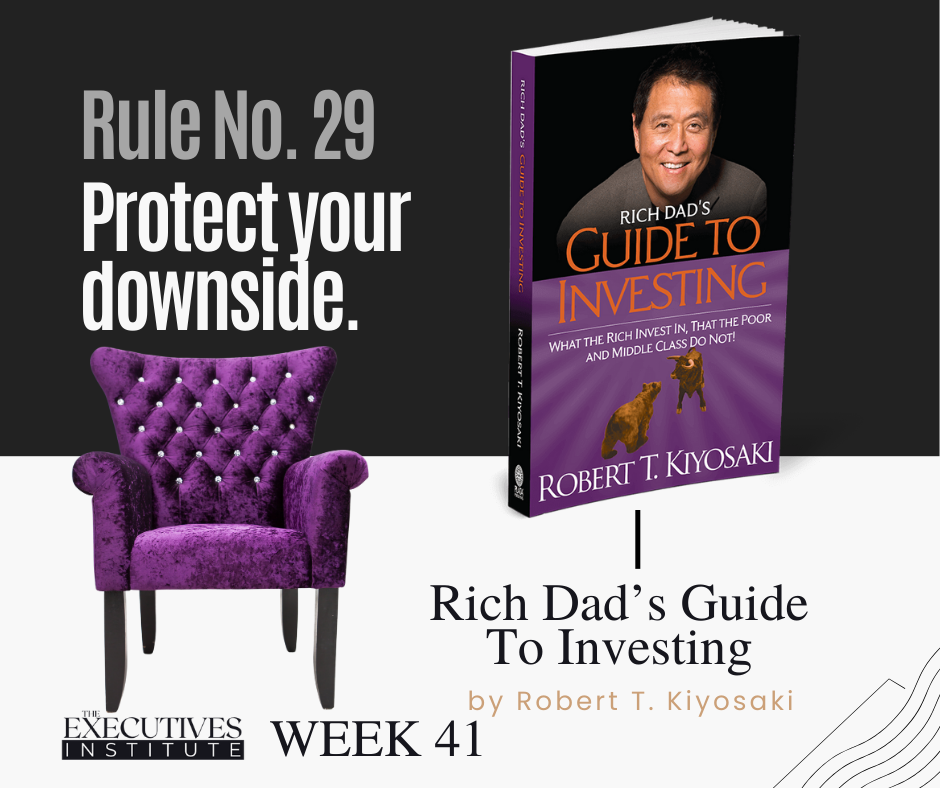
📚 Recommended Reading
Rich Dad’s Guide To Investing
by Robert T. Kiyosaki
“It’s not how much money you make. It’s how much money you keep, how hard it works for you, and how many generations you keep it for.” – Robert Kiyosaki
🛠️ WE ARE STILL BUILDING THIS RULE. CHECK BACK
🧭 THIS RULE HELPS YOU WITH
- Surviving volatility: You stay in the game when others are wiped out.
- Making smarter bets: You pursue opportunities with asymmetric risk — limited downside, significant upside.
- Building long-term wealth: You avoid catastrophic mistakes that set you back years.
- Creating sustainable strategies: You structure deals, projects, and business models that weather uncertainty.
- Thinking like an owner, not a gambler: You stop relying on hope and start using margin of safety thinking.
🔍 ASK THE RIGHT QUESTIONS
“Progress starts with asking better questions. Use this section and these prompts throughout The Institute to challenge assumptions, surface blind spots, and drive clearer thinking.”
Use these questions to assess whether your current strategy is bold but not blind:
- What’s the worst-case scenario here — and can we survive it?
Example: Before launching a new product line, ask: If it flops, will it just sting… or sink us? - Where are we exposed without realizing it?
Example: A single supplier, an overreliance on one client, or unhedged pricing could be quiet risks waiting to explode. - Are we protecting cash flow, not just chasing profits?
Example: That big project might look good on paper, but how does it impact your liquidity month-to-month? - Do we have clear exit criteria before we enter?
Example: Before investing or expanding, decide upfront: What would make us walk away — and how fast can we do it? - Is our enthusiasm blinding us to risk?
Example: Teams can fall in love with an idea. Who’s playing devil’s advocate in the room — and do they have real power to challenge?
🖋️Many businesses fail not from lack of ambition, but from ignoring downside risk until it’s too late. Protecting your downside isn’t about being conservative — it’s about being smart. Strategic defense is what gives you the right to play offense tomorrow.

What are the top 1–2 areas in your business right now where you’re vulnerable to a downside risk — and what would a disciplined plan look like to protect or eliminate that exposure?
Follow up:
Would your team even recognize those vulnerabilities — or are they flying below the radar?
 This Rule isn’t finished—and it never will be. Business changes, leaders learn, and our Members keep sharpening the edges with real stories and hard-won lessons. What you see here is today’s version. Tomorrow’s will be better, clearer, and backed by more lived experience.
Thank you for being here and bringing your perspective—add your insight, share a story, or challenge what’s written. Together, we keep these Rules alive and relevant.