

Rule No. 23 summary:
Simplicity isn’t just elegant—it’s efficient, repeatable, and scalable. The most effective strategies, decisions, and systems are grounded in a few clear rules that people can understand, remember, and act on.
Complexity kills execution.
If it takes a whiteboard and a translator to explain, it won’t scale.
Most businesses don’t fail from a lack of ideas—they fail under the weight of their own complexity. Somewhere along the way, what started as a clear mission gets buried in process, politics, and too many moving parts. Simplicity isn’t a luxury; it’s a leadership discipline. The companies that scale—really scale—do so by ruthlessly clarifying what matters, codifying it into a few simple rules, and repeating them with precision. If it’s not simple, it won’t stick. If it doesn’t stick, it won’t scale.
If you’ve fought battles that became lessons — this is where we collect them.
The insight you share might be the turning point someone else is waiting for.
 Write this down…
Complexity grows naturally. Simplicity must be protected.
📚 Recommended Reading
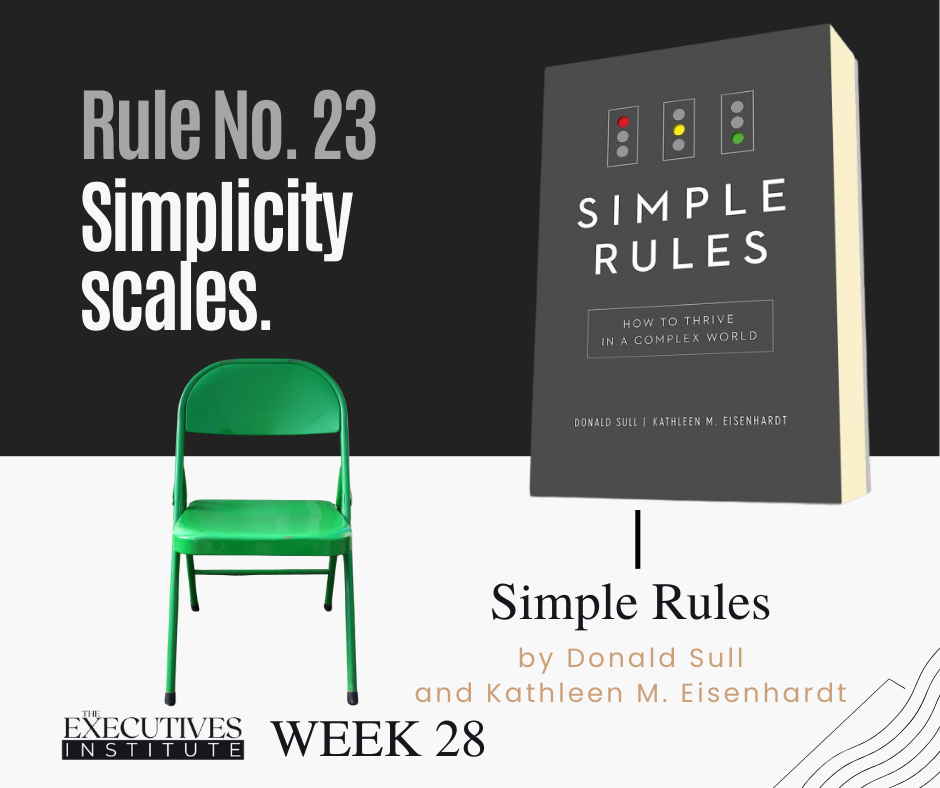
Simple Rules
by Donald Sull and Kathleen M. Eisenhardt
“Too many rules stifle innovation. Too few lead to chaos. Simple rules hit the sweet spot.”— Simple Rules
📚Book Summary
Simple Rules delivers a blunt truth: most organizations drown themselves in unnecessary complexity. Sull and Eisenhardt show that success often hinges on a small set of clear, memorable rules that guide decisions and actions when things get chaotic. Through case studies ranging from tech companies to sports teams to military units, the authors reveal how a few well-crafted rules outperform bloated processes, complicated strategies, and endless checklists. The book isn’t about dumbing things down—it’s about sharpening focus so people can move fast, execute consistently, and adapt without losing their bearings.
 Key Executive Takeaway
If your team can’t remember the rules, they can’t follow them.
Leaders who want scale must stop glorifying complexity and instead distill their operating principles into a handful of simple, decisive rules that everyone—from the intern to the EVP—can apply under pressure. Simplicity isn’t minimalism; it’s strategic clarity.
April 8, 2026🛠️WE ARE STILL BUILDING THIS RULE. CHECK BACK
🧭 This Rule Helps You With
- Scaling operations without bloating your processes or overhead.
- Making decisions faster by limiting choices to what truly matters.
- Creating alignment across teams with simple, memorable guiding principles.
- Identifying what to eliminate when things feel needlessly complicated or slow.
- Building repeatable success by designing frameworks that people can follow under pressure.
🔍 ASK THE RIGHT QUESTIONS
Let’s challenge you to see where complexity is quietly undermining your business. Below are thought-provoking Ask the Right Questions—each with a real-world example—and a Discussion Prompt to drive an unfiltered conversation with your leadership team or fellow executives.
 Where has complexity crept into our processes—and what are we tolerating as “normal”?
Example: A B2B tech firm had a 17-step client onboarding process. By rethinking what actually added value, they trimmed it to 5 steps—and saw onboarding time drop by 60%.
Ask: What are our “17 steps” that nobody has dared question?
What decisions are slowed down because people don’t know the rules or priorities?
Example: A regional bank had to escalate even minor decisions up three layers because no one understood the risk thresholds. After codifying 3 simple principles for frontline staff, decision speed and morale shot up.
Ask: Where are we bogged down because people are unclear on what they’re allowed to do?
If a new team member joined today, how easily could they explain how we operate?
Example: A manufacturing firm distilled their operations into “The 5 Things We Never Compromise,” which they put on every break room wall. It became the cultural backbone—and new hires adopted it within days.
Ask: What core operating rules would we bet the business on?
Are we mistaking sophistication for effectiveness?
Example: A services company had a stunning KPI dashboard with 40+ metrics. The CEO admitted he only looked at 3 regularly. They ditched the rest, focused on the vital few—and performance improved.
Ask: What are we tracking, building, or maintaining that looks smart but adds no real value?
In high-performing businesses, simplicity isn’t laziness—it’s precision. Yet many leadership teams unintentionally reward over-engineering: complex strategies, bloated dashboards, 80-slide decks. Why? Because complexity feels safer. It looks like work. But the truth is, complexity dilutes clarity, slows momentum, and suffocates scale.

What’s one part of your business that only “works” because smart people keep patching it?
What would it take to burn that down and rebuild something simple, strong, and scalable?
“Too many rules stifle innovation. Too few lead to chaos. Simple rules hit the sweet spot.”
— Donald Sull & Kathleen Eisenhardt, Simple Rules
 This Rule isn’t finished—and it never will be. Business changes, leaders learn, and our Members keep sharpening the edges with real stories and hard-won lessons. What you see here is today’s version. Tomorrow’s will be better, clearer, and backed by more lived experience.
Thank you for being here and bringing your perspective—add your insight, share a story, or challenge what’s written. Together, we keep these Rules alive and relevant.