

Rule No. 20 summary:
Forget vanity metrics. Forget top-line revenue. If your business doesn’t produce consistent, positive cash flow, it’s not healthy — it’s just temporarily surviving.
This rule reminds us that cash is not just a financial metric; it’s the oxygen of a business. You can’t grow, pay your people, or weather a storm without it.
Mastering cash flow isn’t an accounting detail — it’s leadership.
Every business leader eventually learns — often the hard way — that revenue is not the same as results. You can land big contracts, have a full pipeline, and still lie awake at night wondering how you’ll make payroll. That’s the brutal truth of cash flow. This rule separates real businesses from vanity projects. Cash flow isn’t just a financial detail for your accountant — it’s the single most important indicator of whether your business is healthy, scalable, and built to last. Ignore it, and your business might grow itself into the ground.
If you’ve fought battles that became lessons — this is where we collect them.
The insight you share might be the turning point someone else is waiting for.
 Write this down…
Profits look good on paper. Cash keeps the doors open.
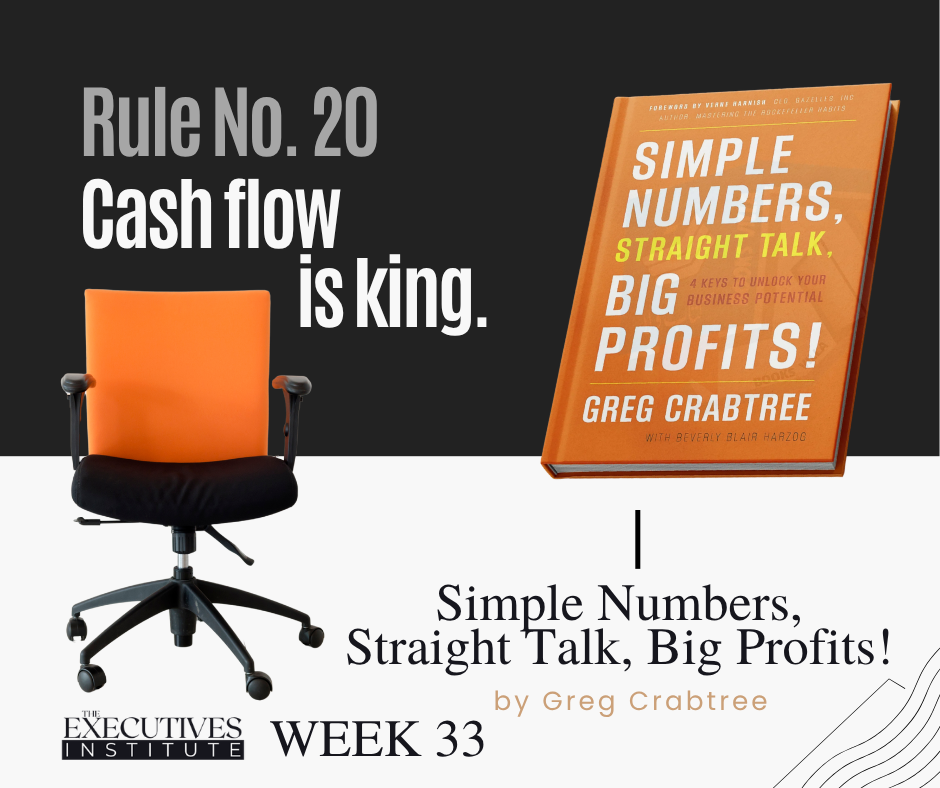
📚 Recommended Reading
Simple Numbers, Straight Talk, Big Profits!
by Greg Crabtree
“Profit is a theory. Cash is a fact.” – Greg Crabtree


April 8, 2026🛠️ WE ARE STILL BUILDING THIS RULE. CHECK BACK
THIS RULE HELPS YOU WITH 🧭
- Getting real about financial health. Profit on paper means nothing if your bank account is empty.
- Making better decisions under pressure. When you know your cash position, you lead with confidence — not guesswork.
- Scaling responsibly. Growth eats cash before it generates it. This rule keeps you from outrunning your own oxygen supply.
- Avoiding hidden traps. From bloated receivables to underpriced services, poor cash flow exposes operational flaws most metrics hide.
🔍 ASK THE RIGHT QUESTIONS
Let’s sharpen this. Rule No.20 isn’t just about managing money — it’s about facing the financial truths most leaders dodge until it’s too late. Here’s how to push that conversation forward:
Challenge yourself and your team with these — each one cuts to the core of how cash flow is understood and managed.
 Are we building a business model that consistently generates cash, or just hoping profit shows up?
Example: A services firm shows strong margins on paper but is constantly behind on payroll. The problem? Clients are paying 90 days out, and no one’s watching collections.
What would a 90-day cash drought do to our operations — and do we have a real plan for it?
Example: A manufacturer ramped up production for a big order, but the client delayed payment. Without a cash reserve strategy, they missed other vendor payments and lost trust.
Where are we letting cash leak — slow invoicing, bad pricing, or uncollected receivables?
Example: A consulting business hadn’t raised rates in 4 years and was doing unpaid ‘scope creep’ work. Cash flow was tight not because of costs, but because value was being given away.
Do our leaders understand cash flow — or are they still just focused on revenue goals?
Example: A sales VP pushes deals through with steep discounts to hit targets. The CFO flags that the deals are cash-negative once all fulfillment costs hit. Misaligned priorities kill momentum.
Lead-in:
Most leaders will nod along when they hear “cash flow is king,” but few operate like they believe it. Why? Because it forces tough tradeoffs, uncomfortable questions, and brutal clarity about whether the business is actually sustainable. This isn’t just finance — it’s a leadership discipline.

What’s one time your business had a cash flow scare — and what did you do differently afterward?
How has your mindset around cash changed as your business has grown, and what lessons would you pass on to someone scaling fast but cash-strapped?
“Profit is a theory. Cash is a fact.”
– Greg Crabtree in Simple Numbers, Straight Talk, Big Profits
It’s a cold truth most entrepreneurs ignore until reality hits. Crabtree’s entire approach is built around killing illusions and focusing on what actually keeps the business alive — and that always starts with cash flow.
 This Rule isn’t finished—and it never will be. Business changes, leaders learn, and our Members keep sharpening the edges with real stories and hard-won lessons. What you see here is today’s version. Tomorrow’s will be better, clearer, and backed by more lived experience.
Thank you for being here and bringing your perspective—add your insight, share a story, or challenge what’s written. Together, we keep these Rules alive and relevant.