
Rule No. 19 summary:
Success can become its own trap. The habits, strategies, and mindsets that helped you reach your current level often become blind spots as you aim higher.
This rule demands the discipline to let go of outdated behaviors—especially the ones that feel familiar, comfortable, or once-effective. It’s about recognizing that yesterday’s wins may be today’s liabilities.
Real growth starts not just by adding new tactics—but by subtracting what no longer serves you or your business.
If you’ve fought battles that became lessons — this is where we collect them.
The insight you share might be the turning point someone else is waiting for.
 Write this down…
Most businesses don’t fail from new mistakes—they fail from repeating old ones.
📚 Recommended Reading
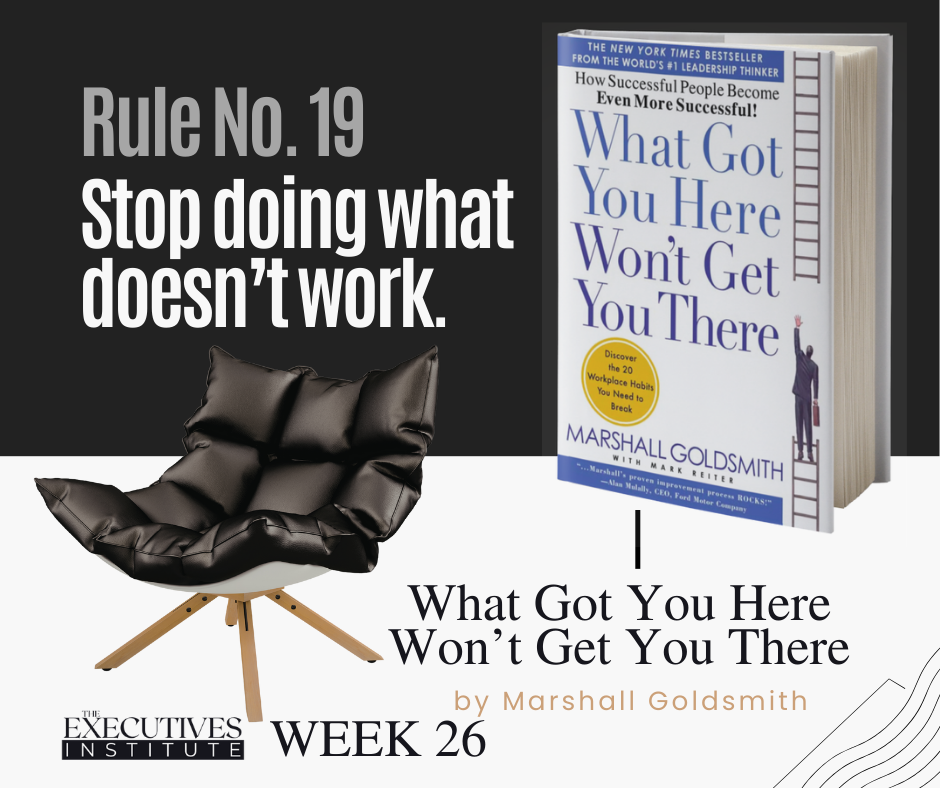
What Got You Here, Won’t Get You There
by Marshall Goldsmith
“The higher you go in the organization, the more your problems are behavioral. The problems that got you to your current level of success are rarely the ones that will get you to the next level.” – Marshall Goldsmith
📘 Book Summary
Marshall Goldsmith’s book is a blunt reminder that the biggest obstacles for successful leaders aren’t skill gaps—they’re behavioral blind spots. Goldsmith lays out the twenty common habits that undermine high achievers: defensiveness, needing to win too much, refusing to apologize, clinging to old methods, or simply ignoring feedback. His point is direct: the behaviors that earned you early success often become liabilities as the stakes rise. Advancement requires self-awareness, humility, and the courage to change the habits that no longer serve you—especially the ones you’re most attached to. The book teaches leaders to confront their own arrogance, listen more than they talk, and deliberately replace ego-driven actions with growth-driven ones.
🔑 Key Executive Takeaway
If you want to reach the next level, you must be willing to shed the behaviors that built the last one. The leaders who stagnate are the ones who refuse to evolve. The ones who rise are those who face their blind spots head-on and let go of the habits that no longer produce results.
April 8, 2026🛠️WE ARE STILL BUILDING THIS RULE. CHECK BACK
THIS RULE HELPS YOU WITH 🧭
- Breaking autopilot routines that no longer yield results
- Identifying legacy habits or leadership styles that stall progress
- Letting go of ego-driven behaviors that were once rewarded
- Creating space for better decisions by eliminating wasteful actions
- Evolving as a leader by aligning your behavior with your future, not your past
🔍 ASK THE RIGHT QUESTIONS
“Progress starts with asking better questions. Use this section and these prompts throughout The Institute to challenge assumptions, surface blind spots, and drive clearer thinking.”
These questions are designed to reveal what needs pruning in your leadership, business strategy, or team culture. Each includes an example to ground the thinking:
What am I still doing just because it used to work? (Inner Dialogue🧠)
→ Example: You’re still personally approving every marketing campaign, even though your team has outgrown the need for that level of oversight.
Where am I avoiding change because I’m afraid of losing control or comfort? (Inner Dialogue🧠)
→ Example: Refusing to delegate key client relationships because you’re attached to being the face of the business.
 What behaviors are rewarded in this organization that actually hold us back?
→ Example: Celebrating constant busyness instead of real outcomes keeps people chasing noise instead of results.
Who on my team—or in my peer group—is holding on to yesterday’s playbook? Have I called it out?
→ Example: A longtime sales leader still pushing cold calls instead of adapting to inbound strategies, and no one is challenging it.
Many leaders rise by doing certain things very well—then fall by continuing to do those same things for too long. This month, challenge your group to surface and name what’s no longer serving them.
Lead-In:
The hardest things to let go of are often the ones that got us applause in the past. But the market doesn’t care what used to work. It rewards what works now. So—what needs to go?

What’s one behavior, process, or decision-making habit that once worked for you or your business—but no longer does? Why is it still hanging around?
 This Rule isn’t finished—and it never will be. Business changes, leaders learn, and our Members keep sharpening the edges with real stories and hard-won lessons. What you see here is today’s version. Tomorrow’s will be better, clearer, and backed by more lived experience.
Thank you for being here and bringing your perspective—add your insight, share a story, or challenge what’s written. Together, we keep these Rules alive and relevant.