

Rule No. 13 summary:
If you don’t understand the numbers, you don’t understand the business. Knowing your financials isn’t just for accountants—it’s essential for every leader who wants to make smart decisions, allocate resources wisely, and build a business that lasts.
You don’t need to be an accountant—but if you’re running a business, you damn well need to know your numbers.
Too many entrepreneurs make gut decisions without realizing they’re bleeding cash, underpricing their work, or chasing growth that’s actually killing profitability. This rule is about financial clarity—not spreadsheets for the sake of spreadsheets, but real-world understanding that helps you make smarter moves, avoid costly mistakes, and build something that lasts. Because in the end, what you don’t know will hurt you.
If you’ve fought battles that became lessons — this is where we collect them.
The insight you share might be the turning point someone else is waiting for.
 Write this down…
If you don’t know your numbers, you’re not running a business—you’re running a guess.

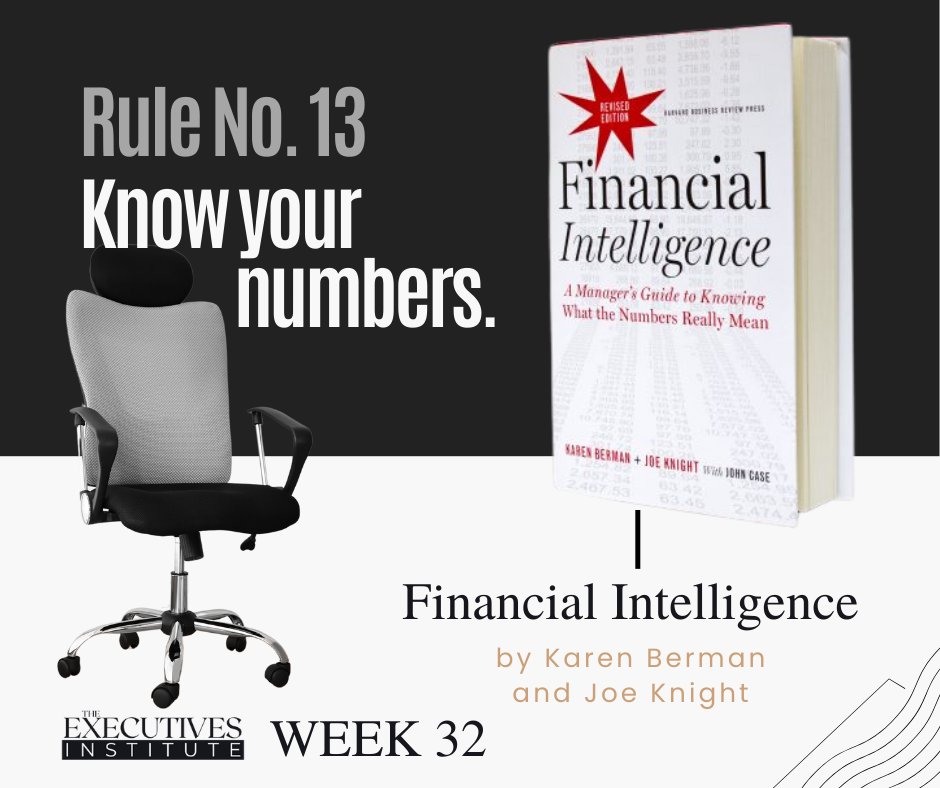
📚 Recommended Reading
Financial Intelligence
by Karen Berman and Joe Knight
“Numbers don’t lie. But people who don’t understand numbers do.” – Karen Berman

Book Summary
Financial Intelligence breaks down financial concepts into plain English so non-financial managers and entrepreneurs can read—and truly understand—the story their numbers are telling. Berman explains how the three main financial statements work together, how metrics like profit, cash flow, and ROI actually drive decisions, and why context matters as much as the raw numbers. The book’s core message: you don’t need to become a CPA, but you do need to see the numbers as a strategic tool—because better financial understanding leads to better leadership.
Executive Takeaway:
If you can’t read your financials, you can’t lead your business. Financial Intelligence gives leaders the clarity to see beyond spreadsheets—showing how profit, cash flow, and key ratios reveal the real health of the business. Mastering this skill turns guesswork into strategy and keeps you from being blindsided by numbers you thought you understood.

April 1, 2026🛠️WE ARE STILL BUILDING THIS RULE. CHECK BACK

This rule helps us with:
- Making informed, data-driven decisions
- Understanding how strategy impacts the bottom line
- Identifying red flags before they become crises
- Communicating with financial stakeholders more credibly
- Aligning team efforts with financial goals
- Avoiding costly misinterpretations of key metrics

“Progress starts with asking better questions. Use this section and these prompts throughout The Institute to challenge assumptions, surface blind spots, and drive clearer thinking.”

 Where in your business do you rely on instinct when you should be relying on numbers?
(What’s the cost—visible or hidden—of not having hard data to back up key decisions?)
Example: A CEO of a growing construction firm kept hiring based on gut feel that “they were always short on crews.” But after finally reviewing job completion data and actual labor utilization, it turned out their productivity issues were due to scheduling inefficiencies, not headcount. The hires only deepened the problem.
Which financial metric do you hear often but secretly don’t fully understand?
(If you’re leading without clarity, chances are your team is too. What’s your plan to close the gap?)
Example: A marketing executive nodded along during budget meetings when EBITDA was discussed, but couldn’t explain how it differed from net income. That misunderstanding led to pushing for ad spend that looked affordable on paper but drained real cash flow.
How well does your team connect their daily work to the company’s financial health?
(If the frontline can’t tie effort to outcomes, is it time to make your numbers more visible and relevant?)
Example: A SaaS company’s customer support team worked overtime to deliver exceptional service but didn’t realize that the churn rate was still killing profitability. Once they understood the customer lifetime value (LTV) and its tie to recurring revenue, their efforts shifted toward strategic retention, not just fast ticket resolution.
What’s one recent business decision that might look different with better financial insight?
(Would more accurate forecasting, cost analysis, or cash flow awareness have changed the outcome?)
Example: A boutique retail brand launched a second location based on the success of their flagship store. They didn’t realize the original store had masked low profit margins with high foot traffic. Without understanding contribution margin and fixed cost ratios, they expanded a model that wasn’t truly scalable—and it backfired.
Here’s a no-nonsense breakdown of key financial terms every executive should actually understand—not just nod at in meetings. Each term is paired with what it actually tells you, why it matters, and a question to ask if you’re not seeing it clearly.
📊 Key Financial Terms for Executives
1. Gross Margin
What it is: Revenue minus cost of goods sold (COGS)
Why it matters: It tells you how efficiently your core offering turns revenue into profit before overhead.
Ask yourself: Are we pricing correctly—or just selling more to stay afloat?
2. Net Profit (Net Income)
What it is: What’s left after all expenses, taxes, and interest
Why it matters: It’s your actual bottom line. Growth without profit is just expensive vanity.
Ask yourself: Are we running a real business—or just keeping the lights on?
3. EBITDA (Earnings Before Interest, Taxes, Depreciation, and Amortization)
What it is: A “cleaner” look at operational profitability, before non-operating costs
Why it matters: It’s often used by investors and lenders to assess core business health.
Ask yourself: If we strip away the noise, how well are we really operating?
4. Cash Flow (especially Free Cash Flow)
What it is: The real cash moving in and out of your business
Why it matters: Profit on paper doesn’t pay bills—cash does.
Ask yourself: Can we afford to grow—or will growth break us?
5. Burn Rate
What it is: How quickly you’re spending cash (especially in early-stage businesses)
Why it matters: Helps determine how much runway you have before you’re out of money
Ask yourself: If revenue stops tomorrow, how long can we survive?
6. Contribution Margin
What it is: The portion of sales that helps cover fixed costs after variable costs are paid
Why it matters: It shows whether scaling a product or service will actually help the bottom line
Ask yourself: Are we growing profit or just growing expenses?
7. Working Capital
What it is: Current assets minus current liabilities
Why it matters: It reflects day-to-day liquidity. Low working capital = high risk.
Ask yourself: Can we weather a bad quarter without scrambling?
8. Break-even Point
What it is: The point at which total revenue equals total costs
Why it matters: Below it, you’re losing money. Above it, you’re building wealth.
Ask yourself: Do we know our break-even—or are we flying blind?
9. Return on Investment (ROI)
What it is: Gain from an investment relative to its cost
Why it matters: Not all growth is good growth. ROI measures effectiveness.
Ask yourself: Which of our efforts actually pay off—and which just feel good?
10. Accounts Receivable Turnover
What it is: How quickly you collect what’s owed to you
Why it matters: Sales don’t matter if you don’t collect the money
Ask yourself: Are we building revenue or funding other people’s cash flow problems?
 This Rule isn’t finished—and it never will be. Business changes, leaders learn, and our Members keep sharpening the edges with real stories and hard-won lessons. What you see here is today’s version. Tomorrow’s will be better, clearer, and backed by more lived experience.
Thank you for being here and bringing your perspective—add your insight, share a story, or challenge what’s written. Together, we keep these Rules alive and relevant.