

The Principle: Good questions make people think. They uncover problems, challenge bad assumptions, and often lead to better decisions. Don’t be afraid to ask the question nobody else wants to ask. A good question can save you a lot more money than a bad answer.
Ask better questions.
The Hard Truth
Most leaders get too busy giving answers to ask the right questions.
Executive insights 👥 Let me tell you how that played out in my company.
Most of us can point to a moment where a better question would’ve changed everything. Share the turning point, not the polished version. That’s the real value.
⚠️Content Integrity Statement
To preserve the quality and credibility of The Executives Institute, all submissions must be attributed to a real person. We do not accept anonymous contributions. Our goal is to build a trusted platform grounded in lived experience, not vague opinions or internet commentary. Every insight published on this site comes from a real business owner or leader willing to stand behind their words, helping protect the value of the Institute for all Members. Contributors may contact us at any time to edit or remove their submission. We respect your voice and your choice to participate. At the same time, The Executives Institute reserves the right to remove any submission at our discretion, including in cases of public misconduct, reputational harm, or behavior that compromises the integrity of the platform and its contributors.
- Contributors verification by LinkedIn profile and/or company websites
- Those companies must be based in the United States
- Your submissions must be in English
- We do not email our contributors
- We do not sell or share their information
⚠️Not every submission will be published
Your insights (if approved), along with your name, company, website and/or LinkedIn profile may be added to any specific Rule’s page, bringing valuable exposure for you and your organization to 1000s of U.S. business leaders. Every time you share an insight, you don’t just strengthen the Institute, you elevate your brand. Leaders talk. Leaders refer.
By submitting content to The Executives Institute, you agree that:
- your submission is your own work
- you have the right to share it
- your submission may be edited for clarity, length, or formatting
- your submission may be published on this Site or in related materials
By submitting content, you grant The Executives Institute a non-exclusive, perpetual license to display and distribute that content as part of the Institute’s mission. The Executives Institute Terms of Use + Privacy Policy
The insight you share might be the turning point someone else is waiting for.
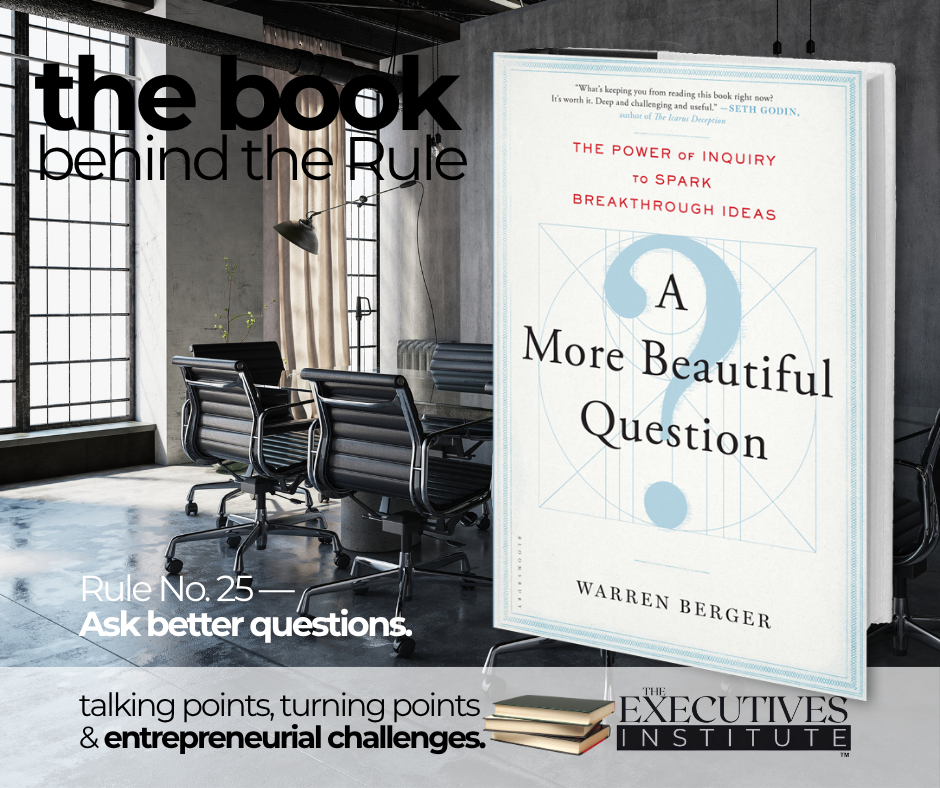
📖 the book behind the Rule
A More Beautiful Question, by Warren Berger
The leaders who win aren’t the ones with the fastest answers, but the ones who ask the kinds of questions that reframe problems, challenge assumptions, and spark innovation. Through examples from business, education, and entrepreneurship, the book shows how powerful questions move organizations from stagnation to possibility. Berger breaks questioning into a disciplined cycle —Why? What if? How? —and shows how leaders can use this process to break through rigidity, reveal opportunity, and push their teams to think more boldly.
Executive Takeaway: If you want better results, stop demanding better answers and start demanding better questions. A leader’s job isn’t to have all the solutions, it’s to create an environment where the right questions surface and shape the path forward.
“You don’t learn unless you question.”
—Warren Berger
It’s easy to jump in with an answer, especially when people expect you to have one. Most leaders are trained to answer, not to think. From early in their careers, high performers are rewarded for decisiveness, speed, and having the solution. Over time, that habit becomes a liability. They stop questioning and stop challenging. A quick answer to the wrong question can send the whole company in the wrong direction. Before you solve the problem, make sure you’re solving the right problem.
🎓 MASTER Rule No.25 —Ask better questions.
- When to Apply | Red Flags
- Rule Overview
- Ask the Right Questions
- Contrarian View
- Actionable Strategies
- Real World Scenarios
- Leadership Team Discussion
- Rules to Results Workshop
- The Right Track | Green Flags
- Key Terms
- Book Summary
- Author Links
- Executive Insights
- Worth Watching
- Related Reading
October 2026
This Master Class is in development.
Help us build each of the 50 Master Classes, by adding your insights and sharing your entrepreneurial stories.
Class begins Monday, January 4, 2027, with each Rule being built out as we go. Each will contain the study sections listed above and will continue to evolve through your contributions. As business leaders continue to challenge these ideas, the Institute becomes more and more valuable, not because it’s finished, but because it never will be.

Here are three clear warning signs that an organization is ignoring this Rule:
⚠️ Meetings are filled with updates, not inquiry
If your leadership meetings sound like a series of reports with little challenge or pushback, you’ve got a problem. Information is being shared, but not examined. No one is pressing deeper, and weak assumptions are slipping through untouched.
⚠️ The same problems keep resurfacing
When issues keep coming back in different forms, it’s a sign you’re treating symptoms instead of causes. That usually traces back to poor questioning—no one stopped to ask what’s really driving the problem in the first place.
⚠️Decisions are made quickly—and quietly
Speed can look like strength, but if decisions aren’t being tested with hard questions, it’s just unchecked momentum. When people hesitate to question direction—or feel it’s unwelcome—you lose the friction that sharpens thinking.
If any of these feel familiar, the issue isn’t capability—it’s discipline. Better questions aren’t a personality trait; they’re a standard.