

The Principle: Keep your business as simple as you can. Make things easy to understand, easy to remember, easy to teach and repeat. If a process doesn’t need to be that complicated, simplify it. The simpler the business, the easier it is to run and grow.
Simplicity scales.
The Hard Truth
If it takes a whiteboard and a translator to explain, it won’t scale.
Executive insights 👥 Let me tell you how that played out in my company.
⚠️Content Integrity Statement
To preserve the quality and credibility of The Executives Institute, all submissions must be attributed to a real person. We do not accept anonymous contributions. Our goal is to build a trusted platform grounded in lived experience, not vague opinions or internet commentary. Every insight published on this site comes from a real business owner or leader willing to stand behind their words, helping protect the value of the Institute for all Members. Contributors may contact us at any time to edit or remove their submission. We respect your voice and your choice to participate. At the same time, The Executives Institute reserves the right to remove any submission at our discretion, including in cases of public misconduct, reputational harm, or behavior that compromises the integrity of the platform and its contributors.
- Contributors verification by LinkedIn profile and/or company websites
- Those companies must be based in the United States
- Your submissions must be in English
- We do not email our contributors
- We do not sell or share their information
⚠️Not every submission will be published
Your insights (if approved), along with your name, company, website and/or LinkedIn profile may be added to any specific Rule’s page, bringing valuable exposure for you and your organization to 1000s of U.S. business leaders. Every time you share an insight, you don’t just strengthen the Institute, you elevate your brand. Leaders talk. Leaders refer.
By submitting content to The Executives Institute, you agree that:
- your submission is your own work
- you have the right to share it
- your submission may be edited for clarity, length, or formatting
- your submission may be published on this Site or in related materials
By submitting content, you grant The Executives Institute a non-exclusive, perpetual license to display and distribute that content as part of the Institute’s mission. The Executives Institute Terms of Use + Privacy Policy
The insight you share might be the turning point someone else is waiting for.
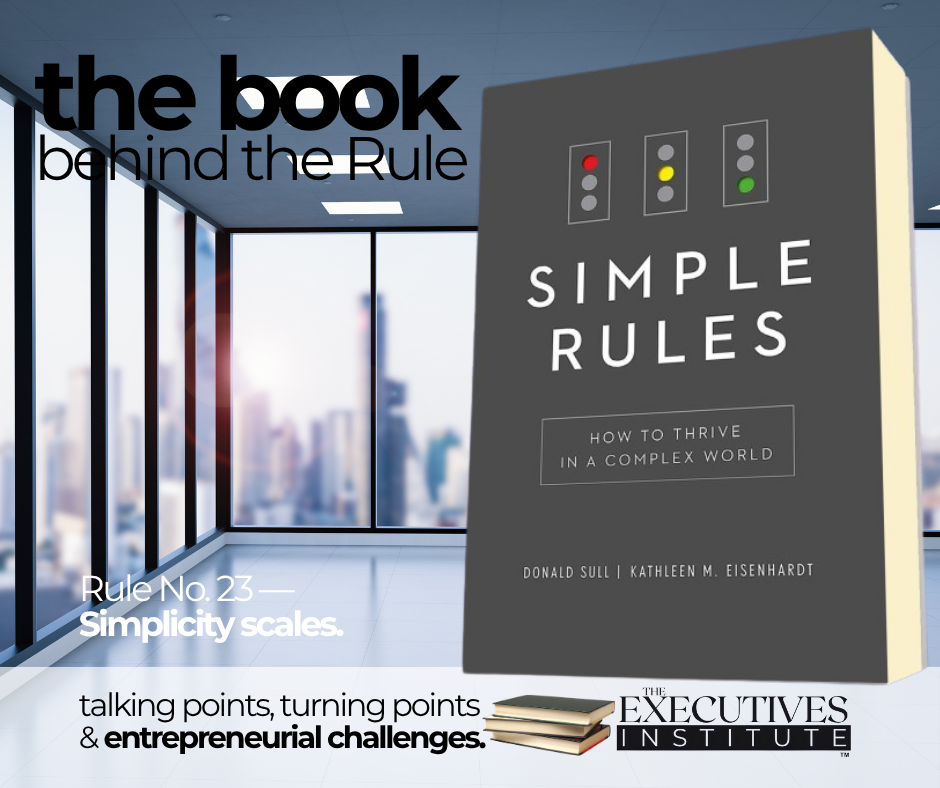
📖 the book behind the Rule
Simple Rules, by Donald Sull and Kathleen W. Eisenhardt
Simple Rules delivers a blunt truth: most organizations drown themselves in unnecessary complexity. Sull and Eisenhardt show that success often hinges on a small set of clear, memorable rules that guide decisions and actions when things get chaotic. Through case studies ranging from tech companies to sports teams to military units, the authors reveal how a few well-crafted rules outperform bloated processes, complicated strategies, and endless checklists. The book isn’t about dumbing things down, it’s about sharpening focus so people can move fast, execute consistently, and adapt without losing their bearings.
Executive Takeaway: If your team can’t remember the rules, they can’t follow them. Leaders who want scale must stop glorifying complexity and instead distill their operating principles into a handful of simple, decisive rules that everyone, from the intern to the EVP, can apply under pressure. Simplicity isn’t minimalism; it’s strategic clarity.
“Too many rules stifle innovation. Too few lead to chaos. Simple rules hit the sweet spot.” —Simple Rules


Complexity costs money. Every extra step, rule, meeting, product, or layer of management slows you down and gives people more chances to screw things up. The most effective strategies are grounded in a few clear rules that people can understand, remember, and act on. Complexity will grow on its own, but keeping things simple takes work.
🎓 MASTER Rule No. 23 —Simplicity scales.
- When to Apply | Red Flags
- Rule Overview
- Ask the Right Questions
- Contrarian View
- Actionable Strategies
- Real World Scenarios
- Leadership Team Discussion
- Rules to Results Workshop
- The Right Track | Green Flags
- Key Terms
- Book Summary
- Author Links
- Executive Insights
- Worth Watching
- Related Reading
October 2026
This Master Class is in development.
Help us build each of the 100 Master Classes, by adding your insights and sharing your entrepreneurial stories.
Class begins Monday, January 4, 2027, with each Rule being built out as we go. Each will contain the study sections listed above and will continue to evolve through your contributions. As business leaders continue to challenge these ideas, the Institute becomes more and more valuable, not because it’s finished, but because it never will be.