

the principle 🎓 You won’t always feel like doing what needs to be done. Who does? Our self-motivation comes and goes. The key is to keep moving, even on the days when you don’t feel like it. Small steps taken every day add up, and once you get moving, it’s easier to keep moving.
Momentum beats motivation.
the hard truth 📌 Motivation is unreliable. Momentum is not. —Understand that motivation is just a mood, and our moods change pretty quickly.
Executive insights 👥 Let me tell you how that played out in my company.
🏛️ Content Integrity Statement
To preserve the quality and credibility of The Executives Institute, all submissions must be attributed to a real person. We do not accept anonymous contributions. Our goal is to build a trusted platform grounded in lived experience, not vague opinions or internet commentary. Every insight published on this site comes from a real business owner or leader willing to stand behind their words, helping protect the value of the Institute for all Members. Contributors may contact us at any time to edit or remove their submission. We respect your voice and your choice to participate. At the same time, The Executives Institute reserves the right to remove any submission at our discretion, including in cases of public misconduct, reputational harm, or behavior that compromises the integrity of the platform and its contributors.
- Contributors verification by LinkedIn profile and/or company websites
- Those companies must be based in the United States
- Your submissions must be in English
- We do not email our contributors
- We do not sell or share their information
Not every submission will be published
Your insights (if approved), along with your name, company, website and/or LinkedIn profile may be added to any specific Rule’s page, bringing valuable exposure for you and your organization to 1000s of U.S. business leaders. Every time you share an insight, you don’t just strengthen the Institute, you elevate your brand. Leaders talk. Leaders refer.
By submitting content to The Executives Institute, you agree that:
- your submission is your own work
- you have the right to share it
- your submission may be edited for clarity, length, or formatting
- your submission may be published on the Site or in related materials
By submitting content, you grant The Executives Institute a non-exclusive, perpetual license to display and distribute that content as part of the Institute’s mission. The Executives Institute Terms of Use + Privacy Policy
the Rules matter.
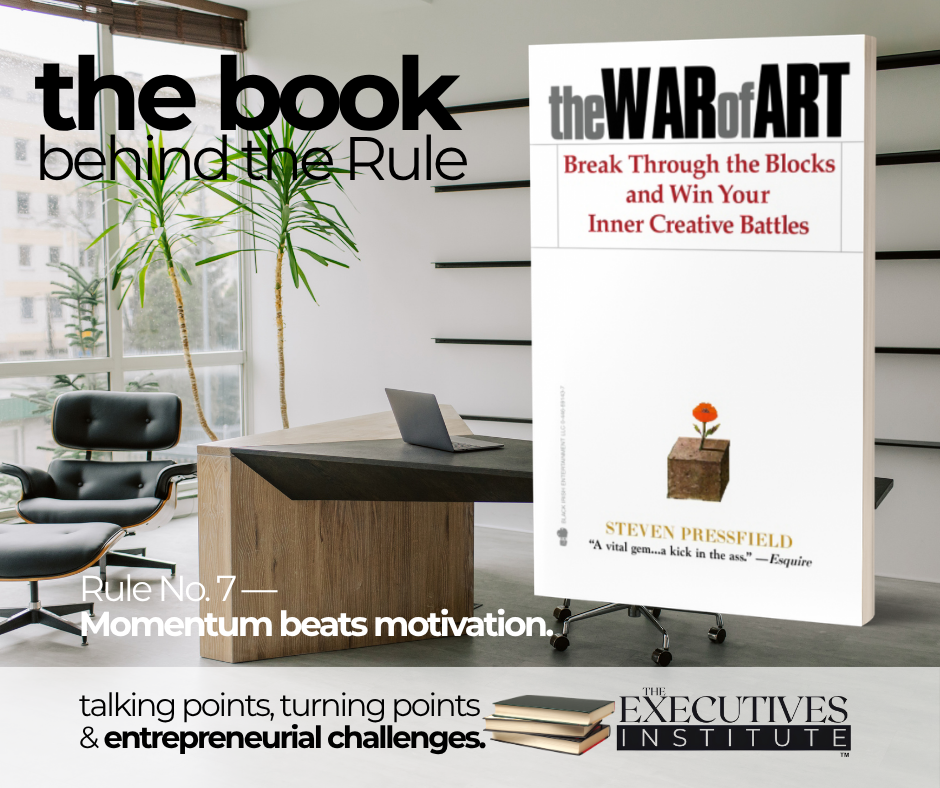
📖 the book behind the Rule
The War of Art, by Steven Pressfield | Follow Steven at LinkedIn
In The War of Art, Steven Pressfield names the invisible force that stops us from doing our most important work: Resistance. Whether you’re an artist, entrepreneur, or executive, Resistance shows up as procrastination, fear, self-doubt, or distraction. Pressfield offers a clear message —amateurs wait for inspiration; professionals show up anyway. This book is a battle manual for defeating excuses, embracing discipline, and building the kind of momentum that turns vision into reality. Short, sharp, and immediately applicable.
Executive Takeaway: The leaders who outperform everyone else aren’t the most inspired; they’re the ones who act despite hesitation. Treat your priorities like a professional: show up, do the work, build momentum, and let discipline carry you past the excuses that stall everyone else.
“Resistance will tell you anything to keep you from doing your work. It will perjure, fabricate; it will seduce you. Resistance is insidious.” —Steven Pressfield

turning points 📈 executive study
We give motivation too much credit. It’s unreliable, emotional, and not there when we need it most. Motivation comes and goes. Some days you feel like working, and some days you don’t. Don’t wait until you feel inspired or motivated. Show up and do the work anyway. Let discipline build momentum. Waiting to feel inspired is a trap. Progress happens when you show up consistently, especially when you don’t feel like it.
A) Where in your business, right now, are you waiting for motivation, enthusiasm, or the “right time” instead of just taking action?
B) Have you ever mistaken persistence for progress? What did it cost you, and what finally made you change direction?
C) What personal routines have you adopted to keep your momentum going, even when your motivation fades?
🥊 challenge the Rules | take the contrarian view
Momentum is powerful, but momentum in the wrong direction is dangerous. Business leaders are often told to keep moving, stay consistent, and push through resistance. But not every obstacle is resistance. Maybe the obstacle is a warning. We can become so committed to discipline and persistence that we stop asking whether the work is still worth doing. A failing strategy doesn’t become a good strategy just because you execute it consistently. A bad hire doesn’t become a good hire because you give it more time. And a product customers don’t want won’t succeed just because the team keeps pushing.
The best leaders know when to push through resistance and when to stop, rethink, and change direction.
Around the table…
- How do you distinguish between resistance that should be overcome and resistance that is telling you to change course?
A closing word for the week…
Motivation fades by Tuesday. Momentum carries you through Friday. The highest-performing leaders don’t wait to feel ready, they build momentum through discipline and routine. That’s the difference between amateurs and professionals, as The War of Art makes clear. Real progress begins the moment you stop waiting for inspiration and start moving anyway. Take this lesson back to the office.
Leadership team discussion
- What important initiative has lost momentum in our organization?And what consistent action could get it moving again?
- Where in our business are we waiting for motivation when what you really need is momentum? Where we simply need to take the next step.
This is your turning point.
📔 Week 7: Stop waiting for motivation
Choose one meaningful business priority you’ve been postponing; a document, a tough conversation, a hiring decision, a customer visit, or a process you’ve been meaning to improve.
Then commit to working on it for 30 uninterrupted minutes at the same time every day this week.
Also, find a colleague to take The 30-Day Executive Accountability Challenge with you.
Take a deeper dive into this Rule and see what it looks like in the real world. Hear how other business leaders have approached the issue, look for red flags and green flags in your own organization, and explore the additional terms, links, videos, and resources we’ve assembled.
MASTER 🎓 Rule No. 7 —Momentum beats motivation.
- When to Apply | Red Flags
- Rule Overview
- Ask the Right Questions
- Contrarian View
- Actionable Strategies
- Real World Scenarios
- Leadership Team Discussion
- Rules to Results Workshop
- The Right Track | Green Flags
- Key Terms
- Book Summary
- Author Links
- Executive Insights
- Worth Watching
- Related Reading
October 2026
This Master Class is in development.
Help us build each of the 50 Master Classes, by adding your insights and sharing your entrepreneurial stories.
Class begins Monday, January 4, 2027, with each Rule being built out as we go. Each will contain the study sections listed above and will continue to evolve through your contributions. As business leaders continue to challenge these ideas, the Institute becomes more and more valuable, not because it’s finished, but because it never will be.