

the principle 🎓 You never outgrow the need to learn. Ask questions. Listen to people who know more than you do. Learn from your mistakes and stay open to better ways of doing things. Experience matters, but staying curious matters too. The leaders who last are the ones who never confused experience with expertise.
Never stop learning.
the hard truth 📌 Success is one of the easiest ways to stop learning. —Wake up. Stay sharp. The day you think you know it all is the day a twenty-three-year-old with a laptop eats your lunch. Stay a student or become a story.
Executive insights 👥 Let me tell you how that played out in my company.
1. When did you realize that what made you successful in the past was no longer enough for the future of your business?
2. What is one hard lesson you learned the slow way, through failure, missed opportunity, or costly trial and error?
🏛️ Content Integrity Statement
To preserve the quality and credibility of The Executives Institute, all submissions must be attributed to a real person. We do not accept anonymous contributions. Our goal is to build a trusted platform grounded in lived experience, not vague opinions or internet commentary. Every insight published on this site comes from a real business owner or leader willing to stand behind their words, helping protect the value of the Institute for all Members. Contributors may contact us at any time to edit or remove their submission. We respect your voice and your choice to participate. At the same time, The Executives Institute reserves the right to remove any submission at our discretion, including in cases of public misconduct, reputational harm, or behavior that compromises the integrity of the platform and its contributors.
- Contributors verification by LinkedIn profile and/or company websites
- Those companies must be based in the United States
- Your submissions must be in English
- We do not email our contributors
- We do not sell or share their information
Not every submission will be published
Your insights (if approved), along with your name, company, website and/or LinkedIn profile may be added to any specific Rule’s page, bringing valuable exposure for you and your organization to 1000s of U.S. business leaders. Every time you share an insight, you don’t just strengthen the Institute, you elevate your brand. Leaders talk. Leaders refer.
By submitting content to The Executives Institute, you agree that:
- your submission is your own work
- you have the right to share it
- your submission may be edited for clarity, length, or formatting
- your submission may be published on this Site or in related materials
By submitting content, you grant The Executives Institute a non-exclusive, perpetual license to display and distribute that content as part of the Institute’s mission. The Executives Institute Terms of Use + Privacy Policy
the Rules matter.
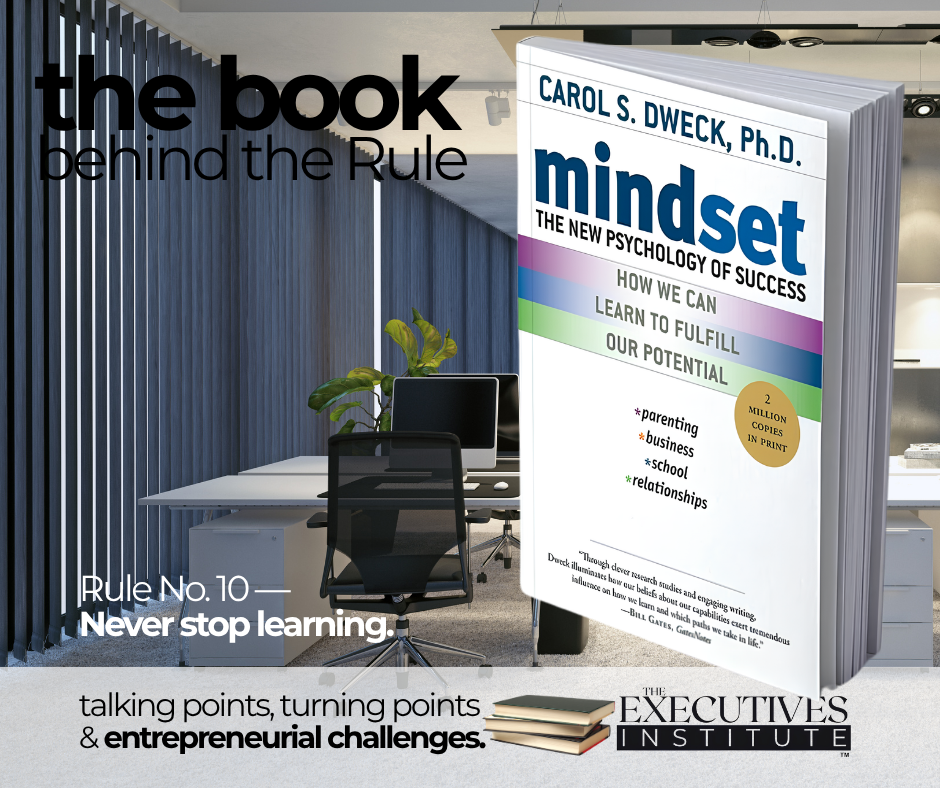
📖 the book behind the Rule
Mindset; The New Psychology of Success, by Carol S. Dweck, Ph.D.
Mindset explores the profound impact of how we think about our abilities. Dweck identifies two primary mindsets: the fixed mindset, which believes talent and intelligence are static, and the growth mindset, which sees them as skills that can be developed through effort, feedback, and persistence. Leaders, teams, and organizations that embrace a growth mindset adapt faster, overcome challenges more effectively, and unlock greater long-term potential. The book makes it clear: success isn’t just about what you know, it’s about your willingness to keep learning.
Executive Takeaway: Your ability to grow as a leader is limited only by your willingness to keep learning. A growth mindset turns challenges, criticism, and failure into fuel for improvement, while a fixed mindset turns them into roadblocks.
“Becoming is better than being.” — Carol S. Dweck

turning points 📈 executive study
Once things start going well, it’s easy to think you have it all figured out. But markets change, customers change, and business changes. The moment you think you know it all is the moment you start falling behind.
A) What habit, practice, or discipline have you built into your routine to ensure you try to always continue learning?
B) Tell us about a time when you realized something that was successful in the past was no longer enough for the future of your business? What did you have to learn next?
C) In your experience, what is one lesson you learned the hard way, through failure, missed opportunity, or costly trial and error?
challenge the Rules 🥊 contrarian view for a healthy debate
Stop Learning. Start Doing. There is a point where learning could become procrastination. You can read another book, attend another conference, listen to another podcast, take another course and have another discussion about what they should do —while the business sits there waiting for someone to actually do it. Experience doesn’t come from learning about business. It comes from running one. Sometimes the best thing you can learn is that you already know enough to make a decision. Stop gathering information. Make the call. Test the idea. Talk to the customer. Fix the problem. See what happens.
The danger isn’t always that leaders stop learning. Sometimes the danger is that they never stop learning because they’re afraid to start doing.
Around the table:
Are we genuinely learning? Or are we using learning as a comfortable excuse to avoid making a difficult decision?
A word, before you go on to next week…
The older we get, the longer we lead, the easier it is to lean on our instincts and our experience. When a younger business owner is telling me about their latest issue or challenge, I can usually recognize a pattern and solve their problem today with an answer from yesterday. Most of us with some years under our hats do this often. It works until it doesn’t. The leaders who last are the ones who never confuse experience with expertise. The moment you think you’ve figured it out is the moment you start falling behind.
This is another Rule that requires a little gut check. The best leaders I’ve ever known and most highly-respected, share two characteristics: they stay humble and they stay genuinely curious. They read, a lot, and they take notes on everything. Have you ever sat in a conference and been surprised by a local business owner who raised their hand and asked a question about a topic you’d have guessed they already knew everything about? I’ve seen it a hundred times. They might be asking because they know that younger leaders in the audience may be too afraid to ask (and that’s great of them) or, they’re humble enough to publicly acknowledge that none of us knows it all. Either way, that’s real leadership. I’ve been around so many good businesses that stall or plateau because their owners simply stopped learning new things. It’s not that they become lazy, they became successful.
Leadership team discussion:
- Where am I relying on what I already know instead of learning what I need to know?
- What’s something new you’ve learned recently (by choice or by necessity) that’s shifted your thinking as a leader?
- What example am I setting for my team when it comes to learning and development?
This could be the turning point.
📔 Week 10: Build one learning habit that drives growth.
Meet with your leadership team and answer the following question together: What structures or habits could we put in place to ensure our leadership team is continuously learning, and applying that learning, to drive growth?
Ready to put this Rule to work?
The full Rule page gives you more to consider; real-world insights from business leaders, red flags to watch for, green flags to look for, key terms, links, videos, and practical ways to take the idea from the page into your business.
MASTER 🎓 Rule No. 10 —Never stop learning.
- When to Apply | Red Flags
- Rule Overview
- Ask the Right Questions
- Contrarian View
- Actionable Strategies
- Real World Scenarios
- Leadership Team Discussion
- Rules to Results Workshop
- The Right Track | Green Flags
- Key Terms
- Book Summary
- Author Links
- Executive Insights
- Worth Watching
- Related Reading
October 2026
This Master Class is in development.
Help us build each of the 50 Master Classes, by adding your insights and sharing your entrepreneurial stories.
Class begins Monday, January 4, 2027, with each Rule being built out as we go. Each will contain the study sections listed above and will continue to evolve through your contributions. As business leaders continue to challenge these ideas, the Institute becomes more and more valuable, not because it’s finished, but because it never will be.

⚠️ Here are five clear warning signs that signal a breakdown of Rule No. 10—the kind leaders ignore at their own risk…
1. “We’ve Always Done It This Way” Becomes a Default Answer. When past success is used to shut down new ideas, learning has stopped and complacency has taken over.
2. Leaders Talk More Than They Listen. If leaders are always teaching and rarely asking questions, curiosity is gone—and blind spots are growing.
3. Feedback Is Deflected or Dismissed. When criticism is explained away instead of examined, improvement stalls and culture hardens.
4. Training Is Treated as a One-Time Event. If learning only happens during onboarding or annual workshops, growth is accidental, not intentional.
5. Mistakes Are Hidden Instead of Studied. When people fear being wrong, they stop experimenting. And when experimentation stops, progress does too.
Short Talk: “The Power of Not Yet”
I want to share a story I recently heard from psychologist Carol Dweck, who studied how people learn and grow. She told about a high school in Chicago where students had to pass a certain number of courses to graduate. If they didn’t pass, they didn’t get an F. They got the grade: Not Yet.
Think about that. Not Yet.
It’s a powerful way to look at progress. An F says, “You’re done. You failed. You’re not good enough.” But Not Yet says, “You’re still on the path. You’re not there yet, but you can get there.”
Here’s why this matters for us. In our work, we’re going to miss targets. We’re going to try new things that don’t pan out the first time. If we treat every miss like an F, people stop taking risks. They stop trying. They play safe—and safe companies don’t grow.
But if we take the mindset of Not Yet, it changes the story. Every setback becomes part of a learning curve. Every miss comes with the belief that we can adjust, adapt, and improve.
So here’s what I’m asking of you, and of myself: when something doesn’t go the way we want, don’t say, “We failed.” Say, “We’re not there yet.” Then ask, “What do we need to learn, and what’s the next step forward?”
That one word—yet—keeps us moving, keeps us improving, and keeps us growing.
Subscribe to The Executives Institute YouTube Channel