
The most original thinkers don’t settle for their first solution —they generate many. Great ideas often emerge later in the creative process, after initial concepts have been tested, challenged, or discarded, proving that persistence and revision often lead to better solutions. Quantity breeds quality when you’re willing to rethink, revise, and persist beyond what’s obvious.
Ask yourself: Where in our organization are decisions being made too quickly, built on the first idea that hits the table?
👥 Executive Insights | “Let me tell you how that played out in my company.“
- Your Name, Title, Organization + Insights
- Your Name, Title, Organization + Insights
- Your Name, Title, Organization + Insights
If you’ve fought battles that became lessons, this is where we collect them. Have you ever moved forward with the first idea that seemed right, only to later realize a better option existed? What did that experience teach you and your team about slowing down our decision-making process?
⚠️ This Rule is currently under development and will be fully available on our official launch day, January 4, 2027. After launch, it will continue to evolve through real-world experience, member contributions, and timeless business principles—because great leaders never stop learning.
STUDY 📌 Rule No. 6 —Your first idea is rarely your best.
📓 the LEDGER
the LEDGER is the recommended companion to your weekly study through The Weekly Edge. Each week includes a printable PDF designed to help you plan with intention, apply the Rule in real time, and record the decisions, priorities, and lessons that shape your leadership. You can print one week at a time and begin anytime throughout the year, or choose the full professionally printed spiral-bound hardcover LEDGER for a complete year of disciplined growth and reflection.
— the LEDGER Volume 1 will be available this Summer 2026 through this site
This Rule will help you…
Improve decision quality through iteration
Avoid premature commitment to untested ideas
Encourage creative thinking within teams
Build a culture of thoughtful innovation
Increase the likelihood of breakthrough solutions
Let me share something most young business owners learn the hard way: the first idea usually wins because it’s convenient, not because it’s correct. It sounds decisive. It feels productive. Everyone nods, and you move. But speed can often mask shallow thinking. Be honest with yourself…
In your organization are decisions being made too quickly—built on the first idea that hits the table?
— The Problem With Your Best Idea
The first idea is usually the most obvious one — which is precisely why it’s the most dangerous.
In his book, Originals, Adam Grant studied how original thinkers operate and found something counterintuitive: the people who generate the most good ideas are the same people who generate the most bad ones. The difference isn’t raw creativity. It’s volume and iteration.
In business, there’s enormous pressure to decide quickly and execute. Speed is a virtue. But speed applied to the wrong idea compounds the mistake.
“That ‘brilliant’ idea you had in the shower? Keep brainstorming.”
The executives who consistently make good strategic decisions have usually developed the discipline to question their first instinct. Not endlessly — decision paralysis is its own failure. But enough to pressure-test the assumption underneath the idea before committing resources to it.
The best strategic decisions I’ve observed came from leaders who were willing to hold their first idea loosely. They explored alternatives. They let the thinking evolve. And then they committed fully — to a decision that had survived scrutiny.
One of our principles at The Executives’ Institute reflects this: Your first idea is rarely your best. It’s a reminder that the quality of your thinking often depends on your willingness to keep thinking a little longer.
Patience before commitment. Conviction after it.
 Write this down…
The obvious idea is usually the one everyone else already had.
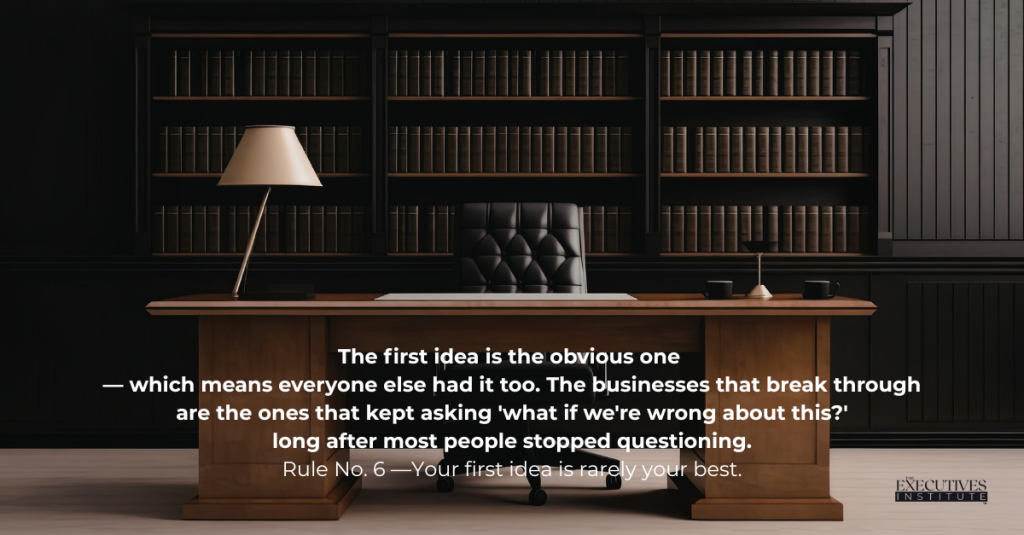

Here are 5 warning signs you and your team may be ignoring Rule No. 6:
⚠️ Fast Consensus– Teams quickly agree on the first idea presented, with little debate or exploration of alternatives.
⚠️ Idea Fatigue – Leaders discourage “too many” suggestions, signaling that efficiency is valued over creativity.
⚠️ Fear of Rework – Projects push forward even when flaws emerge, because revisiting the concept is seen as wasted effort.
⚠️ Overconfidence in the Pitch – A strong initial presentation is mistaken for a strong long-term solution, without deeper testing.
⚠️ Lack of Iteration – Products, strategies, or campaigns are launched without pilots, prototypes, or scenario testing.

💬 Leadership Team Discussion
This rule invites leaders to step back and ask a question that cuts through complexity. Discuss with your leadership team:
🔍 Where in our organization are decisions being made too quickly—built on the first idea that hits the table?
🔍 Which recent idea or initiative did we move forward with too quickly—without exploring better alternatives?
(What might have improved with more iteration or input?)
🔍 How does our team create space for second, third, or even tenth ideas—rather than just rallying around the first one that sounds good?
(Do we reward speed or thoughtful exploration?)
🔍 Here are a few more that may fit your team better…
When did a process of iteration—prototypes, revisions, or repeated attempts—lead to a breakthrough idea that never would have surfaced if we had stopped at the first solution?
In our experience, when has someone on our team challenged our first idea and ultimately improved the outcome? What did that moment teach us about creating space for dissent?
How did a second or third idea end up outperforming our original plan in a major decision, project, or strategy? What changed between the first concept and the final one?
When did pressure for speed cause our organization to commit to an idea too quickly? Looking back, what could we have done differently to explore better alternatives?

Many teams hide behind this rule and end up slower, not smarter. Here’s a little pushback that will surface that truth:
Contrarian View:
“Your first idea is often your clearest—and overworking it can dilute speed, conviction, and competitive advantage.”
Strong leaders recognize that early ideas are usually grounded in instinct, experience, and pattern recognition. The danger isn’t the first idea—it’s hesitation. Teams that endlessly refine often lose timing, miss windows, and ship something watered down.
Debate Question:
🔍 Are we improving the idea—or just delaying the decision because we’re uncomfortable committing to it?
That’s where the real tension lives: discipline vs. overthinking.

Here’s a Real World Scenario
A regional manufacturing firm set out to reduce production delays by introducing a new shift schedule. The initial idea was to add more staff to the night shift, assuming it would balance workloads.
After three months, delays persisted—and morale declined. Instead of sticking with the original plan, leadership initiated a root-cause analysis and engaged frontline workers for feedback. It turned out the issue wasn’t staffing, but bottlenecks in machine maintenance and inconsistent supply deliveries.
The third solution—a preventive maintenance rotation paired with vendor scheduling changes—cut delays by 40% within six weeks.
The first idea sounded logical. The best idea came after listening, learning, and letting go of assumptions.
🔁 Actionable Strategies
Here are 5 actionable strategies that put Rule No. 6 – Your First Idea Is Rarely Your Best into practice:
1. Require a “Three-Option” Standard for Major Decisions
Never approve a proposal—strategic, financial, or operational—unless the team presents at least three viable alternatives. This forces deeper thinking and prevents defaulting to the first idea that sounds good.
2. Pilot Before You Commit
Run small tests, prototypes, or limited trials before going all-in. A quick pilot exposes weaknesses early and often reveals a stronger version of the idea.
3. Separate Idea Generation from Evaluation
Hold brainstorms where ideas cannot be judged or debated until later. When people know they won’t be shut down immediately, they offer more—and better—alternatives.
4. Use “Assumption Audits” Before Moving Forward
List the assumptions behind the first idea and challenge each one. If the idea relies on too many untested beliefs, it’s a sign you haven’t pushed far enough.
5. Reward Iteration, Not Just Execution
Publicly recognize leaders who revisit and improve ideas—not just those who move fast. When refinement is celebrated, people stop clinging to their first concepts and start improving them.

When we default to our first idea, we often mistake motion for progress.
Strong organizations slow down just long enough to pressure-test assumptions, surface alternatives, and make space for better thinking to emerge. This prompt pushes you to confront where you’re rushing decisions—and what stronger options you might be leaving on the table.
Ask yourself —
As a decision-maker, how do you balance the urgency to act with the discipline to challenge your first idea—especially when others are ready to follow your lead? What systems or habits help you avoid locking in too early?
Action Step —
Come up with three new variations on a current project before finalizing your plan.
Recommended Reading —
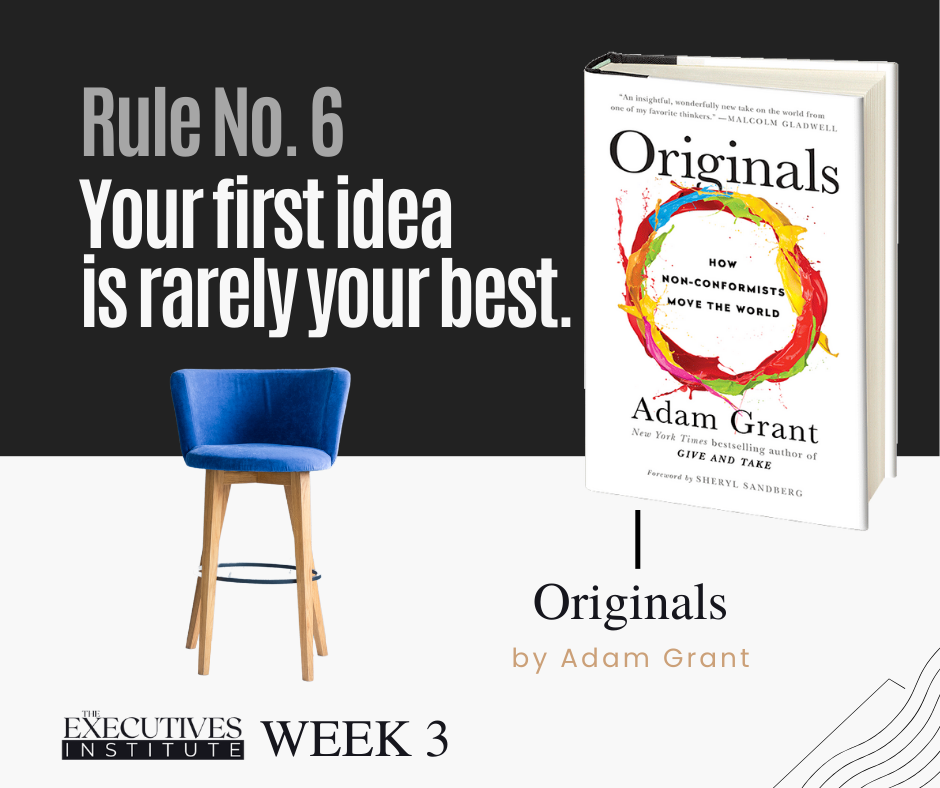
Originals: How Non-Conformists Move the World
by Adam Grant
“The greatest originals are the ones who fail the most, because they’re the ones who try the most.” — Adam Grant
Originals shows that innovation isn’t about having a single lightning-bolt idea—it’s about generating many, challenging your own thinking, and refining until the best solution emerges. The most successful leaders aren’t the ones who act first, but the ones who think differently and persist long enough to get it right.
📘Quick Summary
Originals explores how individuals champion new ideas and drive change without waiting for permission or perfect timing. Adam Grant draws on research and real-world examples to reveal that originality isn’t just about creativity—it’s about courage, persistence, and strategic risk-taking. He explains how to recognize good ideas (and weed out bad ones), speak up effectively, build support, and overcome the fear of failure. The book challenges the myth of the lone genius, showing that innovation thrives through iteration, feedback, and a willingness to challenge the status quo.
Executive Takeaways
1. Your first idea is almost always the most obvious—strong leaders push past it.
Winners aren’t the ones who grab the first concept; they’re the ones who force themselves to explore alternatives.
2. Quantity leads to quality.
Originals makes it clear: the people who generate the most ideas also land the best ones. Iteration isn’t waste—it’s the process.
3. The fastest decisions are rarely the sharpest.
Rushing to action creates blind spots. The workshop exposes where your organization confuses speed with good thinking.
4. Assumptions must be challenged, not protected.
Breakthrough ideas require questioning the comfortable logic behind your first solution. If you don’t audit assumptions, they own you.
5. Great organizations reward refinement, not just execution.
Cultures that value second and third ideas end up with better strategies, stronger products, and fewer costly course corrections.
Subscribe to The Executives Institute YouTube Channel

Rules to Results Workshop: Rule No. 6 – Your First Idea Is Rarely Your Best
Total Time: 45 Minutes
1. Opening & Framing (5 minutes)
- Brief overview of the rule and why first ideas are often the weakest.
- One quick example (manufacturing, tech, or leadership misstep).
- Set the tone: this session is about pushing past comfortable thinking.
2. The “First Idea Trap” Exercise (10 minutes)
Activity:
- Participants write down a recent initiative where the first idea became the default.
- In pairs, they identify what assumptions went unchallenged and what alternatives were never explored.
Outcome:
A clear awareness of where teams rush to action rather than pressure-test.
3. Idea Expansion Drill (10 minutes)
Activity:
- Each group takes one real initiative and forces themselves to generate three alternate options—no matter how rough.
- Ask: If we couldn’t use the first idea, what would we do instead?
- Quick share-out.
Outcome:
Leaders see firsthand that better options appear when you refuse to settle.
4. Systems Check: Where We Encourage or Kill Iteration (10 minutes)
Discussion:
- What in our culture punishes revisiting ideas?
- Where are we rewarding speed over thinking?
- What bottlenecks keep us from testing alternatives (time, structure, ego, habit)?
Outcome:
Teams expose the internal habits that keep them stuck on first ideas.
5. Commitment to One Change (5 minutes)
Action Step:
Each leader identifies one specific place where they will enforce a “second-option” rule in the next 30 days—meetings, proposals, product ideas, strategy sessions, anything.
Outcome:
Practical commitment, not theory.
Close (Optional 1 minute)
Reaffirm the rule: Breakthroughs come from the iterations you haven’t explored yet.