

the principle 🎓 When every project is labeled “critical,” none of them are. Playing to win means saying no more often than yes. Confident decision-making leads to clearer strategy, faster execution and a more measurable impact.
Spread yourselft too thin and you’ll risk mediocrity across the board. Bold, deliberate moves, based in strategy instead of reaction, will create your real advantage.
Make fewer, bolder moves.
the hard truth 📌 Busy isn’t strategic. It’s just loud and chaotic. —Consider this: ten small bets probably means ten small outcomes. Pick one thing that could change everything and put your whole weight behind it.
Executive insights 👥 Tell us how that played out in your company.
If your strategy doesn’t scare anyone on your team, it’s not a strategy. Tell us how this Rule had an impact on your organization.
🏛️Content Integrity Statement
To preserve the quality and credibility of The Executives Institute, all submissions must be attributed to a real person. We do not accept anonymous contributions. Our goal is to build a trusted platform grounded in lived experience, not vague opinions or internet commentary. Every insight published on this site comes from a real business owner or leader willing to stand behind their words, helping protect the value of the Institute for all Members. Contributors may contact us at any time to edit or remove their submission. We respect your voice and your choice to participate. At the same time, The Executives Institute reserves the right to remove any submission at our discretion, including in cases of public misconduct, reputational harm, or behavior that compromises the integrity of the platform and its contributors.
- Contributors verification by LinkedIn profile and/or company websites
- Those companies must be based in the United States
- Your submissions must be in English
- We do not email our contributors
- We do not sell or share their information
Not every submission will be published
Your insights (if approved), along with your name, company, website and/or LinkedIn profile may be added to any specific Rule’s page, bringing valuable exposure for you and your organization to 1000s of U.S. business leaders. Every time you share an insight, you don’t just strengthen the Institute, you elevate your brand. Leaders talk. Leaders refer.
By submitting content to The Executives Institute, you agree that:
- your submission is your own work
- you have the right to share it
- your submission may be edited for clarity, length, or formatting
- your submission may be published on the Site or in related materials
By submitting content, you grant The Executives Institute a non-exclusive, perpetual license to display and distribute that content as part of the Institute’s mission. The Executives Institute Terms of Use + Privacy Policy
the Rules matter.
Your insights will appear here, along with your name, title, company. Be the first to add your insights to Rule No. 5 —Make fewer, bolder moves, or the book Playing To Win.
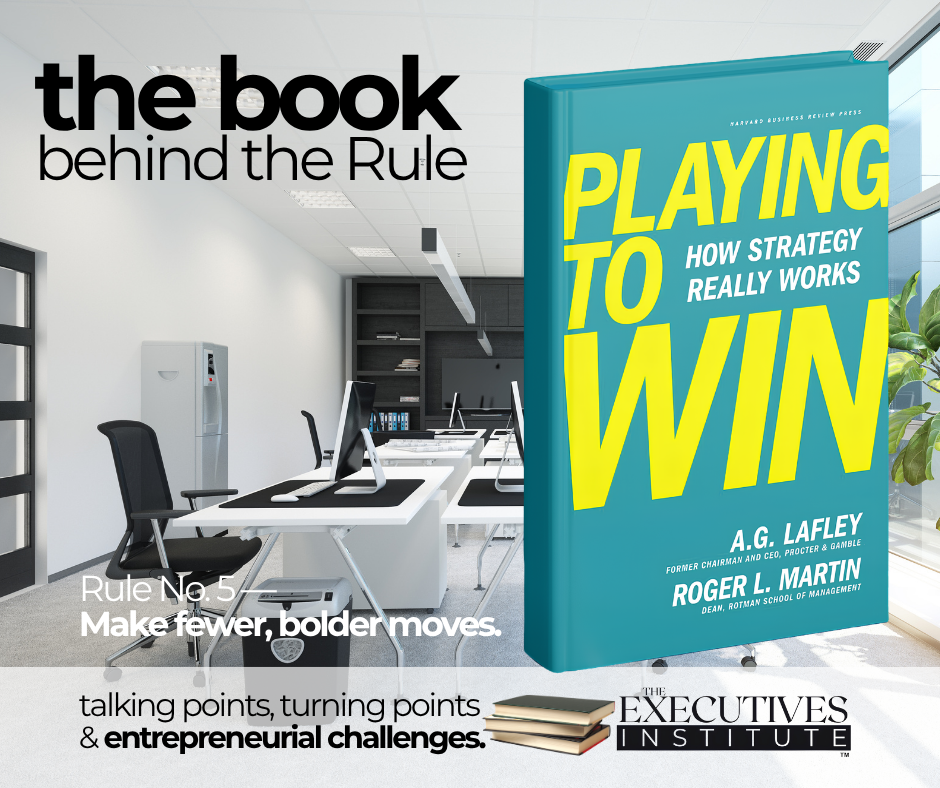
📖 the book behind the Rule
Playing To Win, by A.G. Lafley and Roger L. Martin
This book strips strategy back to its essentials: winning requires choice. Lafley and Martin lay out a practical, repeatable framework built on five questions: What is our winning aspiration? Where will we play? How will we win? What capabilities do we need? What management systems support them? Drawing from Lafley’s turnaround of Procter & Gamble, the book shows how disciplined, courageous choices create real competitive advantage. It’s a blueprint for leaders who want strategy that actually drives action..
Executive Takeaway: A strategy that tries to do everything isn’t a strategy. Your advantage comes from saying no; from choosing the markets you’ll dominate, the customers you’ll serve, and the moves you’ll make at the expense of all others.
“Strategy is about making specific choices to win in the marketplace. It requires making explicit choices, to do some things and not others, and building a business around those choices.”
turning points 📈 executive study
Are you accomplishing a lot? Or just attempting a lot? Spread yourself too thin and you’ll probably do most things half-ass. Too many companies are mediocre across the board, because they’re chasing ten things at once, every day. You can’t do everything well. You can’t chase every new idea; jump on every opportunity; or try to fix every problem that comes along. You can, but if you want to play the long game, you shouldn’t. The leaders who win pick fewer bets, but go all in. Pick the things that matter most and do them really, really well. Commit to fewer initiatives, but back them fully, and win where it matters.
A) Tell us about a time when your organization was trying to do too much. What finally made you realize that focus, not more effort, was the answer?
B) Looking back, what is one initiative your organization should have killed sooner? What did that experience teach you about making fewer, bolder moves?
C) What is the boldest strategic decision you have made as a leader? What did you have to say “no” to in order to make it happen?
Roger Martin on How Strategy Really Works


🥊 challenge the Rules | take the contrarian view
In a volatile market, making fewer, bolder moves can be reckless. Diversifying across many smaller bets is the smarter path. Let me push you, as a group, to wrestle with this:
- Are you calling something “bold” when it’s actually just concentrated risk?
- Are you hiding behind diversification to avoid making a real strategic commitment?
As a group, let’s try to list 5 practical, actionable strategies that could make this Rule a habit, not just something that gets talked about once a year.
One last word…
The older I get, the more I believe that business isn’t won by the “hustle and grind”, by just doing more. It’s won by knowing what really matters and having the guts to put your time and money behind it. Making fewer, bolder moves means you going to have to say no. It also means you’ll have to be willing to accept that some people are not going to like it. Some good opportunities will also pass you by. Oh well. That’s the price of focus and discipline. But if you can leave this discussion with one thing, this is it: you don’t need more on your plate. You need more conviction behind the things that are most important. Win where it matters.
Now, it’s time to take this discussion back to the office. We’ll see you next week.
Leadership team discussion
- What are we doing that looks productive, but isn’t actually moving the needle?
- Where are we spreading ourselves too thin to avoid making some hard decisions?
- If we could only bet on one big initiative this year, what would it be? Why?
This might be a turning point for you…
📔 Week 5: Conduct a “Strategic Elimination” Exercise
Identify the one or two initiatives with the greatest potential to move your business forward over the next 12 months.
These become your bold moves.
Now identify at least one initiative to pause, eliminate, or postpone.
There’s more to this Rule than these few sentences.
MASTER 🎓 Rule No. 5 —Make fewer, bolder moves.
October 2026
This Master Class is in development.
Help us build each of the 50 Master Classes, by adding your insights and sharing your entrepreneurial stories.
Class begins Monday, January 4, 2027, with each Rule being built out as we go. Each will contain the study sections listed above and will continue to evolve through your contributions. As business leaders continue to challenge these ideas, the Institute becomes more and more valuable, not because it’s finished, but because it never will be.

Here are five eye-opening warning signs that signal your organization is ignoring Rule No. 5 —Make Fewer, Bolder Moves. These are the kinds of issues leaders pretend aren’t problems…until they’ve already cost them years.
⚠️ 1. Everything is labeled a “priority.” When every project is “critical,” none of them are. This is the classic sign of a leadership team that lacks the courage to choose. Busyness replaces strategy.
⚠️ 2. The roadmap keeps expanding, but nothing meaningful gets finished. If initiatives pile up while outcomes stall, you’re not being bold—you’re drifting. A bold move has a finish line. A bloated list is just avoidance dressed up as ambition.
⚠️ 3. Leaders defend pet projects instead of killing them. Old initiatives stick around because no one wants to pull the plug. That’s how companies end up with dozens of half-alive efforts draining energy and morale.
⚠️ 4. Resources are spread so thin that teams are constantly “starting over.” People jump between five projects and make progress on none of them. This is the operational death spiral that comes from refusing to commit.
⚠️ 5. The company talks about “innovation” but only pursues low-risk tweaks. If your boldest move each year is a new feature, a new tagline, or a new flavor, you’re not innovating—you’re decorating. Real strategy requires stakes.