

the principle 🎓 Building a solid business takes time. Don’t sacrifice the future just to make today look good. Short-term thinking will get you a rollercoaster company that fizzles out in a few years. Build trust, take care of your customers and make decisions that will still make sense five or ten years from now.
The goal isn’t just to win today. It’s to build something that lasts.
Play the long game.
the hard truth 📌 Short-term thinking creates short-term companies. Let’s be honest, anyone can “grind it out” for a quarter. The real test is whether you’re still swinging the hammer in year ten, when everyone else got bored. Build something real.
Executive insights 👥 Tell us how that played out in your company.
How has this Rule impacted your organization? We’re looking for your short stories, insights, or turning points.
🏛️ Content Integrity Statement
To preserve the quality and credibility of The Executives Institute, all submissions must be attributed to a real person. We do not accept anonymous contributions. Our goal is to build a trusted platform grounded in lived experience, not vague opinions or internet commentary. Every insight published on this site comes from a real business owner or leader willing to stand behind their words, helping protect the value of the Institute for all Members. Contributors may contact us at any time to edit or remove their submission. We respect your voice and your choice to participate. At the same time, The Executives Institute reserves the right to remove any submission at our discretion, including in cases of public misconduct, reputational harm, or behavior that compromises the integrity of the platform and its contributors.
- Contributors verification by LinkedIn profile and/or company websites
- Those companies must be based in the United States
- Your submissions must be in English
- We do not email our contributors
- We do not sell or share their information
Not every submission will be published
Your insights (if approved), along with your name, company, website and/or LinkedIn profile may be added to any specific Rule’s page, bringing valuable exposure for you and your organization to 1000s of U.S. business leaders. Every time you share an insight, you don’t just strengthen the Institute, you elevate your brand. Leaders talk. Leaders refer.
By submitting content to The Executives Institute, you agree that:
- your submission is your own work
- you have the right to share it
- your submission may be edited for clarity, length, or formatting
- your submission may be published on the Site or in related materials
By submitting content, you grant The Executives Institute a non-exclusive, perpetual license to display and distribute that content as part of the Institute’s mission. The Executives Institute Terms of Use + Privacy Policy
the Rules matter.
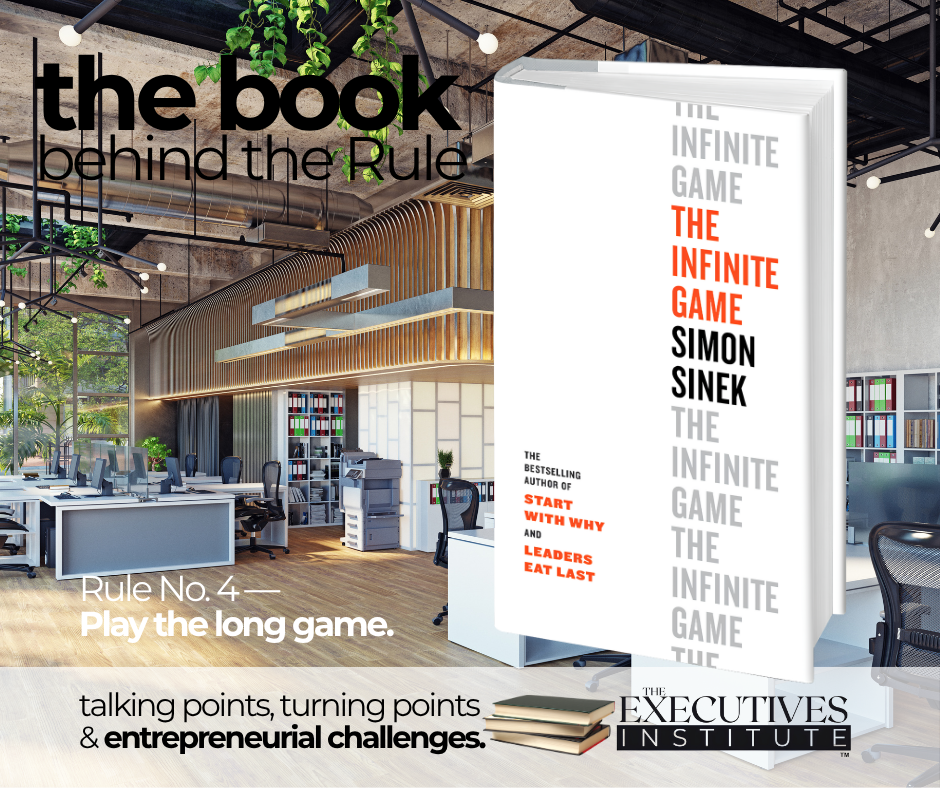
📖 the book behind the Rule
The Infinite Game, by Simon Sinek | Follow Simon at LinkedIn
This book is a call for leaders to stop chasing immediate validation and build organizations that are durable and principled for decades. Sinek argues that most leaders make a critical mistake: they treat business as a finite game with winners, losers, and an endpoint. In reality, business is an infinite game, the rules change, the players come and go, and there is no finish line. He outlines the pillars of infinite-minded leadership: advance a just cause, build trusting teams, study worthy rivals, prepare for existential flexibility, and have the courage to lead with long-term principles rather than short-term pressure.
Executive Takeaway: If you run your company like a finite game, you’ll eventually lose. Markets shift, competitors change, and the finish line keeps moving. Companies that focus on outlasting rather than “winning” build stronger cultures, more loyal customers, and more resilient strategies.
“Short-term wins feel great…until they kill the company.” —Simon Sinek
turning points 📈 executive study
From day one, think long-term. Short-term decisions are exciting, but dangerous. Most short-term decisions seem reasonable at the time, because they solve the problem you’re having today. No one wakes up and says “We’re going to sacrifice our 10-year plan to hit this quarterly number”. But it happens through a series of smaller decisions that take you in the wrong direction. You can’t build a company that lasts if you’re only thinking about the next 90 days, or the next big win. Great companies focus on building something that lasts, not just something that performs today. Make your 30, 60 or 90-day goals, but protect the 10-year plan by prioritizing trust, resilience, and long-term value.
A) Tell us about a decision your company made that required sacrificing a short-term win for the stronger, smarter long-term position. And would you make the same decision again?
B) Where would you admit that your business today is most vulnerable to short-term thinking? What is the pressure of that causing you to neglect?
C) Where does your company make its biggest long-term investments today; people, technology, equipment, customer relationships, brand, or something else? What makes those investments worth making before the payoff is obvious?
D) What long-term investment do you continue to make even when the short-term numbers made it tempting to cut back? What have you learned from sticking with it; your advice to younger leaders?


🥊 challenge the Rules | take the contrarian view
What if playing the long game is just an excuse for avoiding hard, short-term accountability? Long-term thinking is valuable, but it can also become a convenient excuse. You can’t build for five years while ignoring what needs to get done this week. A company still has to hit targets, solve problems, make payroll, serve customers, and hold people accountable.
Around the table:
- Where might you be using “long-term thinking” to justify weak execution today?
- How do you know the difference between being patient with a good long-term investment and simply avoiding a hard decision?
- Discuss some national brands that have sacrificed long-term success for a short-term victory, or vice versa. For example: Blockbuster played a finite game, hoping to dominate the current market, while Netflix envisioned the long game: streaming, personalization, and global scale. The results speak for themselves.
One thing, before we go…
The leaders I’ve known who build strong companies don’t strategize in weeks and quarters, they think in terms of decades. They make hiring decisions, pricing decisions, and culture decisions based on where they want the company to be in ten years, not on what’s going to relieve the pressure this month. Playing the long game doesn’t mean that you ignore urgency. It means understanding which urgencies are real and which are just bumps in the road. The business that’s still here in twenty years will be the one that kept that perspective. Playing the long game isn’t just a strategy, it’s a mindset.
See you next week. Take what you’ve learned back to the office:
Leadership team discussion
- Are we building for the next 5 to 10 years, or are we just reacting to what is happening this year?
- If this team could sit down 5 years from now and evaluate the decisions we are making today, what can we hope they would thank us for? And, what might they criticize us for?
- Are today’s decisions making tomorrow easier? or harder?
“the turning point for us came when we started basing our decisions on our 10-year plan.”
📔 Week 4: Conduct a “Long Game Audit”.
Choose one important decision your business is currently facing. Ask yourself and your leadership team: What is the short-term choice? What is the long-term choice?
Your goal: Make at least one decision this week, that your future company will thank you for.
Go deeper into this Rule.
See how business leaders across the country have wrestled with the issue, the red flags that can signal you’re off track, and the green flags that suggest you’re getting things right. You’ll also find key terms, helpful links, videos, and additional resources to put the Rule to work.
MASTER 🎓 Rule No. 4 —Play the long game.
- When to Apply | Red Flags
- Rule Overview
- Ask the Right Questions
- Contrarian View
- Actionable Strategies
- Real World Scenarios
- Leadership Team Discussion
- Rules to Results Workshop
- The Right Track | Green Flags
- Key Terms
- Book Summary
- Author Links
- Executive Insights
- Worth Watching
- Related Reading
October 2026
This Master Class is in development.
Help us build each of the 50 Master Classes, by adding your insights and sharing your entrepreneurial stories.
Class begins Monday, January 4, 2027, with each Rule being built out as we go. Each will contain the study sections listed above and will continue to evolve through your contributions. As business leaders continue to challenge these ideas, the Institute becomes more and more valuable, not because it’s finished, but because it never will be.

Here are five warning signs for Rule No. 4: Play the Long Game — clear signs you’re thinking too short-term:
⚠️ You celebrate outcomes but ignore the foundation behind them
Wins are recognized, but the systems, discipline, and culture that sustain those wins are overlooked or underdeveloped.
⚠️ You’re managing to the quarter, not the mission
Decisions are driven by immediate metrics, while long-term priorities keep getting pushed “to next quarter.”
⚠️ You cut investment the moment pressure hits
Training, R&D, brand-building — the first things sacrificed when numbers tighten are the very things that secure your future.
⚠️ Your team is afraid to think beyond the next win
When people stop proposing bold, long-term ideas, it’s usually because they’ve learned short-term results are all that matter.
⚠️ You’re reacting to competitors instead of defining your path
Constantly chasing what others are doing is a sign you’ve lost your own long-term direction.