

The Principle: Get the business working right before you try to make it bigger. Fix broken processes. Make sure people know who is responsible for what. Don’t depend on one person to remember how everything works. What is a headache with ten employees can become a disaster with a hundred. Before you scale, get your house in order.
Don’t scale chaos.
The Hard Truth
Growth makes everything bigger, including your problems.
Executive Insights 👥 Tell us how that played out in your company.
⚠️Content Integrity Statement
To preserve the quality and credibility of The Executives Institute, all submissions must be attributed to a real person. We do not accept anonymous contributions. Our goal is to build a trusted platform grounded in lived experience, not vague opinions or internet commentary. Every insight published on this site comes from a real business owner or leader willing to stand behind their words, helping protect the value of the Institute for all Members. Contributors may contact us at any time to edit or remove their submission. We respect your voice and your choice to participate. At the same time, The Executives Institute reserves the right to remove any submission at our discretion, including in cases of public misconduct, reputational harm, or behavior that compromises the integrity of the platform and its contributors.
- Contributors verification by LinkedIn profile and/or company websites
- Those companies must be based in the United States
- Your submissions must be in English
- We do not email our contributors
- We do not sell or share their information
⚠️Not every submission will be published
Your insights (if approved), along with your name, company, website and/or LinkedIn profile may be added to any specific Rule’s page, bringing valuable exposure for you and your organization to 1000s of U.S. business leaders. Every time you share an insight, you don’t just strengthen the Institute, you elevate your brand. Leaders talk. Leaders refer.
By submitting content to The Executives Institute, you agree that:
- your submission is your own work
- you have the right to share it
- your submission may be edited for clarity, length, or formatting
- your submission may be published on the Site or in related materials
By submitting content, you grant The Executives Institute a non-exclusive, perpetual license to display and distribute that content as part of the Institute’s mission. The Executives Institute Terms of Use + Privacy Policy
The insight you share might be the turning point someone else is waiting for.
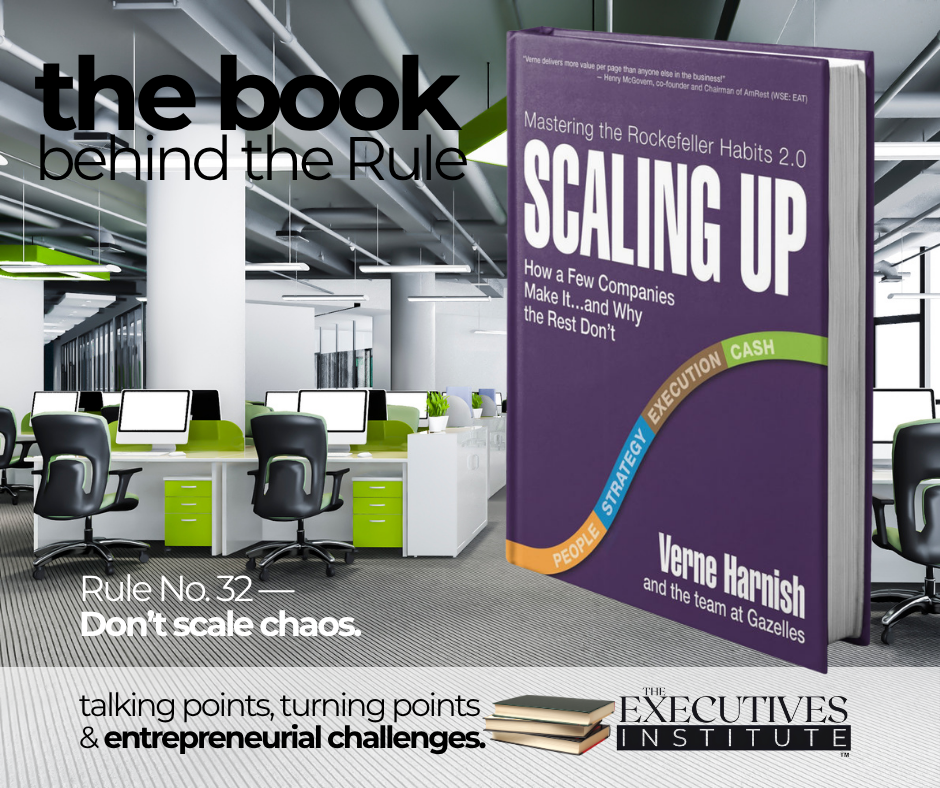
📖 the book behind the Rule
Scaling Up, by Verne Harnish
This is a practical playbook for growing a business without losing control. Drawing from decades of coaching high-growth companies, Harnish introduces a framework centered on four critical decisions every leader must master: People, Strategy, Execution, and Cash. The book emphasizes that sustainable growth is built on disciplined execution, clear priorities, strong communication, and repeatable systems. Companies that scale successfully do so by creating operational clarity before pursuing aggressive expansion.
Executive Takeaway: Growth magnifies whatever already exists. If your systems, people, and processes are strong, scale creates momentum. If they’re weak, scale creates chaos. Before chasing bigger numbers, build a business that can consistently deliver results without relying on extraordinary effort. That’s how great companies grow without losing control.
“Don’t try to scale a business that hasn’t nailed the basics. Otherwise, you’ll just get bigger problems.”
— Verne Harnish


Whatever is broken in your business now will still be broken when you have more people, more customers, and more money. In fact, it will probably be worse. Growth won’t fix chaos. It’ll expose and magnify it. Fix the mess before you make it bigger. Chaos at your small size becomes a catastrophe if you scale.
🎓 MASTER Rule No. 32 —Don’t scale chaos.
- When to Apply | Red Flags
- Rule Overview
- Ask the Right Questions
- Contrarian View
- Actionable Strategies
- Real World Scenarios
- Leadership Team Discussion
- Rules to Results Workshop
- The Right Track | Green Flags
- Key Terms
- Book Summary
- Author Links
- Executive Insights
- Worth Watching
- Related Reading
October, 2026
This Master Class is in development.
Help us build each of the 50 Master Classes, by adding your insights and sharing your entrepreneurial stories.
Class begins Monday, January 4, 2027, with each Rule being built out as we go. Each will contain the study sections listed above and will continue to evolve through your contributions. As business leaders continue to challenge these ideas, the Institute becomes more and more valuable, not because it’s finished, but because it never will be.