
Rule No. 7 —Momentum Beats Motivation

Don’t wait to feel inspired. Show up, act anyway, and let discipline build momentum. Waiting to feel inspired is a trap.
Progress happens when you show up consistently—especially when you don’t feel like it.
Motivation is fleeting; momentum is earned. Like Steven Pressfield teaches in The War of Art, professionals act despite resistance. They build rhythm, not rely on moods. Action fuels clarity, and discipline wins the long game.
We give motivation too much credit. It’s unreliable, emotional, and often absent when we need it most. The highest-performing leaders don’t wait to feel ready—they build momentum through discipline and routine. That’s the difference between amateurs and professionals, as The War of Art makes clear. Real progress begins the moment you stop waiting for inspiration and start moving anyway.
Rule No. 3 —Differentiate or Die

If your business blends in, it’s already falling behind. In crowded markets, blending in is a slow death. The only way to lead—not just survive—is to break away from the pack by creating clear, compelling differentiation. This isn’t about being slightly better. It’s about being meaningfully different in a way that customers recognize, value, and talk about.
Why study Rule No.3? Because if you look like everyone else, you’ll be commoditized.
Most businesses don’t fail because they’re bad. They fail because they’re forgettable. Competing on features, price, or marginal improvements in saturated markets is a slow bleed—one that leaves companies reactive, worn down, and undifferentiated. “Differentiate or Die” is not a slogan; it’s a survival principle.
The most successful companies don’t just compete better—they compete differently. They define new categories, solve overlooked problems, and make themselves impossible to ignore. This rule calls leaders to stop benchmarking the competition and start creating uncontested space—what Blue Ocean Strategy calls “value innovation.” It’s not about being louder. It’s about being unmistakably valuable.
Rule No. 8: Don’t Mistake Movement for Progress

It’s easy to confuse being busy with being effective. But motion without direction isn’t progress—it’s distraction in disguise. This rule reminds us that true advancement comes not from activity, but from purposeful, disciplined action.
Essentialism challenges us to eliminate the nonessential so we can focus our energy on what really matters.
We live in a culture that rewards hustle, glorifies busyness, and often confuses motion with momentum. But constant activity isn’t the same as meaningful progress. This rule invites you to slow down, get clear, and focus your effort where it actually counts. Because doing more is not the goal—doing what matters is.
Rule No. 9 —Focus Beats Multitasking

Multitasking is a myth. Every time you split your attention, you dilute your effectiveness. This rule reminds us that meaningful progress doesn’t come from doing more things—it comes from doing the right thing with undivided attention.
In his book, The One Thing, Gary Keller makes the case that success is sequential, not simultaneous: great results come from narrowing your focus to the single most important task until it’s done.
This rule isn’t about doing less for the sake of minimalism. It’s about doing what matters most, with intensity and discipline, while tuning out everything else.
Rule No. 5 —Make Fewer, Bolder Moves

Focus beats frenzy. Spread too thin, you risk mediocrity everywhere. Bold, deliberate moves—rooted in strategy, not reaction—create real advantage. Commit to fewer initiatives, but back them fully. Win where it matters.
Most organizations don’t fail from a lack of ideas—they fail from a lack of focus. In the name of flexibility, they spread themselves across too many priorities, chasing incremental wins and avoiding hard calls. This rule demands the opposite. It calls leaders to stop hedging and start committing—to fewer initiatives, bigger bets, and clearer strategic choices. Playing to win means saying no more often than yes. If you’re serious about real results, it’s time to make fewer, bolder moves—and stand behind them.
Rule No. 4 —Play the Long Game

Success in business isn’t about winning — it’s about enduring. Prioritize long-term vision, trust, and adaptability over short-term gains.
Great companies focus on building something that lasts, not just something that performs today.
Why is this a rule? Because sustainable advantage requires patience.
Too many leaders treat business like a game to be won — chasing quarterly victories, market share, or momentary headlines. But real leadership isn’t about beating the competition. It’s about building something that lasts. The best companies outlast trends, adapt with purpose, and prioritize trust, resilience, and long-term value. Playing the long game isn’t just a strategy — it’s a mindset.
Rule No. 13 —Know Your Numbers

If you don’t understand the numbers, you don’t understand the business. Knowing your financials isn’t just for accountants—it’s essential for every leader who wants to make smart decisions, allocate resources wisely, and build a business that lasts.
You don’t need to be an accountant—but if you’re running a business, you damn well need to know your numbers. Too many entrepreneurs make gut decisions without realizing they’re bleeding cash, underpricing their work, or chasing growth that’s actually killing profitability. This rule is about financial clarity—not spreadsheets for the sake of spreadsheets, but real-world understanding that helps you make smarter moves, avoid costly mistakes, and build something that lasts. Because in the end, what you don’t know will hurt you.
“Numbers don’t lie. But people who don’t understand numbers do.” – Karen Berman, Financial Intelligence
Rule No. 14 —Know When To Let Go

Knowing when to let go of a person, product, process, or plan is a mark of maturity and strategic clarity. Holding on too long stifles progress. Letting go at the right time creates room for growth, health, and innovation. Endings aren’t failures — they’re often the first step toward something better.
Good leaders don’t just build — they prune.
Every business carries dead weight at some point — a product line that’s lost relevance, a hire who never quite fit, a strategy that once worked but no longer does. But the real risk isn’t in what’s no longer working. It’s in the leader who refuses to let go. Holding on too long is one of the most expensive mistakes an executive can make. This rule — grounded in Necessary Endings by Dr. Henry Cloud — challenges leaders to stop avoiding the hard cuts and start making the necessary ones. Because growth doesn’t just require starting things — it requires ending them too.
Rule No. 16 —Time Is Your Most Precious Asset

Time is the only resource you can’t earn back. Money can be recovered. Opportunities can be replaced. But once time is gone, it’s gone. This rule reminds executives that how they spend their time is how they lead. Protecting it, structuring it, and aligning it with your highest priorities is not optional — it’s foundational.
Those who fail to guard their time are not running their business. Their business is running them.
You can recover from a bad hire. You can bounce back from a financial setback. But wasted time? That’s gone forever. For executives, time isn’t just a resource — it’s the battlefield. Every minute spent in low-value activity is a minute stolen from strategy, leadership, or growth. This rule is a wake-up call: if you’re not treating time as your most precious asset, don’t be surprised when your business treats you like a glorified firefighter.
Rule No. 17 —Speed Matters

Speed beats perfection when it comes to momentum, innovation, and decision-making. In a world where hesitation is often more dangerous than error, moving quickly allows you to test, adapt, and improve in real time. Most breakthroughs don’t come from overthinking — they come from action. The leaders who win are the ones who out-learn and out-adjust, not just out-plan.
When in doubt, make a move. You can correct course faster than you can create a flawless plan.
Most businesses don’t fail from moving too fast — they fail from moving too slow. In today’s environment, hesitation can cost you more than a wrong turn. Customers shift, markets evolve, and windows of opportunity close quickly. While others are still in meetings, the winners are already in motion, learning and adapting in real time. This rule isn’t about being reckless — it’s about being responsive. You don’t need to have it all figured out. You just need to move.
Rule No. 19 —Stop Doing What Doesn’t Work
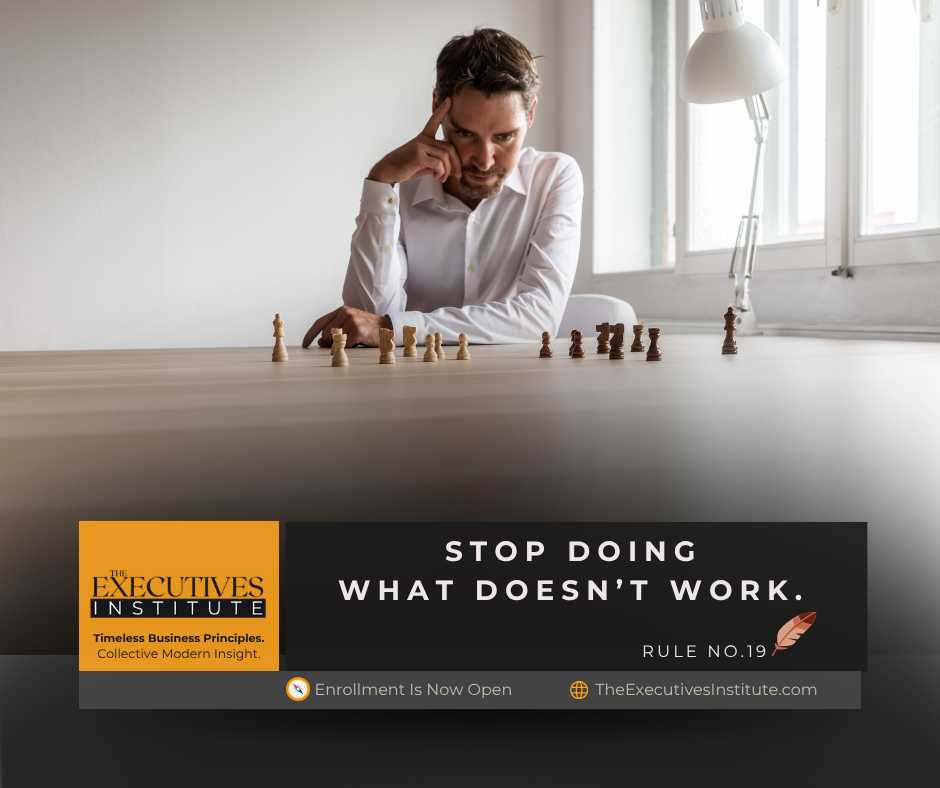
Success can become its own trap. The habits, strategies, and mindsets that helped you reach your current level often become blind spots as you aim higher.
This rule demands the discipline to let go of outdated behaviors—especially the ones that feel familiar, comfortable, or once-effective. It’s about recognizing that yesterday’s wins may be today’s liabilities.
Real growth starts not just by adding new tactics—but by subtracting what no longer serves you or your business.
Rule No. 20 —Cash Flow Is King

Forget vanity metrics. Forget top-line revenue. If your business doesn’t produce consistent, positive cash flow, it’s not healthy — it’s just temporarily surviving.This rule reminds us that cash is not just a financial metric; it’s the oxygen of a business. You can’t grow, pay your people, or weather a storm without it.
Mastering cash flow isn’t an accounting detail — it’s leadership.
Every business leader eventually learns — often the hard way — that revenue is not the same as results. You can land big contracts, have a full pipeline, and still lie awake at night wondering how you’ll make payroll. That’s the brutal truth of cash flow. This rule separates real businesses from vanity projects. Cash flow isn’t just a financial detail for your accountant — it’s the single most important indicator of whether your business is healthy, scalable, and built to last. Ignore it, and your business might grow itself into the ground.
Rule No. 22 —Hire Slow, Fire Fast

The strength of your team determines the strength of your business. Hiring slow means committing to a disciplined process—one that prioritizes fit, capability, and character over speed or convenience. It means refusing to lower the bar just to fill a seat. Firing fast means addressing misalignment or underperformance decisively before it corrodes culture, morale, or momentum. Tolerating the wrong hire too long is more costly than taking the time to hire the right one.
Right people, right roles, right now—or nothing.
Every executive knows people are the difference—but too many forget that how you hire and when you fire is just as critical as who you hire. Rushed hires to “just fill the seat” lead to long-term dysfunction. And once someone proves they’re the wrong fit, hesitation only makes things worse. This rule demands discipline on the front end and courage on the back end. Great teams don’t happen by accident—they’re built through high standards, tough calls, and a willingness to protect the culture at all costs.
Rule No. 23 —Simplicity Scales

Simplicity isn’t just elegant—it’s efficient, repeatable, and scalable. The most effective strategies, decisions, and systems are grounded in a few clear rules that people can understand, remember, and act on.
Complexity kills execution.
If it takes a whiteboard and a translator to explain, it won’t scale.
Most businesses don’t fail from a lack of ideas—they fail under the weight of their own complexity. Somewhere along the way, what started as a clear mission gets buried in process, politics, and too many moving parts. Simplicity isn’t a luxury; it’s a leadership discipline. The companies that scale—really scale—do so by ruthlessly clarifying what matters, codifying it into a few simple rules, and repeating them with precision. If it’s not simple, it won’t stick. If it doesn’t stick, it won’t scale.
Rule No. 24 —Own Your Mistakes

Great leaders don’t deflect blame — they absorb it, learn from it, and lead forward. Owning your mistakes isn’t weakness; it’s the foundation of credibility, respect, and real accountability. In any failure, you either make excuses or you make progress — never both.
Every leader eventually faces the mirror — and it doesn’t always reflect back a win. Projects go sideways, communication breaks down, results fall short. In those moments, the instinct is to explain, justify, or quietly shift the blame. But real leadership demands the opposite. When you own the mistake — fully, visibly, and without excuses — you don’t lose credibility. You gain it.
The strongest leaders don’t hide from failure; they stand in front of it, learn from it, and lead forward. That’s not just responsibility — that’s extreme ownership.
Rule No. 25 —Ask Better Questions

The quality of your outcomes is directly tied to the quality of your questions. Leaders who ask better questions don’t just get better answers—they uncover blind spots, surface assumptions, and spark clearer thinking in themselves and others.
In a room full of smart people, the one who asks the right question often holds more power than the one who rushes to offer the right answer. Yet in business, we tend to glorify decisiveness over inquiry, speed over depth. The problem? Shallow questions produce shallow thinking—and predictable results. Great leaders know that progress begins not with certainty, but with curiosity. By learning to ask better questions, we unlock clarity, challenge assumptions, and open the door to smarter strategies and stronger teams.
Rule No. 26 —Define It. Measure It. Achieve It.

Vague goals don’t move organizations forward—clear objectives do. This rule reminds executives that without defining what success looks like and establishing the right metrics, progress is merely hope in disguise. Define the outcome. Tie it to measurable key results. Then hold the line until it’s achieved.
Too many leaders confuse motion with momentum.
Teams get busy, meetings pile up, and everyone feels like they’re “doing a lot”—but no one can clearly define what success actually looks like. That’s a leadership failure. This rule draws a hard line: If you can’t define the outcome and measure progress, you can’t expect to achieve it. Vague goals lead to vague results. The best organizations operate with relentless clarity—on objectives, metrics, and ownership. Everything else is noise.
Rule No. 27 —Do The Hard Things First

The tasks we avoid are often the ones that matter most. “Do the Hard Things First” is a call to discipline—tackle your toughest, highest-impact priorities before everything else.
It’s not about doing more, it’s about doing what matters when your mind is sharp, your willpower is high, and your excuses haven’t shown up yet.
In leadership and business, procrastination on the hard stuff is procrastination on progress.
Most people don’t fail for lack of talent—they fail for lack of priority. The truth is, the hard things—the uncomfortable calls, the strategic decisions, the deep work—are the very things that move a business forward. But they rarely scream for attention. They sit quietly on your to-do list while easier, lower-stakes tasks hijack your day. This rule cuts through the noise: stop reacting, start leading. Do the hard things first, when it matters most.
Rule No. 31 —Delegate Outcomes, Not Tasks
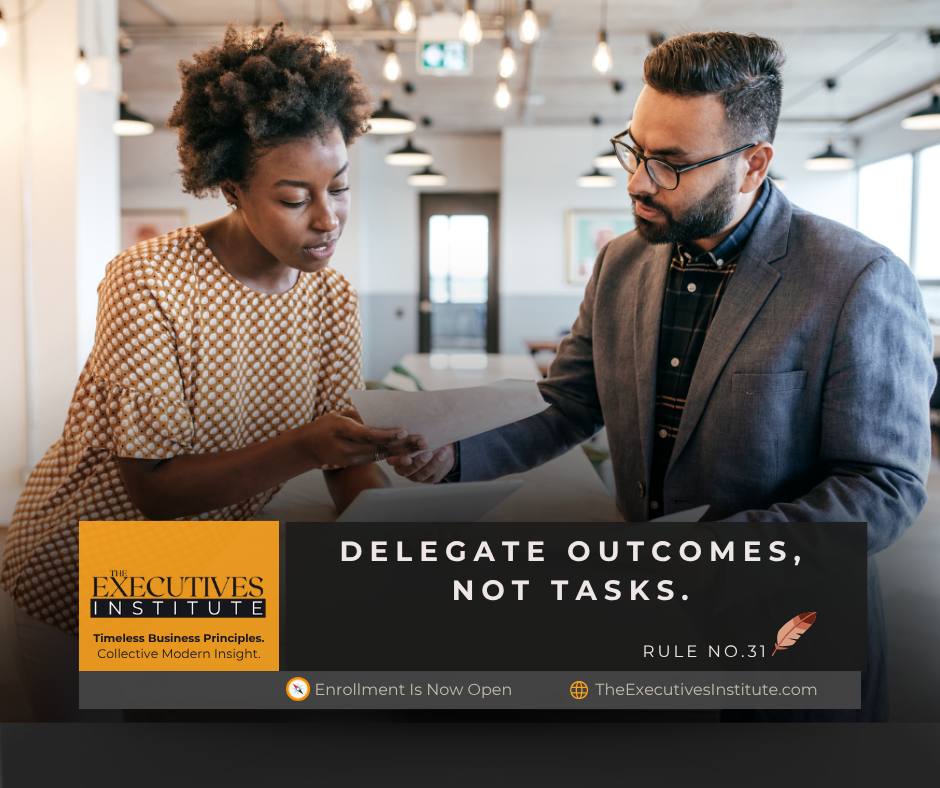
Don’t just assign to-dos—transfer responsibility. When you delegate outcomes instead of tasks, you empower people to think, act, and lead with ownership.
It’s the difference between creating followers and developing leaders.
Most leaders think they’re empowering their teams by delegating—but they’re really just offloading. When you hand someone a task list, you’re still doing the thinking for them. Real leadership means trusting others with the destination, not just the directions. When you delegate outcomes, you create space for ownership, innovation, and decision-making at every level. That’s how you grow leaders, not followers—and how your organization stops depending on you for every answer.
Rule No. 49 —People Over Processes

Processes are important. But people drive results. Over-relying on systems, procedures, and checklists at the expense of human judgment, initiative, and ownership is a slow march to mediocrity. Organizations thrive when they trust and invest in people—not just when they refine processes. Processes should serve people, not control them.
Too many companies hide behind processes. When something breaks, they add another form, another system, another rule. But no amount of process can make up for poor leadership—or compensate for a lack of trust in people. The truth is, great organizations are built by humans, not handbooks. When you invest in capable people and give them the freedom to think, decide, and act—you outperform the rigid, over-engineered machines every time. Bureaucracy is easy. Leadership is hard. But leadership wins. Every time.