

Rule No. 1 summary: If your product, service or strategy isn’t solving a real problem for a real person, it’s a vanity project – not a business.
Painkillers outperform vitamins every time.
Why is this Rule No. 1? Because, without a problem worth solving, everything else is wasted effort.
Businesses don’t fail because their founders didn’t work hard enough. They fail because the work wasn’t aimed at something real. Something felt. Something worth paying for.
Rule No. 1 is where every enduring business begins: Identify the problem your customers can’t ignore—and prove that your solution matters. If you can’t do that, nothing else you build will matter either.
Some of the most impactful businesses didn’t start with a big idea — they started with a real problem someone couldn’t ignore. We’re looking for short stories, insights, or turning points from CEOs, founders, and business leaders that answer one simple question:

What real problem did you decide to solve — and how did that change everything?
Whether it was the spark that launched your company, a strategic pivot, or a lesson learned the hard way, we want to hear the moment you realized this was the problem worth solving.
Optional follow-up questions to consider:
- How did you first discover the problem?
- What made it “real” enough to act on?
- Were others solving the wrong problem?
- How did solving it change your business trajectory?
- What real-world problem inspired the creation of your company or product?
- What was the ‘real problem’ you saw that others in your industry were overlooking or misdiagnosing?
- When did you realize your company was solving the wrong problem — and what changed when you pivoted?
- How do you keep your team focused on solving real customer problems — not just adding features or chasing trends?
STUDY Rule No. 1 —Solve a Real Problem.
Every enduring company begins the same way: by solving a real problem that people actually care about. Not a clever idea. Not a polished pitch deck. A problem. When leaders lose sight of that, organizations drift—products multiply, messaging gets louder, but the connection to the customer’s real pain quietly weakens.
The purpose of this lesson is simple: strip away assumptions and revisit the one question that determines whether a business deserves to exist.
This Rule will help you:
- Validate new business ideas
- Pivot from passion project to viable product
- Focus on MVP development
- Avoid expensive product flops
- Ground innovation in real-world pain points

💬 Leadership Team Discussion
This rule invites leaders to step back and ask a question that cuts through complexity. Discuss with your leadership team:
In our current business model, what problem are we truly solving — and is it still the right problem?
Has the original problem evolved — but our solution hasn’t?
Are our customers buying our product for a reason different than we think?
What assumptions are we making about what our market really needs?
What problem are our best competitors solving better than we are—and why?
If we had to start over today, would we solve the same problem?
Here are 10 red flags your team may be off track…
✅ Customers are customizing your product more than using it as-is. — They’re adapting it to their real need — not yours.
✅ Your value proposition takes more than 15 seconds to explain. — Confusion often means you’re solving something too abstract or irrelevant.
✅ Your most engaged users aren’t your original target audience. — You may have discovered a different (and better) problem to solve.
✅ You’re adding features faster than you’re gaining traction. — This is often a symptom of solving symptoms, not causes.
✅ Sales teams are improvising workarounds or messaging. — If they can’t sell it cleanly, the problem may not feel urgent or real to customers.
✅ The “problem” you’re solving feels theoretical, not felt. — If it doesn’t show up in their calendar, wallet, or stress level — it’s not urgent.
✅ User behavior contradicts what they say they want. — People may tell you the problem, but their actions reveal the real one.
✅ Customer retention is low, even though satisfaction surveys look good. — A band-aid solution can earn good reviews — and still miss the mark.
✅ You’re “problem” is from your past, not your customer’s present. — Founders often create solutions based on personal pain points — but markets move on.
✅ You’re focused on differentiation, not relevance. — Being different doesn’t matter if you’re not solving something real and useful.

Here’s a scenario…
An entrepreneur builds an app to help people find gourmet coffee while traveling. Beautiful UX. Slick marketing. Burned through $200K. No one used it — because no one needed it. Coffee lovers already had Yelp, Google, and each other. Meanwhile, a competitor built a clunky SMS-based tool to help people refill prescriptions in rural areas. It looked terrible, but it worked. It solved a real, painful problem — and they scaled into seven figures in under a year.
The difference?
One chased a cool idea. The other solved a meaningful problem. Business isn’t about invention — it’s about relevance. When you start by identifying pain points, everything else (product design, messaging, growth) becomes clearer — and more effective. Rule No. 1: Solve a real problem.

WORKSHOP: Solve a Real Problem
Objective:
Help your leadership team identify whether your business (or a specific initiative) is solving a real, urgent problem — and if not, realign your focus.
Time Required:
50–60 minutes
(Designed for leadership teams, department heads, or cross-functional groups)
✅ Materials:
- Whiteboard or shared document
- Printed or digital copies of the “Red Flags” list (optional)
- Timer
- Brutal honesty
🧭 Workshop Agenda
1. Kickoff (5 minutes)
“The businesses that endure solve a problem people actually have. Let’s take a hard look at what we’re really solving — and if we’re still on target.”
- Briefly introduce Rule No. 1 and the purpose of this session.
- Optional: Read the Eric Ries quote aloud.
2. Identify the Problem (10 minutes)
Ask each participant to silently write down:
- What they believe is the core problem your company or team solves.
- Who experiences it, when, and how.
Then: Go around the table. No debate yet — just share.
3. Spot the Disconnects (15 minutes)
Facilitator asks:
- Where do we see agreement? Where are we miles apart?
- Are we describing the customer’s actual pain — or our solution?
- Use the “Red Flags” list to pressure-test your answers.
Highlight 2–3 disconnects worth exploring.
4. Case Study Contrast (10 minutes)
“Where are we solving a symptom instead of the root problem?”
- Identify one product, service, or internal initiative.
- Ask: What problem is this really solving?
- What customer behavior tells us it’s not the right problem?
5. Turn Insight Into Action (15 minutes)
Use these prompts:
- What’s one area where we need to revisit the problem we’re solving?
- What’s one experiment or customer convo we can do this week to learn more?
- What’s one thing we’re doing that might be masking the real issue?
Record clear next steps.
🔁 Optional Follow-Up:
Revisit this conversation quarterly to keep the team problem-focused.
Assign one leader to validate a top customer assumption this week.

WEEK 1 | Action Step —
Interview three existing or potential customers to uncover a problem they’re actively trying to solve. Document exactly how they describe it in their own words.
Now, write down your core problem statement—not in your words, but in your customer’s words.
This gets you focused on the pain points of your target audience rather than a proposed solution, setting a “North Star” for strategic decision-making and preventing “feature creep” or chaotic, unfocused work.
Staying problem-oriented is one of the most powerful disciplines a team can adopt. It keeps work grounded in purpose, guides better decisions, and prevents wasted effort. Use this section to help your team stay focused on solving real customer problems.
How do we keep our team focused on solving real customer problems — not just adding features or chasing trends?
🔁 Actionable Strategies
1. Start with the Problem Statement
- Ensure every project, feature, or sprint begins with a clearly articulated customer problem.
- Use frameworks like Jobs To Be Done or problem-centric user stories: “As a [user], I need to [do X] so that I can [achieve Y].”
- Ask: “What pain point are we solving?” — and who feels it most?
2. Make Customer Empathy a Ritual
- Use real customer quotes, videos, or complaints in team meetings.
- Regularly schedule customer interviews or shadowing sessions.
- Share “Customer of the Week” stories that highlight struggles and feedback.
3. Ask “Why?” — Relentlessly
- Use the 5 Whys method to get to the root of every request.
- Don’t take feature requests at face value; ask what problem it solves.
- Teach teams to be skeptical of solutions not tied to a problem.
4. Measure Problem Impact, Not Just Output
- Use KPIs that reflect problem-solving: reduction in support tickets, task completion rate, NPS tied to specific workflows.
- Reward impact, not activity. Praise when problems are avoided or simplified, not when features are just “shipped.”
5. Say “No” — Clearly and Often
- Create a public “Not Doing List” to document shiny object requests you’ve declined and why.
- Train your team to defend focus with data, not opinions.
- Protect roadmaps from bloat by tying every initiative back to a validated problem.
6. Close the Feedback Loop
- After launching a feature, circle back to the original problem: Did we solve it? How do we know?
- If not, iterate or remove the feature. Let the team see that solving is the goal, not just shipping.
7. Instill a “Problem-First” Culture
- Celebrate questions more than answers in team discussions.
- Appoint a “Problem Owner” for initiatives — someone whose job is to ensure the team doesn’t drift into solution-for-solution’s-sake mode.
- Make your value proposition about customer outcomes, not product bells and whistles.
Key Business Terms for Rule No. 1
- Problem-Solution Fit: The alignment between a clear customer problem and the solution your business offers.
- Minimum Viable Product (MVP): The simplest version of a product that allows you to test whether you’re solving a real problem for real users.
- Validated Learning: Learning grounded in data and user behavior — not assumptions or internal opinions.
- Customer Discovery:The process of interviewing and observing potential users to uncover what problems actually matter to them.
- Iteration: Making continuous improvements or pivots based on what you learn — quickly and with minimal waste.
- Early Adopters: The first group of customers who feel the pain most acutely and are most eager for a solution.
- Vanity Metrics: Numbers that look impressive (like page views or downloads) but don’t indicate whether you’re solving a meaningful problem.
- Pivot: A structured course correction designed to test a new hypothesis about the product or business model.
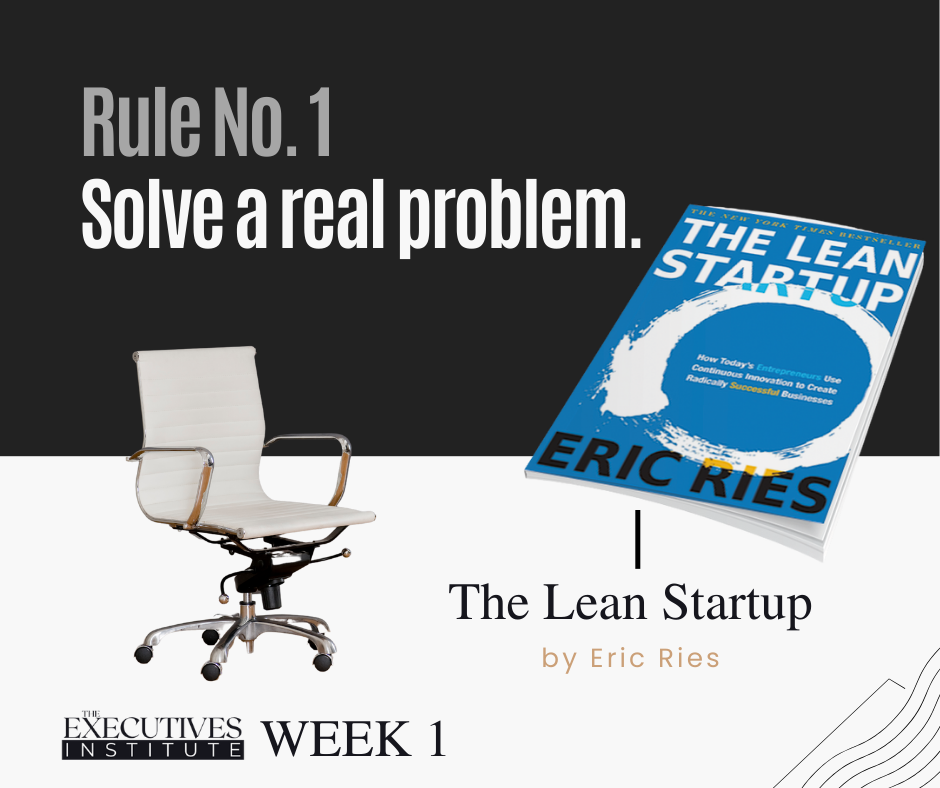
WEEK 1 | Recommended Reading —
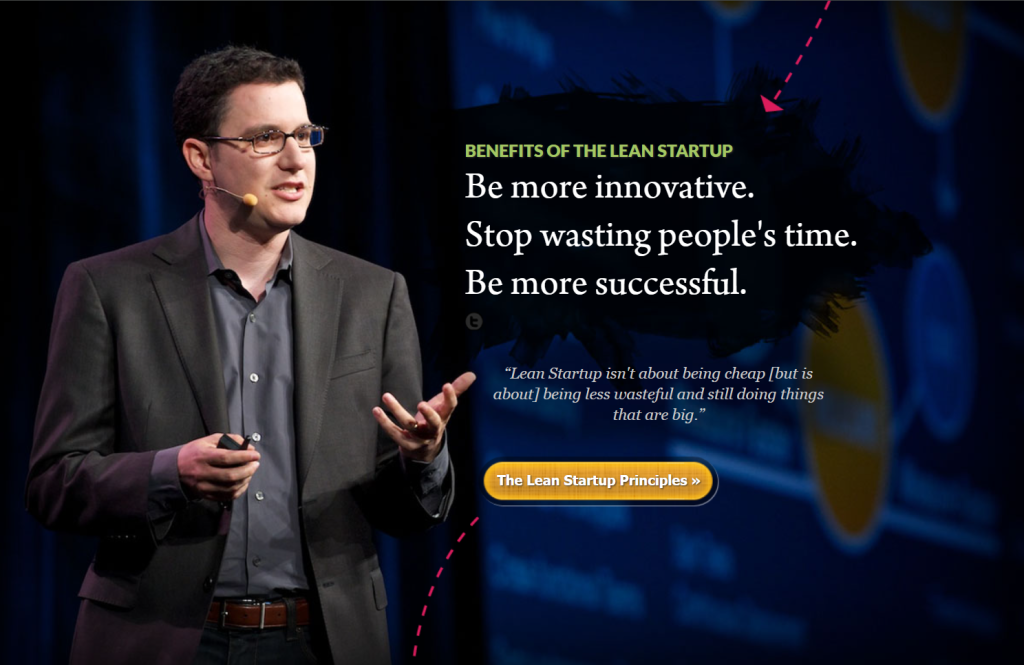
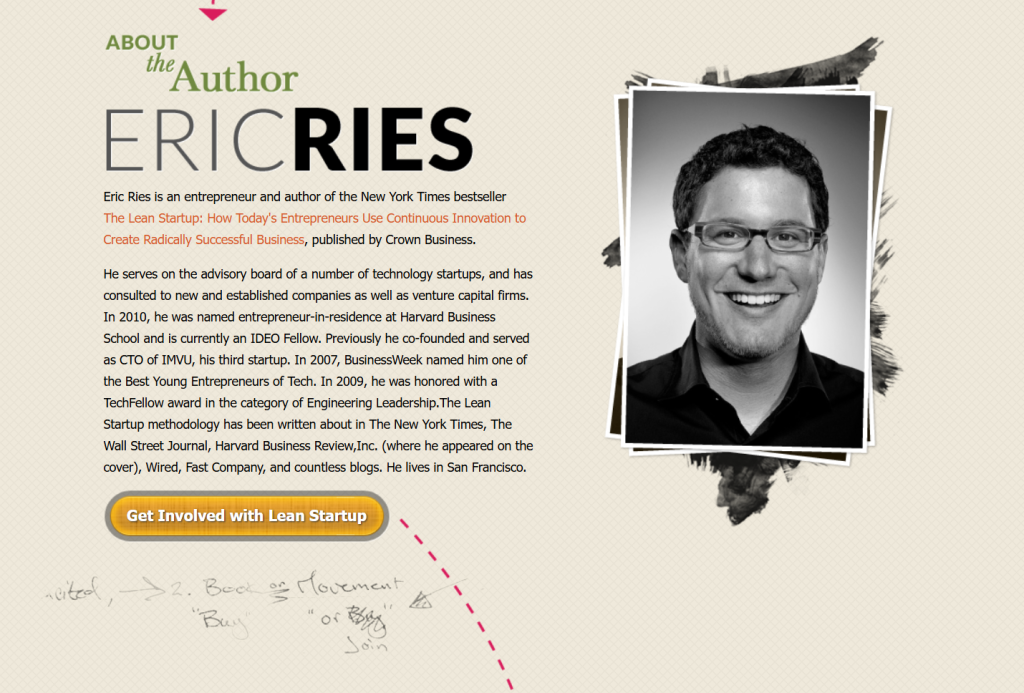
The Lean Startup by Eric Ries
“The question is not ‘Can this product be built?’ Instead, it is ‘Should this product be built?’” — Eric Ries
Key Executive Takeaway
The Lean Startup teaches leaders to replace guesswork with continuous learning—testing ideas quickly, measuring what matters, and adapting fast. Success comes from solving real customer problems, not from perfecting a product no one wants.
📘Book Summary
A modern classic on building businesses that learn before they launch. The Lean Startup presents a methodology for building businesses and launching products more efficiently, especially under conditions of extreme uncertainty. Eric Ries emphasizes rapid experimentation, validated learning, and agility over rigid business planning. Drawing from his experiences in Silicon Valley startups, he proposes a systematic, scientific approach to creating and managing successful startups.
Key Executive Takeaway
The Lean Startup teaches leaders to replace guesswork with continuous learning—testing ideas quickly, measuring what matters, and adapting fast. Success comes from solving real customer problems, not from perfecting a product no one wants.
Quotes from The Lean Startup
- “The question is not ‘Can this product be built?’ Instead, it is ‘Should this product be built?'”
- “No business plan survives first contact with customers.”
- “An MVP is a strategy and process to achieve learning and discovery.”
- “The product is the ultimate manifestation of the vision.”
- “The most successful entrepreneurs are the ones who learn the most, not the ones who fail the most.”
- “The only way to win is to learn faster than anyone else.”
- “Entrepreneurship is management. It’s not just about creativity and vision; it’s about structure and process.”
- “The engines of growth for startups are learning and innovation.”
- “In a lean startup, instead of being organized around traditional functional departments, companies are built around cross-functional teams.”
Business Owner Takeaways
Build-Measure-Learn Loop
- Start with a Minimum Viable Product (MVP)—the simplest version of your idea.
- Release it quickly to test assumptions and gather real-world feedback.
- Use the data to learn what works and what doesn’t, then iterate.
Validated Learning
- Don’t just guess or assume—test hypotheses with customers.
- Every product, feature, or campaign should contribute to validated learning.
Pivot or Persevere
- Be willing to make a pivot (a fundamental change in strategy) if something isn’t working.
- Or persevere if data shows you’re on the right track—just refine and scale.
Innovative Accounting
- Traditional metrics (like vanity metrics) can mislead.
- Focus on actionable metrics that directly relate to user behavior and product success.
Continuous Deployment & Split Testing
- Launch small, frequent changes and test variations (A/B testing) to understand user preferences and behavior.
Entrepreneurship = Management
- Startups need a new kind of management system—one focused on agility, learning, and adaptability rather than control and planning.
Lean Thinking Isn’t Just for Startups
- Established businesses can use lean principles to innovate internally and launch new products with less waste and better customer alignment.
Subscribe to The Executives Institute YouTube Channel
Real World Examples: These Startups Didn’t Guess. They Solved.
🥿 Zappos – Validating Online Shoe Sales – Instead of investing in inventory, founder Nick Swinmurn tested demand by photographing shoes from local stores and posting them online. When someone bought a pair, he purchased it at retail and shipped it himself. The demand was real—Zappos was born.
📂 Dropbox – Testing Demand with a Simple Video – Before building the product, Dropbox created a short explainer video to demonstrate how it would work. It led to thousands of sign-ups overnight, validating interest before a single line of backend code was written.
💳 Stripe – Simplifying Online Payments – Online payments were a developer’s nightmare. Stripe’s founders launched with a few lines of code that made integration effortless. Solving that technical bottleneck made Stripe the go-to platform for startups.
💻 GitHub – Streamlining Code Collaboration – Developers were emailing code back and forth—inefficient and error-prone. GitHub built a collaborative platform around Git, making version control easy and enabling open-source to thrive.
💵 Wagestream – Reducing Financial Stress Between Paychecks – Recognizing that many workers live paycheck to paycheck, Wagestream let employees access earned wages instantly. A simple fix to a widespread problem—and a hit with employers and workers alike.
🧬 Rare Genomics Institute – Connecting Rare Disease Patients with Researchers – After meeting a child with an undiagnosed illness, Dr. Jimmy Lin launched RGI to crowdfund research into rare conditions. They turned one family’s struggle into a platform for thousands.
🎨 Penpot – Bridging the Gap Between Designers and Developers – Designers and developers were often out of sync. Penpot created a collaborative tool both teams could use—solving friction at the root of the product development process.
 The Origin Story Example: Sara Blakely (Spanx) solved the problem of uncomfortable or unflattering undergarments by cutting the feet off her pantyhose. Real problem, scrappy solution, massive outcome.
🏠 The Market Misalignment Example: Airbnb – Monetizing Extra Living Space – Struggling to pay rent, the founders hosted guests on air mattresses during a local conference. The experience uncovered a huge demand for affordable, short-term stays—and led to the creation of a hospitality giant. Airbnb solved the problem of trust in home-sharing — not just lodging access.
The Strategic Shift Example: Slack began as an internal tool at a gaming company solving communication issues — the game failed, but the real problem solved was how teams talk.
Before scaling, these founders took one critical step: they solved a real problem. Whether it was hosting guests during a conference or simplifying a nightmare integration, these companies found pain points and built with purpose. Their stories prove that timeless principles—like solving something real—still drive the most lasting results.
 This Rule isn’t finished—and it never will be. Business changes, leaders learn, and our Members keep sharpening the edges with real stories and hard-won lessons. What you see here is today’s version. Tomorrow’s will be better, clearer, and backed by even more field-tested experience.