
The Principle: You can’t give your best attention to everything at the same time. Every time you jump from one task to another, you lose time and focus. Pick the thing that matters most, give it your full attention, and finish it before moving on. Focus gets things done. Multitasking is a myth.
Focus beats multitasking.
⚠️ The Hard Truth —Multitasking is the most expensive myth in business.
Neuroscience settled this question a long time ago. The human brain doesn’t actually perform two cognitive tasks simultaneously. It quickly switches between them, and each switch carries a cost: context lost, attention down, quality reduced. What’s true for individuals is multiplied in your company. Doing five things at once doesn’t mean you’re getting five things done. It usually means you’re giving half your attention to each one and taking longer to finish any of them. The people who get the most done know what needs their attention and stay with it until the job is done.

👥 turning points | Executive discussions
A) Where are you most guilty of multitasking when you should be focusing on one important thing? What does that look like in your day-to-day work, and what is it costing you?
B) How do you decide what deserves your attention when everything feels important? Share a real example of a time you had to choose between competing priorities.
C) What is one thing you should stop doing, delegate, or say no to so you can give more attention to what really matters? What would change if you actually followed through?
🥊 challenge the Rules | contrarian view for a healthy debate
Multitasking isn’t always the enemy. We rarely have the luxury of working on one thing at a time. Customers need answers, employees need decisions, problems show up unexpectedly, and opportunities don’t wait for your calendar. When we get so focused on one priority that everything else gets ignored, it can create a different kind of problem. The real issue may not be multitasking itself. It may be failing to know when to focus deeply and when to manage several things at once. The best leaders may not eliminate competing priorities, they may simply know which ones deserve their attention right now.
Questions for the group:
- Is “focus on one thing” realistic for a leader running a growing business, or can too much focus actually become a liability?
- When has multitasking or switching priorities actually helped you solve a problem, serve a customer, or seize an opportunity?
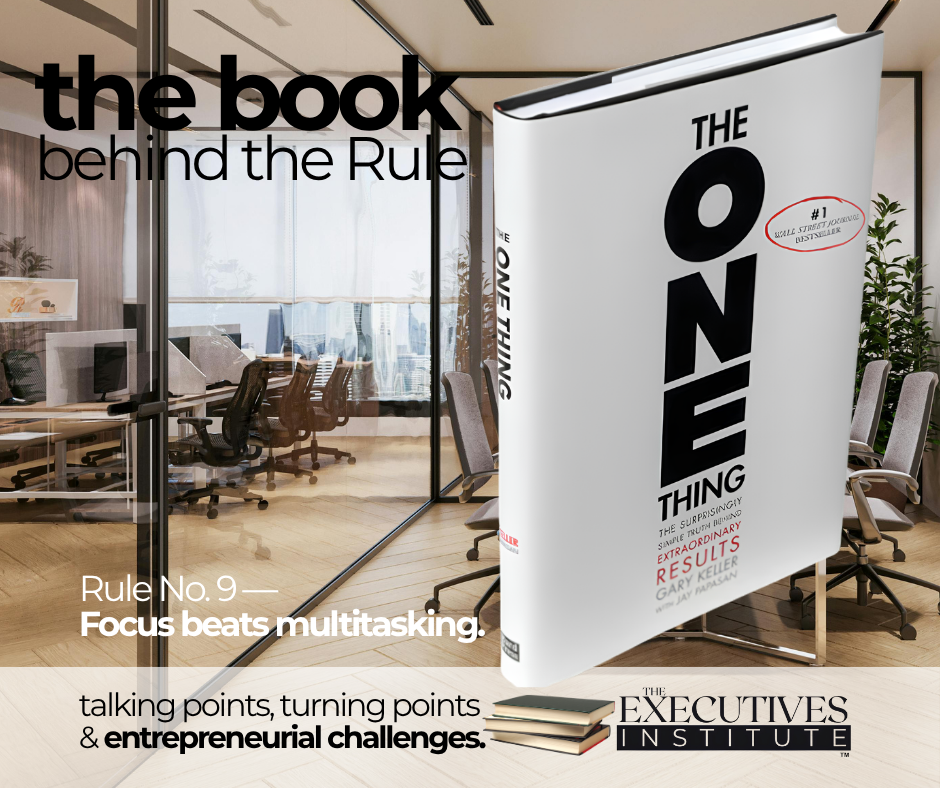
📖 Discuss the book behind the Rule
The One Thing, by Gary Keller and Jay Papasan
The One Thing teaches that success is built through focus, not volume. Gary Keller argues that attempting to do everything at once, multitasking, leads to scattered effort and mediocre results. Instead, identifying the single most important task, project, or goal, the “One Thing”, and giving it undivided attention produces much better outcomes. The book emphasizes prioritization, time-blocking, and eliminating your distractions with discipline, showing that great results come from doing less, but doing it better.
Executive Takeaway: Focus relentlessly on the one task that will move the needle most. Guard your attention as your most valuable asset, everything else is secondary.
“Multitasking is merely the opportunity to screw up more than one thing at a time.”
👥 Executive insights | Tell us how this Rule played out in your company.
- INSIGHTS, Your Name, Title, Company Name
- INSIGHTS, Your Name, Title, Company Name
- INSIGHTS, Your Name, Title, Company Name


This rule isn’t about doing less for the sake of minimalism. It’s about doing what matters most, with intensity and discipline, while tuning out everything else. Tell us how this Rule has impacted your leadership and your company.
⚠️Content Integrity Statement
To preserve the quality and credibility of The Executives Institute, all submissions must be attributed to a real person. We do not accept anonymous contributions. Our goal is to build a trusted platform grounded in lived experience, not vague opinions or internet commentary. Every insight published on this site comes from a real business owner or leader willing to stand behind their words, helping protect the value of the Institute for all Members. Contributors may contact us at any time to edit or remove their submission. We respect your voice and your choice to participate. At the same time, The Executives Institute reserves the right to remove any submission at our discretion, including in cases of public misconduct, reputational harm, or behavior that compromises the integrity of the platform and its contributors.
- Contributors verification by LinkedIn profile and/or company websites
- Those companies must be based in the United States
- Your submissions must be in English
- We do not email our contributors
- We do not sell or share their information
⚠️Not every submission will be published
Your insights (if approved), along with your name, company, website and/or LinkedIn profile may be added to any specific Rule’s page, bringing valuable exposure for you and your organization to 1000s of U.S. business leaders. Every time you share an insight, you don’t just strengthen the Institute, you elevate your brand. Leaders talk. Leaders refer.
By submitting content to The Executives Institute, you agree that:
- your submission is your own work
- you have the right to share it
- your submission may be edited for clarity, length, or formatting
- your submission may be published on this Site or in related materials
By submitting content, you grant The Executives Institute a non-exclusive, perpetual license to display and distribute that content as part of the Institute’s mission. The Executives Institute Terms of Use + Privacy Policy
Final Word
We live in a world that rewards being busy. But busy isn’t the same as productive. You don’t need to do everything. You need to know what matters most, and have the discipline to give it your full attention. The emails will still be there. The phone will still ring. Someone will always have another priority for you. The hard part isn’t finding more time. It’s deciding what deserves the time you already have.
Focus on the right thing. Do it well. Then move to the next thing.
Let’s take this Rule back to the office.

💬 talking points | Leadership team discussion:
Each team member answer…
— What is the one thing I can do right now that will make everything else easier?
— Where am I just checking boxes instead of making deep progress?
— What distractions or obligations do I need to eliminate or say “no” to, so I can fully commit to what matters most?
Here’s your edge on the competition this week.
📔 ourEDGE No. 9: Choose one. Finish one.
This week, resist the temptation to tackle everything at once.
Before your day begins, ask yourself: “What is the one task that, if completed today, would create the greatest positive impact?”
Then make a commitment to protect uninterrupted time to complete it before being pulled into meetings, emails, or other people’s priorities.
At the end of each day, don’t measure success by how busy you were. Measure it by whether you moved your most important objective forward.
Go deeper into this Rule.
See how business leaders across the country have wrestled with the issue, the red flags that can signal you’re off track, and the green flags that suggest you’re getting things right. You’ll also find key terms, helpful links, videos, and additional resources to put the Rule to work.
🎓 MASTER Rule No. 9 —Focus beats multitasking.
- When to Apply | Red Flags
- Rule Overview
- Ask the Right Questions
- Contrarian View
- Actionable Strategies
- Real World Scenarios
- Leadership Team Discussion
- Rules to Results Workshop
- The Right Track | Green Flags
- Key Terms
- Book Summary
- Author Links
- Executive Insights
- Worth Watching
- Related Reading
September 1, 2026
This Master Class is in development.
Help us build each of the 50 Master Classes, by adding your insights and sharing your entrepreneurial stories.
Class begins Monday, January 4, 2027, with each Rule being built out as we go. Each will contain the study sections listed above and will continue to evolve through your contributions. As business leaders continue to challenge these ideas, the Institute becomes more and more valuable, not because it’s finished, but because it never will be.
📘Book Summary
The One Thing teaches that success is built through focus, not volume. Gary Keller argues that attempting to do everything at once—multitasking—leads to scattered effort and mediocre results. Instead, identifying the single most important task, project, or goal—the “One Thing”—and giving it undivided attention produces extraordinary outcomes. The book emphasizes prioritization, time-blocking, and disciplined elimination of distractions, showing that great results come from doing less, but doing it better.
🔑 Key Executive Takeaway
Focus relentlessly on the one task that will move the needle most. Guard your attention as your most valuable asset—everything else is secondary.