
Rule No. 10 summary: A growth-minded leader embraces learning as a lifelong process—not a phase to graduate from. Whether you’re in the boardroom or the breakroom, staying open to new ideas, skills, and feedback separates those who evolve from those who become irrelevant.
The best leaders never graduate from growth. They seek feedback others avoid, explore ideas outside their domain, and view mistakes as tuition—not setbacks. If you’re not learning, you’re not leading. Not for long.

1. When did you realize that what made you successful in the past was no longer enough for the future of your business? What did you have to learn next?
2. What is one hard lesson you learned the slow way—through failure, missed opportunity, or costly trial and error?
3. How did a new idea, book, mentor, or unexpected source of learning change the direction of your leadership or your company?
4. When have you had to unlearn something you once believed was the “right” way to run your business? What forced that shift?
5. What habit, practice, or discipline have you built into your life to ensure you continue learning even after reaching leadership success?
STUDY Rule No. 10 —Never stop learning.
🧠 Leadership Check-In:
Where in your leadership have you become a “knower” instead of a learner?
Are you coasting on experience—or still growing through challenge?
The best leaders stay teachable. Even when they’ve earned the right not to.
This Rule will help you;
- Avoid stagnation in mature roles or industries
- Build resilience when facing failure or criticism
- Develop teams that learn, adapt, and outperform
- Shift from a fixed to a growth-oriented culture
- Stay sharp, relevant, and strategically ahead
Why is this a Rule? Because, growth mindset fuels reinvention.
Success has a strange way of making leaders stop doing the very things that got them there. Learning is often the first to go. Titles replace curiosity. Experience replaces exploration. But in a world that moves faster than comfort allows, those who stop learning start falling behind—quietly at first, then all at once. The best leaders never graduate from growth. They seek feedback others avoid, explore ideas outside their domain, and view mistakes as tuition—not setbacks. If you’re not learning, you’re not leading. Not for long.
Here are five clear red flags that signal a breakdown of Rule No. 10—the kind leaders ignore at their own risk…
1. “We’ve Always Done It This Way” Becomes a Default Answer. When past success is used to shut down new ideas, learning has stopped and complacency has taken over.
2. Leaders Talk More Than They Listen. If leaders are always teaching and rarely asking questions, curiosity is gone—and blind spots are growing.
3. Feedback Is Deflected or Dismissed. When criticism is explained away instead of examined, improvement stalls and culture hardens.
4. Training Is Treated as a One-Time Event. If learning only happens during onboarding or annual workshops, growth is accidental, not intentional.
5. Mistakes Are Hidden Instead of Studied. When people fear being wrong, they stop experimenting. And when experimentation stops, progress does too.
WEEK 4 | Ask Yourself —
Where am I relying on what I already know, instead of seeking what I need to learn, to grow myself and my business?

💬 Leadership Team Discussion Prompt
If every person on our leadership team committed to learning one new high-impact skill this year,
which skill would most accelerate the growth of our company
—and what would it take to make it happen?
Follow-Up Question
What structures or habits could we put in place to ensure our leadership team is continuously learning—and applying that learning—to drive growth?

WEEK 4 | Action Step —
Schedule 60 minutes this week to actively explore one skill, concept, or perspective outside your current expertise that could materially improve your business or leadership impact.
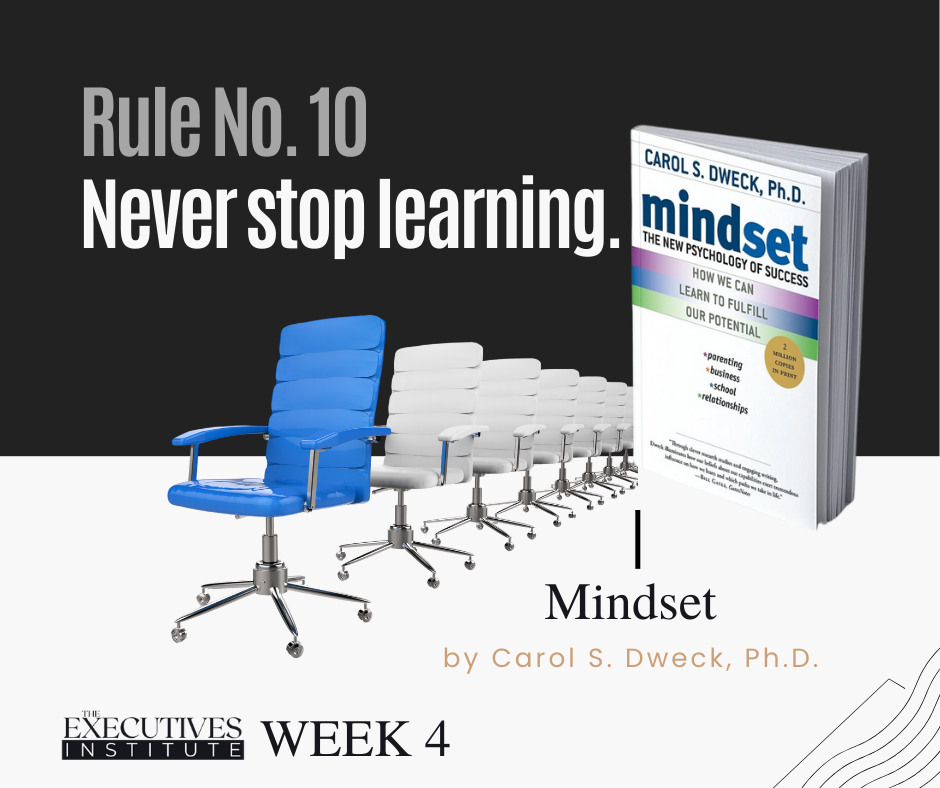
WEEK 4 | Recommended Reading
Mindset by Carol Dweck
“Becoming is better than being.” — Carol S. Dweck
Key Executive Takeaway
Your ability to grow as a leader is limited only by your willingness to keep learning. A growth mindset turns challenges, criticism, and failure into fuel for improvement—while a fixed mindset turns them into roadblocks.
📘Book Summary
Mindset explores the profound impact of how we think about our abilities. Dweck identifies two primary mindsets: the fixed mindset, which believes talent and intelligence are static, and the growth mindset, which sees them as skills that can be developed through effort, feedback, and persistence. Leaders, teams, and organizations that embrace a growth mindset adapt faster, overcome challenges more effectively, and unlock greater long-term potential. The book makes it clear: success isn’t just about what you know—it’s about your willingness to keep learning.
Executive Takeaway:
Your ability to grow as a leader is limited only by your willingness to keep learning. A growth mindset turns challenges, criticism, and failure into fuel for improvement—while a fixed mindset turns them into roadblocks.
Quotes from Mindset:
“Becoming is better than being.”
“Believing that your qualities are carved in stone — the fixed mindset — creates an urgency to prove yourself over and over.”
“No matter what your ability is, effort is what ignites that ability and turns it into accomplishment.”
“Why waste time proving over and over how great you are, when you could be getting better?”
“Picture your brain forming new connections as you meet the challenge and learn. Keep on going.”
“I don’t mind losing as long as I see improvement or I feel I’ve done as well as I possibly could.”
“The passion for stretching yourself and sticking to it, even (or especially) when it’s not going well, is the hallmark of the growth mindset.”
“True self-confidence is ‘the courage to be open—to welcome change and new ideas regardless of their source.’ Real self-confidence is not reflected in a title… It is reflected in your mindset: your readiness to grow.”
“Believing that your qualities are carved in stone creates a need to prove yourself — which in turn makes you avoid risk, hard challenges, or failure.” (paraphrase) — Dweck discusses this idea in multiple passages.
“What on earth would make someone a non-learner? … As soon as children become able to evaluate themselves, some of them become afraid of challenges. They become afraid of not being smart.”
Short Talk: “The Power of Not Yet”
I want to share a story I recently heard from psychologist Carol Dweck, who studied how people learn and grow. She told about a high school in Chicago where students had to pass a certain number of courses to graduate. If they didn’t pass, they didn’t get an F. They got the grade: Not Yet.
Think about that. Not Yet.
It’s a powerful way to look at progress. An F says, “You’re done. You failed. You’re not good enough.” But Not Yet says, “You’re still on the path. You’re not there yet, but you can get there.”
Here’s why this matters for us. In our work, we’re going to miss targets. We’re going to try new things that don’t pan out the first time. If we treat every miss like an F, people stop taking risks. They stop trying. They play safe—and safe companies don’t grow.
But if we take the mindset of Not Yet, it changes the story. Every setback becomes part of a learning curve. Every miss comes with the belief that we can adjust, adapt, and improve.
So here’s what I’m asking of you, and of myself: when something doesn’t go the way we want, don’t say, “We failed.” Say, “We’re not there yet.” Then ask, “What do we need to learn, and what’s the next step forward?”
That one word—yet—keeps us moving, keeps us improving, and keeps us growing.
Subscribe to The Executives Institute YouTube Channel
This Rule isn’t finished—and it never will be. Business changes, leaders learn, and our Members keep sharpening the edges with real stories and hard-won lessons. What you see here is today’s version. Tomorrow’s will be better, clearer, and backed by even more field-tested experience.